The Organisation for Economic Co-operation and Development released the Global Drought Outlook 2025 with a striking shift in framing. Drought, the report argues, is no longer simply a water scarcity problem confined to a particular season or region. It is a systemic risk that propagates through agriculture, energy, trade, finance, public health, and ecosystems, and it is intensifying with climate change. The report’s subtitle, “Trends, Impacts and Policies to Adapt to a Drier World,” captures the message: every economy needs a drought policy, not just the ones that grew up in arid climates.
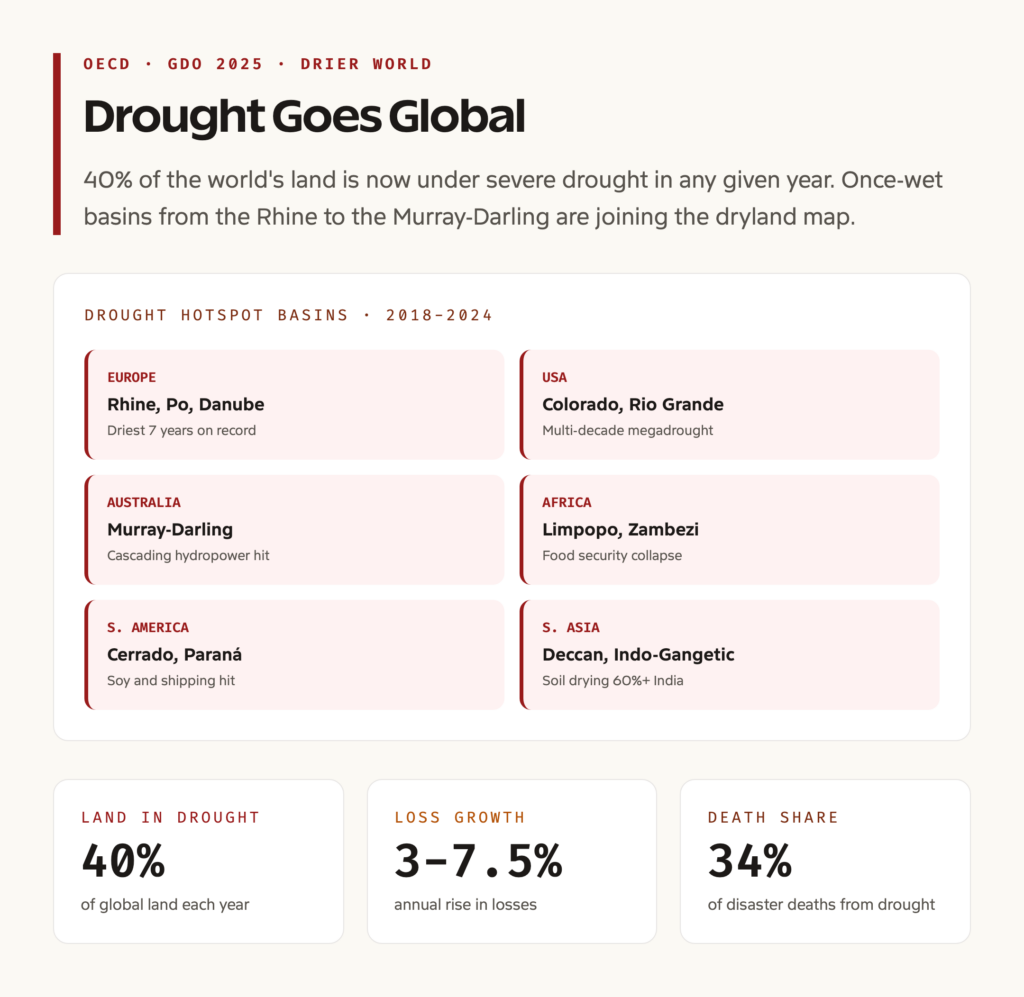
The headline numbers are sobering. Around 40 per cent of the world’s land area is now experiencing severe drought conditions in any given year. Global economic losses from drought are rising at 3 to 7.5 per cent annually, depending on the basin. Drought is responsible for 34 per cent of all disaster-related deaths, a higher share than floods or storms. India shows up repeatedly in the analysis: more than 60 per cent of Indian soils show a measurable drying trend, and the country is increasingly exposed to flash droughts, the rapid-onset variety that traditional drought monitoring misses.
For UPSC, the Global Drought Outlook 2025 is a high-yield reference. It connects to GS-III environment and disaster management, GS-I climate geography, and GS-II international institutions and federal coordination. This guide unpacks the report, places it in India’s drought context, and shows how the topic links to other prelims and mains material.
Quick Facts
- Full name: Global Drought Outlook 2025
- Released by: Organisation for Economic Co-operation and Development (OECD)
- Theme: Trends, Impacts and Policies to Adapt to a Drier World
- Headline: Drought is a global systemic risk, not just water scarcity
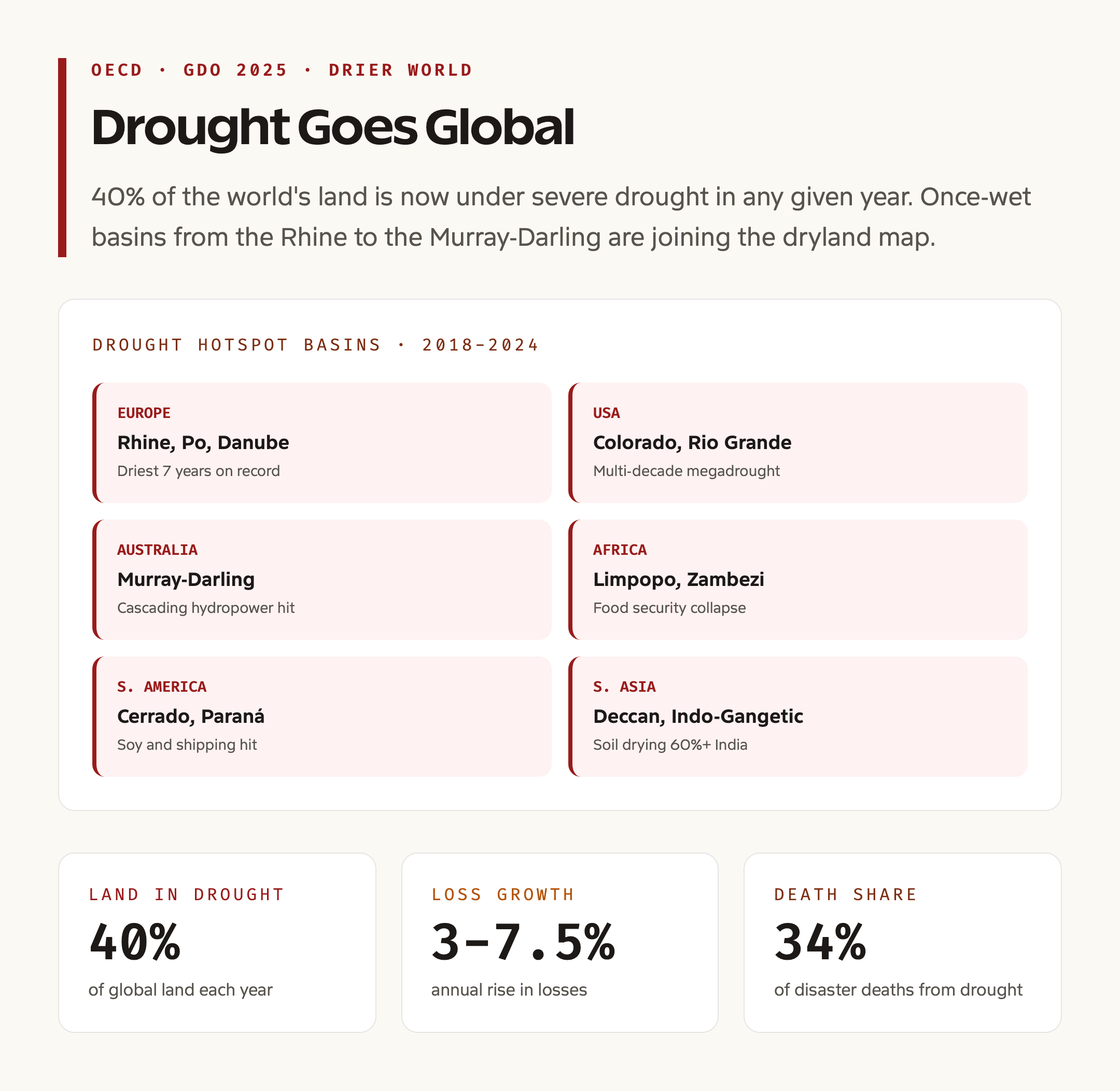
- Land area in severe drought: Around 40 per cent globally
- Economic loss growth rate: 3 to 7.5 per cent annually
- Share of disaster deaths from drought: 34 per cent
- India soil drying trend: Over 60 per cent of soils show drying
- Flash drought concern: Rising frequency in India and South Asia
- Linked frameworks: UNCCD, IPCC AR6, Sendai Framework, SDGs (especially SDG 6, 13, 15)
What the Report Says
The Global Drought Outlook is the OECD’s first dedicated drought stocktake, building on years of work on water risk, agricultural resilience, and climate adaptation. The 2025 edition marks an analytical shift. Earlier OECD water reports treated drought as one of several water risks, alongside floods, scarcity, and pollution. The 2025 outlook elevates drought into its own category and frames it as a systemic risk that propagates through interconnected sectors.
The report is divided into three parts. Part one tracks the global trends in drought frequency, intensity, duration, and spatial spread, drawing on satellite, model, and ground data over four decades. Part two assesses impacts on agriculture, energy, water supply, public health, ecosystems, supply chains, and finance, with country case studies. Part three lays out a policy menu: integrated drought planning, water pricing reform, drought-tolerant agriculture, ecosystem-based adaptation, financial instruments, and international cooperation.
Key Global Findings
The first finding is geographic. Drought has spread beyond the historical drylands. Once reliably wet regions like central Europe, the southwestern United States, parts of the Mediterranean, large stretches of southern Africa, the Brazilian cerrado, and South Asia all show longer and more intense drought episodes than in the late twentieth century. The 2018 to 2024 period was the driest seven-year stretch on record for several major river basins, including the Rhine, the Po, the Colorado, and the Murray-Darling.
The second finding is economic. Drought losses are growing faster than insurance, faster than GDP, and faster than agricultural output. The 3 to 7.5 per cent annual growth in drought losses is not even across regions. Low-income countries see steeper relative losses because their economies depend more on rainfed agriculture and informal water supply. High-income countries see steeper absolute losses because their infrastructure and supply chains are more interconnected.
The third finding is the systemic dimension. The report shows in detail how drought in one sector cascades into others. A drought lowers river levels; lower river levels reduce hydropower generation; reduced hydropower forces a switch to fossil generation, raising emissions and electricity prices; higher electricity prices feed into industrial costs; constrained barge transport on low rivers raises freight costs; food prices rise as harvests fall; in countries with weak safety nets, food insecurity follows; in countries with strong safety nets, fiscal stress follows. The cascade is real and increasingly common.
The fourth finding is on flash droughts. Traditional drought develops over months or seasons. Flash droughts develop in a few weeks under a combination of high temperatures, dry air, and low rainfall. They are difficult to forecast, devastating for agriculture, and increasingly common. India, the United States, China, and parts of Europe all show rising flash drought frequency. The 2022 European heat-drought episode and the 2022 South Asian summer were textbook cases.
India-Specific Findings
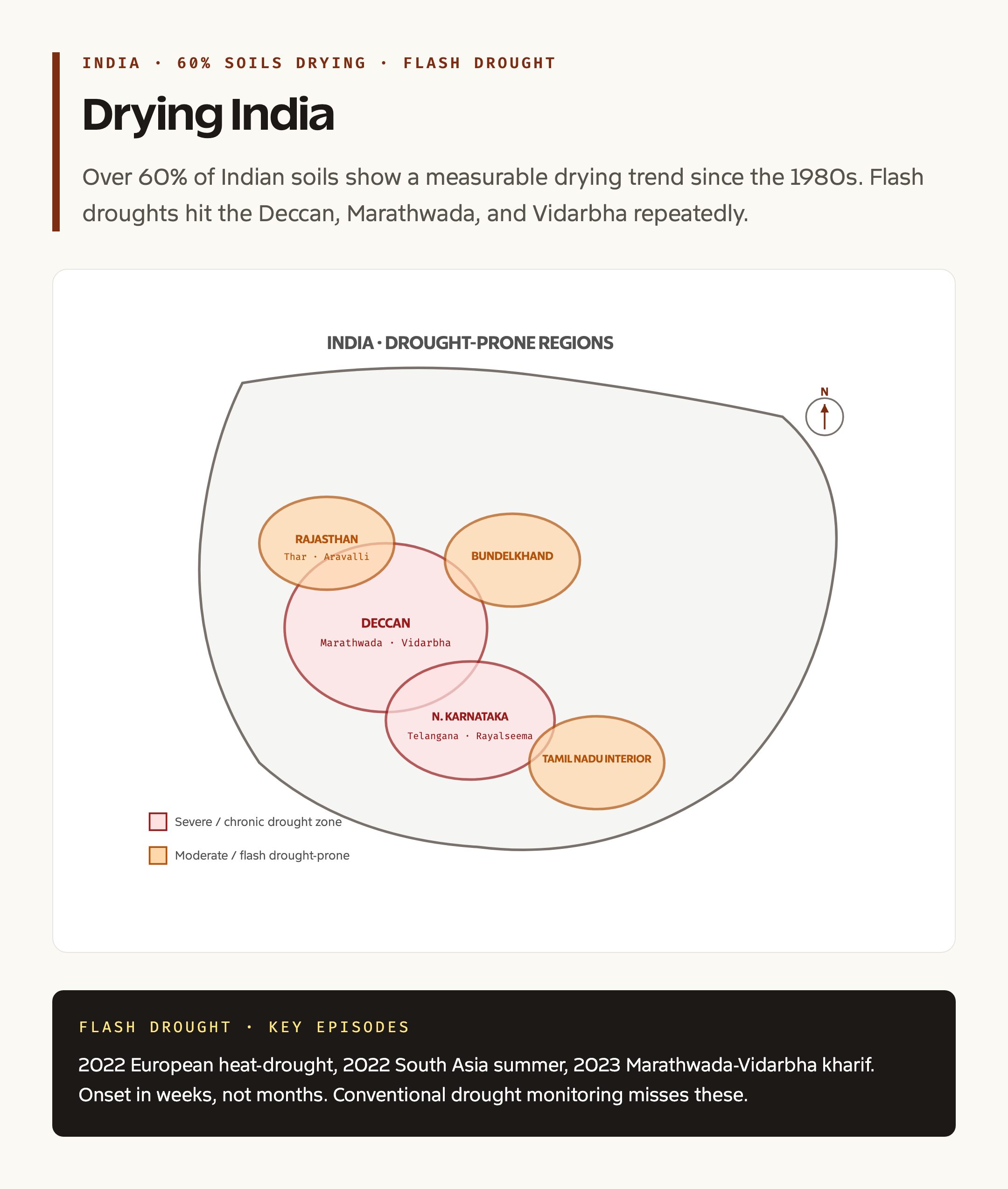
India’s drought picture in the 2025 outlook is a tightening one. Over 60 per cent of Indian soils show measurable drying since the 1980s, based on satellite soil moisture data. The drying is concentrated in the Deccan plateau, the southern peninsula, parts of central India, and the Indo-Gangetic plain in spring. Even the northeastern states, normally water-surplus, show isolated drying in the foothills.
Flash droughts are an emerging concern. Indian Meteorological Department analyses show flash drought episodes becoming more common in the post-monsoon and pre-monsoon windows, often triggered by El Niño years and amplified by Indian Ocean Dipole anomalies. The 2022 and 2023 episodes hit kharif crops in Marathwada, Vidarbha, Telangana, and northern Karnataka.
Groundwater stress runs alongside meteorological drought. The Central Ground Water Board’s annual assessments show roughly 17 per cent of assessment units in over-exploited stage and another 14 per cent in critical or semi-critical stages. The Punjab, Haryana, Western Uttar Pradesh, Rajasthan, and Gujarat clusters dominate the over-exploited list. Drought hits these areas harder because the surface buffer is already thin.
For India, the report’s prescriptions align with the National Water Policy, the Jal Jeevan Mission, the Atal Bhujal Yojana, the Pradhan Mantri Krishi Sinchayee Yojana, and the new Cauvery, Godavari, and Krishna basin programmes. The cross-cutting message is the same: integrate weather forecasts, soil moisture, groundwater, surface water, and crop choice into one drought-aware planning system.
Types of Droughts
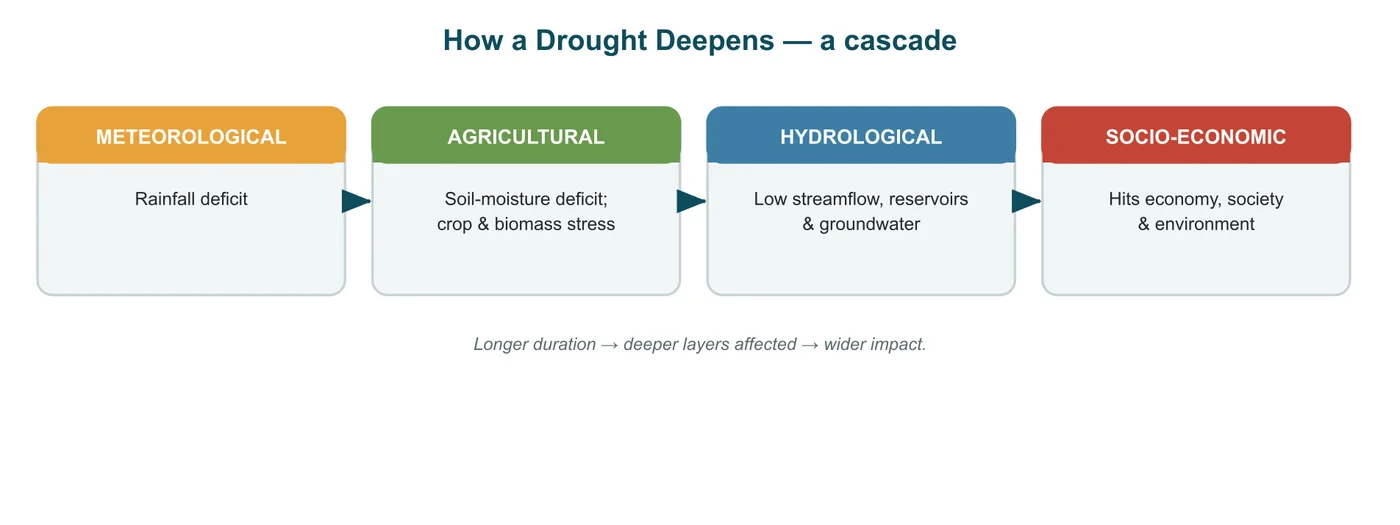
The report uses the standard typology that UPSC questions also rely on. Meteorological drought is a deficit in rainfall over a defined period. Agricultural drought is a deficit in soil moisture, which lags rainfall and depends on temperature, evapotranspiration, and crop stage. Hydrological drought is a deficit in surface and groundwater storage, which lags both rainfall and soil moisture. Socio-economic drought is the impact on human systems, the slowest to emerge and the slowest to resolve. Flash drought is the rapid-onset variant that compresses these phases into weeks.
| Drought Type | Lead Indicator | Typical Lag | Sector Most Hit |
|---|---|---|---|
| Meteorological | Rainfall deficit | None | Indicates only |
| Agricultural | Soil moisture | Weeks | Crops, livestock |
| Hydrological | Reservoir, river, groundwater | Months | Cities, hydropower |
| Socio-economic | GDP, prices, migration | Quarters to years | Households, fiscal |
| Flash drought | Rapid soil moisture loss | Weeks | Crops at vulnerable stage |
For a deeper background on India’s classification system, see types of droughts in India.
Drivers of the Systemic Risk
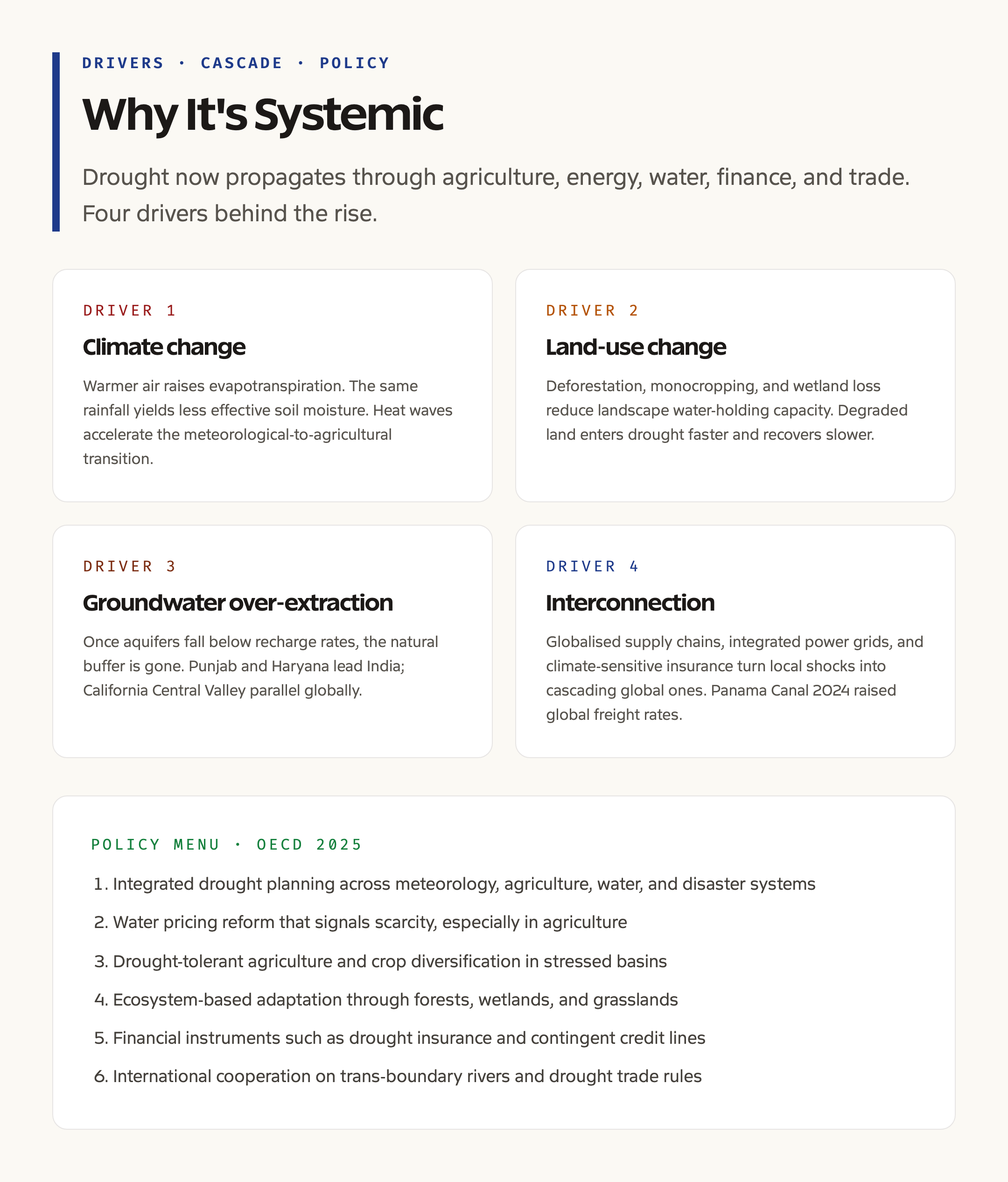
The report identifies four drivers behind the rising systemic risk. The first is climate change. Warmer air holds more moisture, raising evapotranspiration and turning the same rainfall into less effective soil moisture. Heatwaves coupled with dry air accelerate the progression from meteorological to agricultural drought.
The second driver is land-use change. Deforestation, intensive monocropping, urbanisation, and wetland loss reduce the ability of landscapes to hold and release water. Degraded land moves quickly into drought conditions and recovers slowly.
The third driver is over-extraction of groundwater. Once aquifers fall below natural recharge rates, the buffer that smoothed past droughts disappears. India’s Punjab and Haryana are early examples; California’s Central Valley is a similar trajectory.
The fourth driver is interconnection. Globalised supply chains, integrated power grids, regional financial systems, and climate-sensitive insurance markets amplify what would once have been local shocks into international ones. The 2022 European drought raised wheat prices in North Africa; the 2024 Panama Canal drought raised shipping rates worldwide.
Policy Responses
The report recommends six policy directions. First, integrated drought planning that brings together meteorological, agricultural, hydrological, and socio-economic indicators into a single early-warning and response framework. India’s National Drought Manual and the IMD-NCMRWF flash drought monitoring fit this prescription.
Second, water pricing reform that signals scarcity through tariffs, especially in agriculture where water is often free or near-free. The political difficulty is acknowledged.
Third, drought-tolerant agriculture: shifting from water-intensive crops in water-stressed areas, adopting drought-resistant varieties, improving on-farm water-use efficiency through micro-irrigation, and building soil organic carbon to hold moisture longer.
Fourth, ecosystem-based adaptation: protecting and restoring forests, wetlands, and grasslands that act as natural water buffers. The Central Asian Flyway wetlands, the Western Ghats catchments, and the Aravalli forests in India are examples.
Fifth, financial instruments. Drought insurance, contingent credit lines, sovereign drought bonds, and weather derivatives can spread the risk that no single farm, utility, or treasury can absorb alone.
Sixth, international cooperation. Trans-boundary rivers like the Indus, Mekong, Nile, and Limpopo need joint drought management. Global trade agreements need to factor in drought-driven export controls, which can otherwise destabilise food markets.
India’s Toolkit
India already has many of the building blocks. The IMD’s seasonal forecasts, the National Centre for Medium Range Weather Forecasting, the Crop Acreage and Production Estimation system, and the Central Ground Water Board’s quarterly assessments provide much of the data. The Pradhan Mantri Fasal Bima Yojana provides crop insurance, with limitations. The Atal Bhujal Yojana focuses on community groundwater management. The Compensatory Afforestation Fund and the Green India Mission target ecosystem restoration.
The remaining gap is integration. Drought planning often sits in agriculture, water in jal shakti, climate in environment, and disaster response in home affairs. The Global Drought Outlook’s prescription of an integrated framework matches the policy direction but requires institutional choreography that is genuinely difficult.
Linkages and Multi-Topic Connections
The Global Drought Outlook connects to the United Nations Convention to Combat Desertification, to the IPCC Sixth Assessment Report’s chapter on water, to the Sendai Framework for Disaster Risk Reduction, and to multiple SDGs (particularly SDG 6 on water, SDG 13 on climate, and SDG 15 on land). It also links to India’s Central Ground Water Authority, the India Meteorological Department, and the State of Forest Report.
For prelims, expect questions on the issuing body (OECD), the headline statistics (40 per cent global land in severe drought, 34 per cent of disaster deaths, India’s 60 per cent soil drying), and the flash drought concept. For mains, the report supplies a policy frame for questions on drought management, climate adaptation, water resource governance, and rural distress.
Way Forward
The way forward for India tracks the report’s recommendations closely. First, an integrated national drought information system that fuses IMD rainfall, satellite soil moisture, CGWB groundwater, and reservoir data into a single dashboard. Second, a credible water pricing signal in agriculture, even if introduced gradually. Third, drought-tolerant cropping plans for the Deccan and central India, backed by procurement reform. Fourth, ecosystem restoration in the Aravalli, the Western Ghats catchments, and the central Indian forests that act as water towers. Fifth, deeper drought insurance penetration with better risk pricing. Sixth, active engagement with neighbours on shared rivers and with global partners on drought-related trade rules.
UPSC Relevance
For prelims, remember: the OECD released the Global Drought Outlook 2025; the theme is “Trends, Impacts and Policies to Adapt to a Drier World”; 40 per cent of global land is under severe drought; drought causes 34 per cent of disaster deaths; over 60 per cent of Indian soils show drying; flash droughts are a rising concern.
For mains, the report supports answers on drought as a systemic risk, the limits of meteorological-only drought monitoring, the integration challenge across ministries, and the need for ecosystem-based adaptation. Useful companion topics include drought types, El Niño, and Sustainable Development Report 2025.
Frequently Asked Questions
Who released the Global Drought Outlook 2025?
The Global Drought Outlook 2025 was released by the Organisation for Economic Co-operation and Development (OECD). It is the OECD’s first dedicated drought stocktake and builds on its earlier work on water risk and agricultural resilience.
What is the theme of the Global Drought Outlook 2025?
The theme is u0022Trends, Impacts and Policies to Adapt to a Drier World.u0022 The report frames drought as a systemic risk that propagates through agriculture, energy, water, public health, ecosystems, and finance, rather than as a narrow water-scarcity problem.
What share of global land is under severe drought?
According to the report, around 40 per cent of the world’s land area experiences severe drought conditions in any given year. The figure has risen steadily over the last four decades and is concentrated in the drylands and the recently drying mid-latitudes.
How much of India’s soil shows a drying trend?
Over 60 per cent of Indian soils show a measurable drying trend since the 1980s, based on satellite soil moisture data. The drying is concentrated in the Deccan plateau, southern peninsula, parts of central India, and the Indo-Gangetic plain in spring.
What is a flash drought?
A flash drought develops in a few weeks under a combination of high temperatures, dry air, and low rainfall. Unlike traditional drought, it does not develop over months. It is difficult to forecast, hits crops at vulnerable stages, and is rising in frequency in India, the United States, China, and parts of Europe.
What share of disaster-related deaths is caused by drought?
The report attributes 34 per cent of all disaster-related deaths to drought. This is a higher share than floods or storms, reflecting drought’s slow but pervasive impact on food security, public health, and migration.
Tell Google you want more of this.
Add Anantam IAS as a preferred sourceOne tap, and this site shows up more often in your own Top Stories, AI Overviews and AI Mode. Remove it any time.