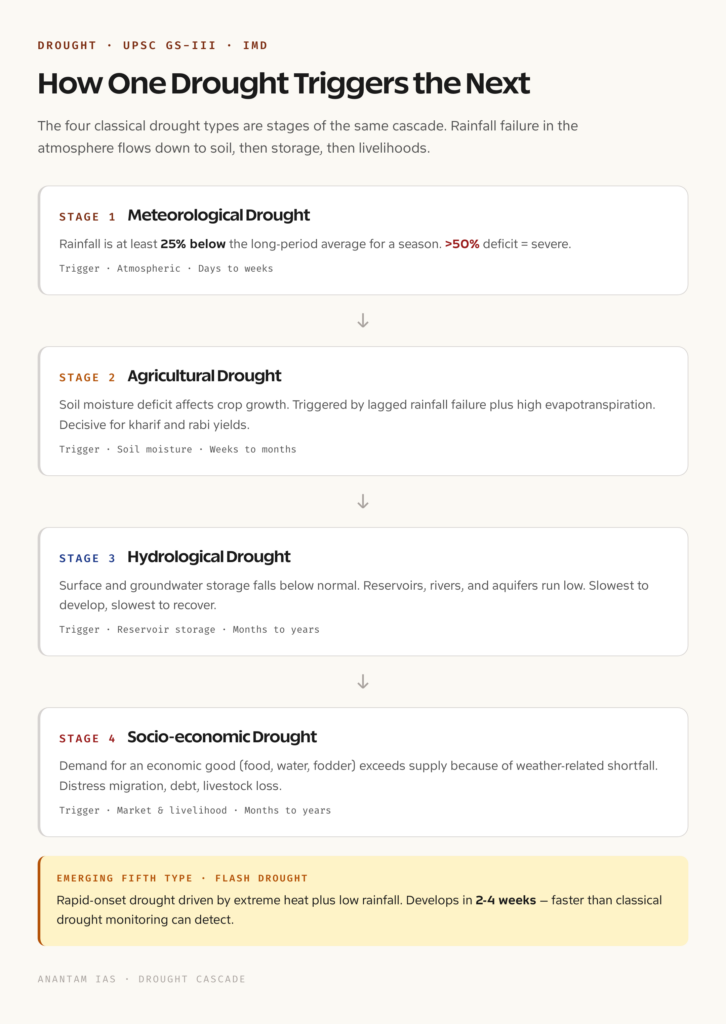
A drought is not a single event. It is a cascading sequence that begins with rainfall deficiency in the atmosphere, moves through the soil, and ends with empty reservoirs and stressed economies. The India Meteorological Department classifies droughts into four main types, with a fifth, flash drought, gaining recognition over the past decade as climate change accelerates the speed at which dry spells develop. Understanding these categories is the foundation for any UPSC GS-III answer on drought, water security, or agricultural distress.
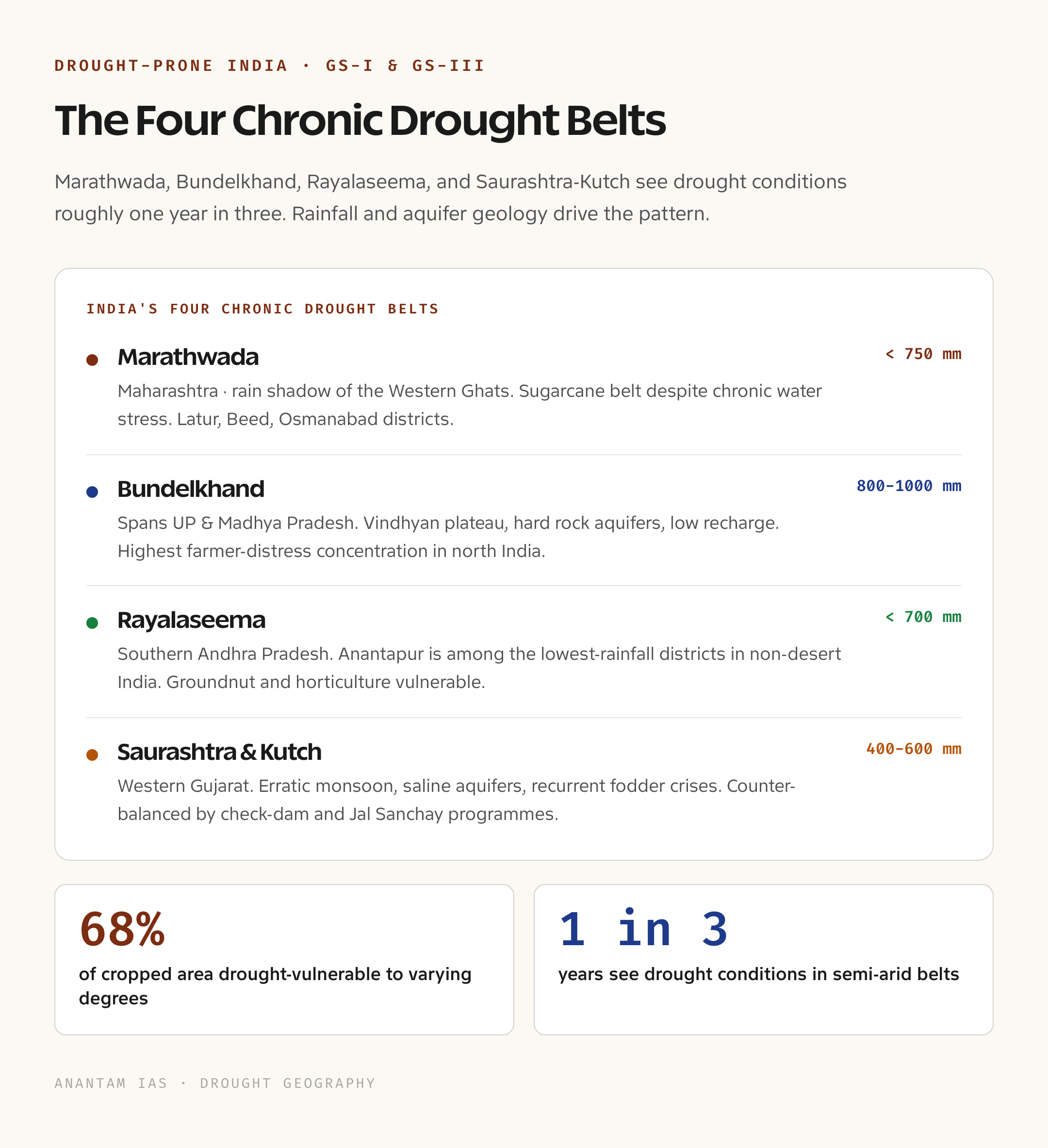
India is one of the most drought-vulnerable countries in the world. The semi-arid belts of Rayalaseema, Marathwada, Bundelkhand, and Saurashtra see drought conditions in roughly one out of every three years. The drought response architecture has evolved across multiple regimes, from the colonial-era famine codes to the modern integration of MNREGA, the Pradhan Mantri Fasal Bima Yojana, and the National Disaster Management Authority’s drought guidelines. The classification system that anchors all of this is the IMD framework that this article unpacks.
Quick Facts on Drought Types in India
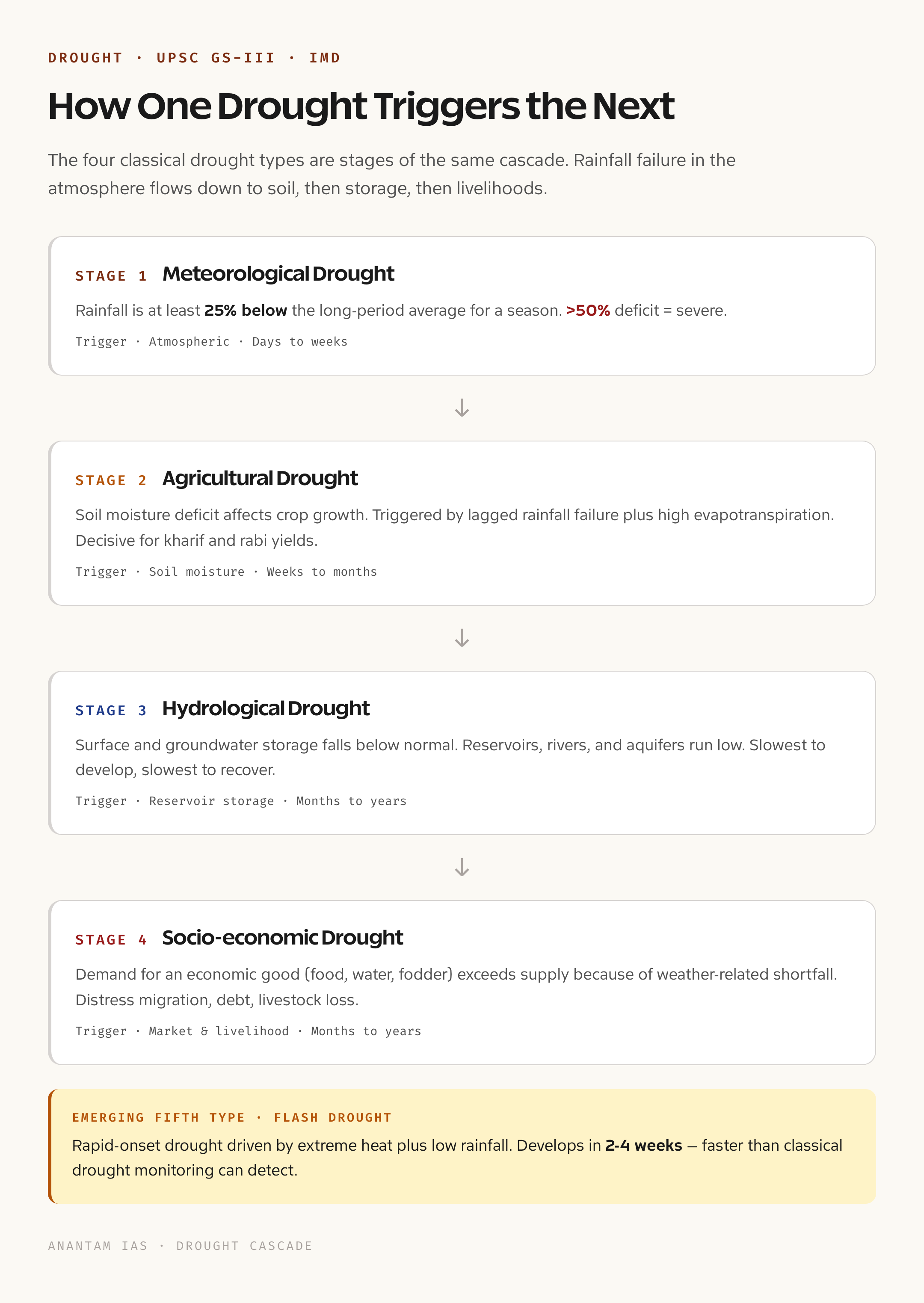
The India Meteorological Department recognizes four classical drought types: meteorological, agricultural, hydrological, and socio-economic. A fifth, flash drought, has emerged as a distinct category over the past decade. Drought is broadly defined as a prolonged period of deficient rainfall leading to hydrological, agricultural, and ecological stress. Roughly 68 percent of the country’s cropped area is vulnerable to drought to varying degrees.
The Manual for Drought Management, published by the Ministry of Agriculture and Farmers Welfare, is the primary operational guidance for state governments declaring drought. The United Nations Convention to Combat Desertification, ratified by India in 1996, is the international framework that shapes drought and desertification policy globally.
What Drought Actually Is
The classical definition treats drought as a deviation from the long-term rainfall normal for a place. The IMD considers a drought to have occurred when rainfall in a region is at least 25 percent below the long-period average for the season. If the deficit exceeds 50 percent, it is classified as a severe drought. This is the meteorological definition, which is the starting point for all other drought categories.
What makes drought different from other natural hazards is its slow onset. A cyclone arrives in days. A flood arrives in hours. A drought builds up over weeks and months, often invisibly, until the wells start running dry. By the time agricultural distress is visible, the meteorological drought has usually already peaked. This temporal lag is why drought policy has to monitor multiple indicators simultaneously rather than wait for one signal.
Background and Historical Context
India’s relationship with drought is older than the nation itself. The Bengal famine of 1770, the Great Famine of 1876 to 1878, and the Bengal famine of 1943 are all rooted in monsoon failure compounded by colonial administrative neglect. Independent India inherited a Famine Code from the British that focused on relief works during scarcity. The 1960s and 1970s saw a shift toward prevention through the Drought Prone Areas Programme, launched in 1973, which targeted long-term watershed development in the most vulnerable districts.
The 1987 drought, which affected fifteen states and roughly 285 million people, prompted a fundamental rethink. The Crop Insurance Scheme was launched in 1985 and has gone through multiple iterations to today’s PMFBY. The National Watershed Development Project for Rainfed Areas began in 1990 and was followed by the Hariyali Guidelines and eventually the Integrated Watershed Management Programme.
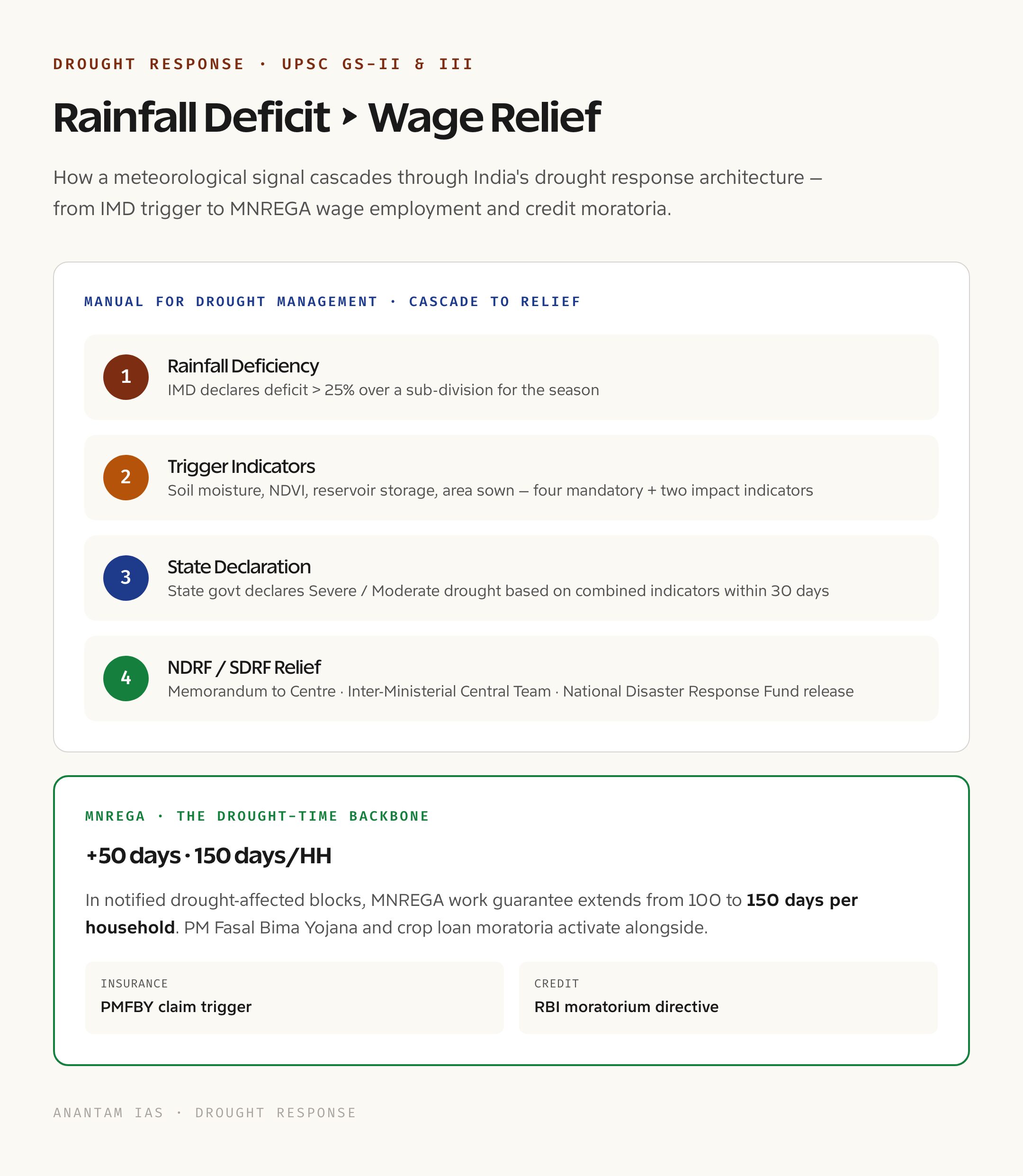
The current drought management architecture is anchored in the Disaster Management Act, 2005, which created the National Disaster Management Authority. NDMA released its national guidelines on drought management in 2010, and the Ministry of Agriculture released the revised Manual for Drought Management in 2016, which is the framework currently in force. This sits alongside the broader drought response framework in India, which integrates MNREGA, crop insurance, and credit relief.
Key Provisions: The Four IMD Drought Types
The IMD classification follows the cascade from atmosphere to society. Meteorological drought is the first stage, defined by a deficiency of precipitation compared to the long-term seasonal average for a specific area. The threshold of 25 percent below normal triggers a moderate drought classification, and 50 percent below triggers severe. Meteorological drought can be measured at any time scale, from a fortnight to a year, but the standard reporting is for the southwest monsoon season from June to September, which delivers about 75 percent of India’s annual rainfall.
Agricultural drought occurs when soil moisture is insufficient to support healthy crop growth during the growing season. It usually follows a meteorological drought but does not always require one. A delayed monsoon onset, a long dry spell during the grain-filling stage, or unseasonal heat during flowering can all cause agricultural drought even in years where the seasonal rainfall total is normal. The IMD uses a Standardized Precipitation Index, soil moisture data from satellite observations, and the Vegetation Health Index to track agricultural drought.
Hydrological drought refers to a prolonged period of precipitation deficiency that affects bulk water supplies. It manifests in falling water levels in rivers, lakes, reservoirs, and aquifers. Hydrological drought lags meteorological drought by months because surface and groundwater storage buffers the initial rainfall deficit. By the time reservoir levels drop visibly, the meteorological drought is usually already several months old. The Central Water Commission tracks 150-plus major reservoirs and publishes weekly storage bulletins that are the primary signal of hydrological drought.
Socio-economic drought happens when the demand for an economic good, typically water, food, or fodder, exceeds supply because of a weather-related shortfall. This is the most policy-relevant category because it triggers the formal declaration of a drought-affected area, which in turn unlocks relief mechanisms. A socio-economic drought is what gets people on television. The earlier categories build up silently in soil and reservoirs.
The Emerging Fifth Type: Flash Drought
Flash drought is the newest category and is increasingly important in a warming climate. Unlike classical droughts, which build up over months, flash droughts develop within weeks. They are driven by extreme heat, low humidity, and high wind, which together pull moisture out of the soil at an accelerated rate. A flash drought can take a healthy crop from green to wilted in two to three weeks.
Researchers at the Indian Institute of Technology Gandhinagar have documented an increase in flash drought frequency over the past forty years, with a particular concentration in central India and the Indo-Gangetic Plain. The 2022 heatwave that hit northern India in March and April was followed by classic flash drought conditions in several wheat-growing districts, with soil moisture dropping by half within four weeks despite no major change in seasonal rainfall.
Why Drought Classification Matters
The cascade structure has policy consequences. Meteorological drought is monitored by the IMD. Agricultural drought is monitored by the Mahalanobis National Crop Forecast Centre and state agriculture departments. Hydrological drought is monitored by the Central Water Commission and the Central Ground Water Authority for aquifers. Socio-economic drought is the trigger for relief, declared by state governments after meeting the criteria laid out in the Manual for Drought Management.
This means that a drought-affected farmer’s access to relief depends on which agencies declare which type of drought, in which sequence, and against which thresholds. The 2016 Manual reforms tried to simplify this by mandating that state governments declare drought within a fixed window after the southwest monsoon, using a combination of the four IMD indicators plus ground-truth verification. Disputes between the Centre and several states on whether a drought has occurred have repeatedly tested this framework.
Detailed Analysis: The Cascade in Practice
Looking at a real cascade clarifies the classification. Consider a hypothetical year in which the southwest monsoon delivers 30 percent below normal rainfall in the Marathwada region of Maharashtra. By July, the IMD classifies it as a moderate meteorological drought. By September, soil moisture in the kharif sowing window is well below normal and standing crops are showing stress, which the Crop Forecast Centre flags as agricultural drought. By December, reservoir levels in the Jayakwadi dam fall to less than 15 percent of capacity, and the Central Water Commission flags hydrological drought. By January, fodder prices in Beed and Latur jump 40 percent and migration from rural to urban areas accelerates, which the state government recognizes as socio-economic drought and uses to declare the affected talukas as drought-hit.
The flash drought variant looks different. In a hypothetical April, a heatwave drives surface temperatures to 45 degrees Celsius for two weeks. Soil moisture in standing wheat crops drops by 60 percent. Yields fall by a quarter even though seasonal rainfall through March was normal. By the time agricultural drought is recognized, the harvest is already lost.
Comparative View: India’s Drought Architecture vs Global Frameworks
India’s drought management architecture compares interestingly with other major drought-prone economies. The United States uses a similar four-category system but adds an explicit “ecological drought” category and produces a weekly Drought Monitor that integrates all indicators on a single map. Australia uses a Bureau of Meteorology Drought Statement that emphasises rainfall deciles. The European Drought Observatory uses a Combined Drought Indicator that blends precipitation, soil moisture, and vegetation indices.
India’s framework is closer to the US model in structure but is operationally fragmented across multiple agencies. The proposed National Drought Information System, mooted in the 2016 Manual, is meant to consolidate these data streams into a single dashboard, but progress has been slow. The UNCCD framework, to which India is a party, encourages countries to adopt drought policies that emphasize prevention and preparedness over relief, which is the direction India’s policy has been moving for the past two decades.
Challenges in Drought Management
The first challenge is data integration. Meteorological data, soil moisture data, reservoir storage data, and crop yield data sit in different agencies with different reporting cycles. The 2016 Manual mandates a composite index, but state implementation varies. The second challenge is the trigger threshold. Several states have argued that the 50 percent rainfall deficit benchmark for severe drought is too strict, leaving genuinely affected areas without formal recognition. The Centre has pushed back, arguing that loosening thresholds would dilute relief.
The third challenge is climate change. The classical drought definitions are built around a stationary climate, but the Indian monsoon is shifting. Rainfall is becoming more concentrated in fewer high-intensity events, with longer dry spells in between. This means a season can have normal seasonal rainfall but multiple within-season droughts, none of which trigger the formal definition. The increasing frequency of flash droughts is a symptom of this shift.
The fourth challenge is groundwater. India’s aquifers have absorbed a lot of the buffering against drought over the past four decades, but the groundwater crisis has eaten into that reserve. Hydrological drought now hits faster than it used to, because the groundwater cushion is thinner.
Prelims Pointers on Drought
The four classical drought types recognized by the IMD are meteorological, agricultural, hydrological, and socio-economic. Flash drought is the emerging fifth category. A meteorological drought is declared when rainfall is at least 25 percent below the long-period average, and severe when more than 50 percent below. The southwest monsoon delivers about 75 percent of India’s annual rainfall. The Manual for Drought Management 2016 is issued by the Ministry of Agriculture and Farmers Welfare. The Drought Prone Areas Programme was launched in 1973. The UNCCD was adopted in 1994 and ratified by India in 1996.
Roughly 68 percent of India’s cropped area is drought-vulnerable. The Drought Manual covers four key parameters: rainfall, vegetation indices, soil moisture, and reservoir storage. The National Disaster Management Authority issued national drought guidelines in 2010 under the Disaster Management Act, 2005.
Mains-Level Questions
A standard mains question might ask candidates to distinguish between the different types of drought and discuss the policy implications. A strong answer would walk through the cascade, link each type to its monitoring agency, explain the trigger thresholds, and end with the climate change angle that makes flash drought a growing concern.
Another framing asks whether India’s drought management framework is fit for purpose under climate change. The answer can build on the 2016 Manual reforms, the gaps in data integration, the groundwater overuse problem, and the case for a National Drought Information System.
Way Forward
India’s drought management needs to evolve along three axes. First, real-time data integration. A National Drought Information System that pulls IMD, MNCFC, CWC, and CGWB data into a single weekly bulletin would let state governments act earlier in the cascade rather than waiting for visible distress. Second, climate-resilient cropping. Crop diversification toward drought-tolerant varieties, especially millets, has begun under the International Year of Millets and needs to be accelerated through procurement and PDS reforms.
Third, water budgeting at the panchayat level. Atal Bhujal Yojana already pilots this in seven states, and expanding it to all drought-prone districts would build local accountability for groundwater use. The flash drought problem also needs a dedicated policy track, with insurance products that account for short-window stress events and with revised crop calendar advisories that incorporate heatwave forecasts. The lessons from the broader flood management framework in India on early warning and decentralized response are directly applicable.
Frequently Asked Questions
What are the types of droughts in India?
The India Meteorological Department classifies droughts into four main types: meteorological drought, agricultural drought, hydrological drought, and socio-economic drought. A fifth category, flash drought, has emerged in recent years as a distinct phenomenon driven by extreme heat and rapid soil moisture loss.
What is meteorological drought?
Meteorological drought is the initial stage, defined by a deficiency of precipitation compared to the long-term average for a specific duration and area. It is declared when rainfall is at least 25 percent below the long-period average and is classified as severe when more than 50 percent below.
What is the difference between agricultural and hydrological drought?
Agricultural drought refers to insufficient soil moisture for healthy crop growth, usually visible within weeks of a meteorological drought. Hydrological drought refers to a prolonged period of precipitation deficiency that affects bulk water supplies in rivers, lakes, reservoirs, and aquifers, and typically manifests months later.
What is socio-economic drought?
Socio-economic drought occurs when the demand for water, food, or fodder exceeds supply because of a weather-related shortfall. It is the policy-trigger category, since the formal declaration of a drought-affected area unlocks relief mechanisms like wage employment, fodder camps, and credit moratoriums.
What is flash drought?
Flash drought is a rapid-onset drought that develops within weeks rather than months, driven by extreme heat, low humidity, and high wind that together pull moisture out of the soil quickly. It can take a healthy crop from green to wilted in two to three weeks and is increasingly common under climate change.
Which Indian regions are most drought-prone?
The most drought-prone regions are the semi-arid belts of Marathwada and Vidarbha in Maharashtra, Bundelkhand in Uttar Pradesh and Madhya Pradesh, Rayalaseema in Andhra Pradesh, parts of Telangana, Saurashtra and Kachchh in Gujarat, and parts of Rajasthan and Karnataka.
What is the Manual for Drought Management?
The Manual for Drought Management is the operational document issued by the Ministry of Agriculture and Farmers Welfare that lays out the criteria and process for state governments to declare a drought-affected area. The most recent edition was published in 2016 and prescribes a composite index combining rainfall, vegetation, soil moisture, and reservoir storage.
How does MNREGA respond to drought?
In drought-affected areas, MNREGA’s wage employment guarantee is extended from 100 to 150 days per household per year, and certain works like watershed development, farm bunding, and well recharging are prioritized. This was first implemented systematically during the 2015 to 2016 drought and is now standard practice.
What is the role of the UNCCD in drought policy?
The United Nations Convention to Combat Desertification, adopted in 1994, is the international framework that addresses desertification and drought, particularly in dryland countries. India ratified it in 1996 and submits national reports on land degradation and drought response. The UNCCD encourages a shift from drought relief to drought preparedness.
How is climate change affecting droughts in India?
Climate change is making droughts more variable. Rainfall is becoming concentrated in fewer high-intensity events, with longer dry spells in between. Flash droughts are becoming more frequent. Heatwaves are intensifying soil moisture loss. The classical drought monitoring framework, which assumes a stationary climate, is increasingly being supplemented with climate-projected scenarios for medium-term planning.
Tell Google you want more of this.
Add Anantam IAS as a preferred sourceOne tap, and this site shows up more often in your own Top Stories, AI Overviews and AI Mode. Remove it any time.