The Central Ground Water Authority is the regulator nobody noticed until India ran out of easy water. As the country’s largest user of groundwater, the Indian economy now leans on aquifers to irrigate roughly two-thirds of its cropped area, supply most of its rural drinking water, and quench much of its industrial demand. Somewhere in that cascade of pumps, bore-wells, and tube-wells sits a small statutory authority constituted under the Environment (Protection) Act, 1986, that decides who can extract and how much.
The CGWA is often confused with its older sibling, the Central Ground Water Board. The two bodies share a ministry but do entirely different jobs. The Board surveys the resource. The Authority regulates its use. Get that distinction right and most prelims questions on Indian groundwater governance fall into place.
This guide walks through the legal foundations, statutory powers, and operational mechanics of the CGWA, the block classification system that drives most of its decisions, and the policy debates that examiners now ask about with increasing frequency.
Quick Facts: Central Ground Water Authority
- Nature: Statutory authority
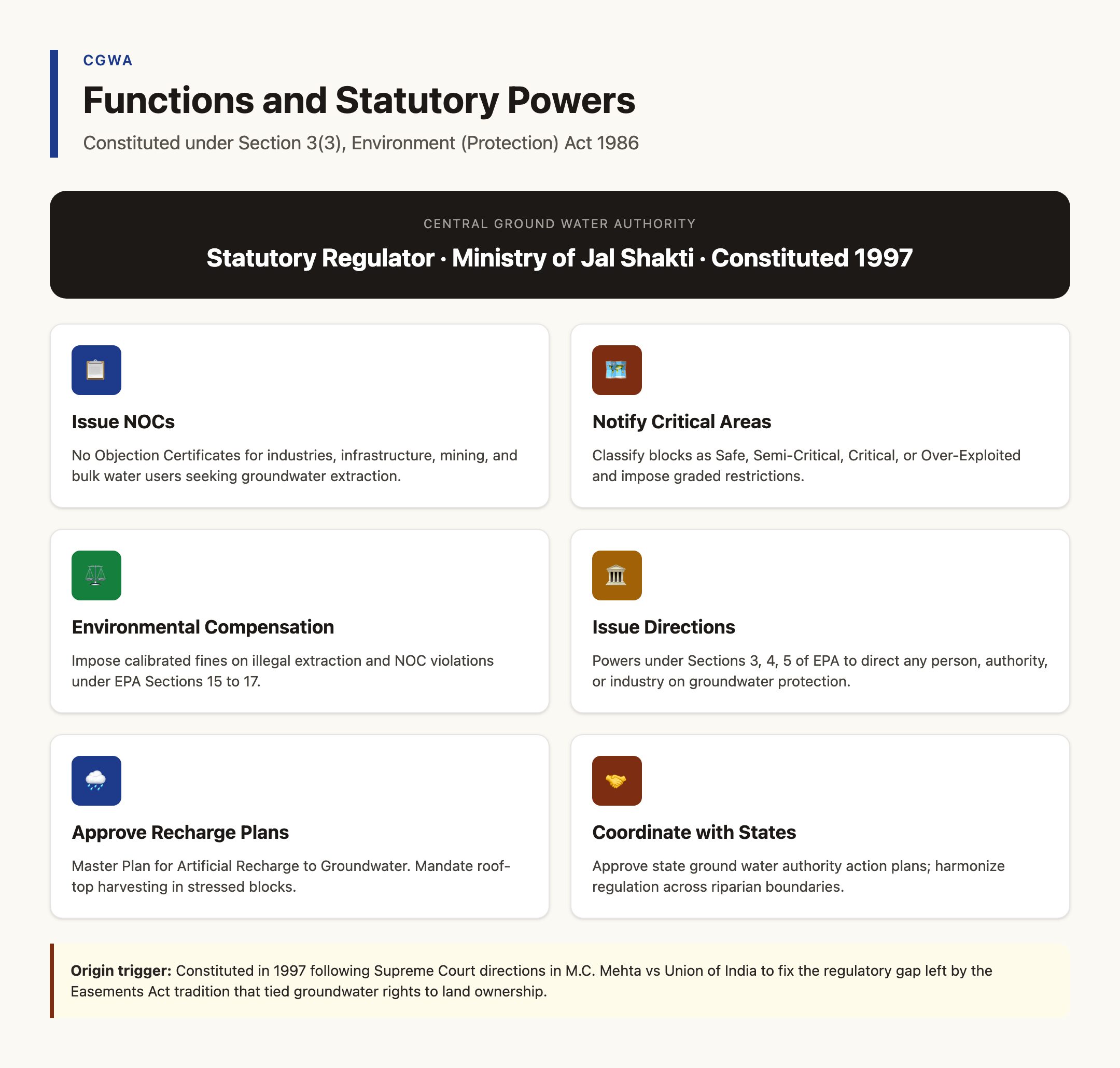
- Constituted under: Section 3(3) of the Environment (Protection) Act, 1986
- Year of constitution: 1997, by a notification of the central government
- Administrative ministry: Ministry of Jal Shakti, Department of Water Resources, River Development and Ganga Rejuvenation
- Not constituted under: The Water (Prevention and Control of Pollution) Act, 1974
- Primary functions: Regulating groundwater extraction, issuing No Objection Certificates, notifying critical areas
- Block classification categories: Safe, Semi-Critical, Critical, and Over-Exploited
- Scientific counterpart: Central Ground Water Board, established in 1970 as a subordinate office
- Key initiative: NOC Guidelines for industries, infrastructure, and mining projects
- Legal lineage: A direction by the Supreme Court in M.C. Mehta vs Union of India led to the constitution of the CGWA
What the CGWA Actually Does
The Central Ground Water Authority is, in plain language, a permits and notifications body. It decides whether a factory in a water-stressed district may install a bore-well, whether a real estate project in an over-exploited block can extract groundwater for construction, and whether a particular aquifer in a state should be brought under regulation. Its tools are administrative orders, NOC conditions, environmental compensation fines, and notifications that designate areas as critical.
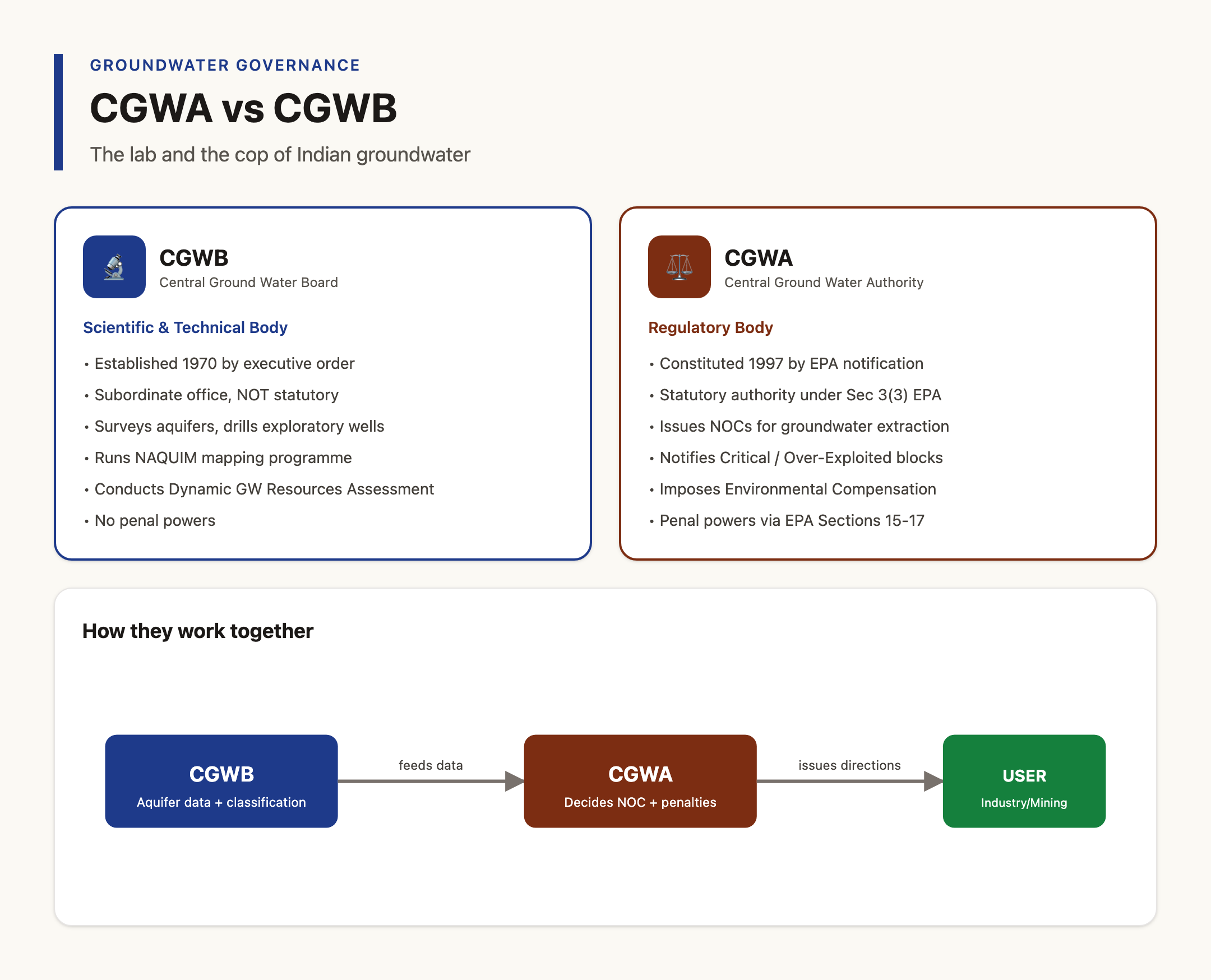
The Authority does not survey aquifers itself. It does not drill exploratory wells or maintain piezometers. Those are the jobs of the Central Ground Water Board, which feeds the Authority with the scientific data that makes the regulatory decisions defensible in court. The legal force of CGWA decisions comes from Section 3 of the Environment (Protection) Act, 1986, which lets the central government delegate its powers to any authority it constitutes for the purpose of environmental protection.
Background and Historical Context
Until the 1990s, groundwater in India was treated as a private resource attached to land ownership. The Indian Easements Act, 1882, gave landowners virtually unlimited rights to extract water beneath their plots. As tube-well technology spread in the 1970s and electricity tariffs were subsidized through the 1980s, extraction surged in the wheat-rice belt of Punjab and Haryana, in western Uttar Pradesh, in coastal Tamil Nadu, and across the Deccan. Water tables started falling in many districts, and saline ingress threatened coastal aquifers.
The legal turning point came through the Supreme Court. In M.C. Mehta vs Union of India and other writ petitions through the mid-1990s, the Court asked the Union government to set up a body with statutory powers to regulate groundwater. The Ministry of Environment and Forests issued a notification in January 1997 under Section 3(3) of the Environment (Protection) Act, 1986, constituting the Central Ground Water Authority. The Authority took over functions that the older Central Ground Water Board, established in 1970 by executive order, did not have the legal teeth to perform.
In 2019, the Ministry of Jal Shakti was carved out of the older Ministry of Water Resources, and the CGWA was placed under it. Successive NOC Guidelines, most recently revised in the early 2020s, have tightened the conditions under which industries and infrastructure projects can extract groundwater in stressed blocks.
Key Provisions and Statutory Powers
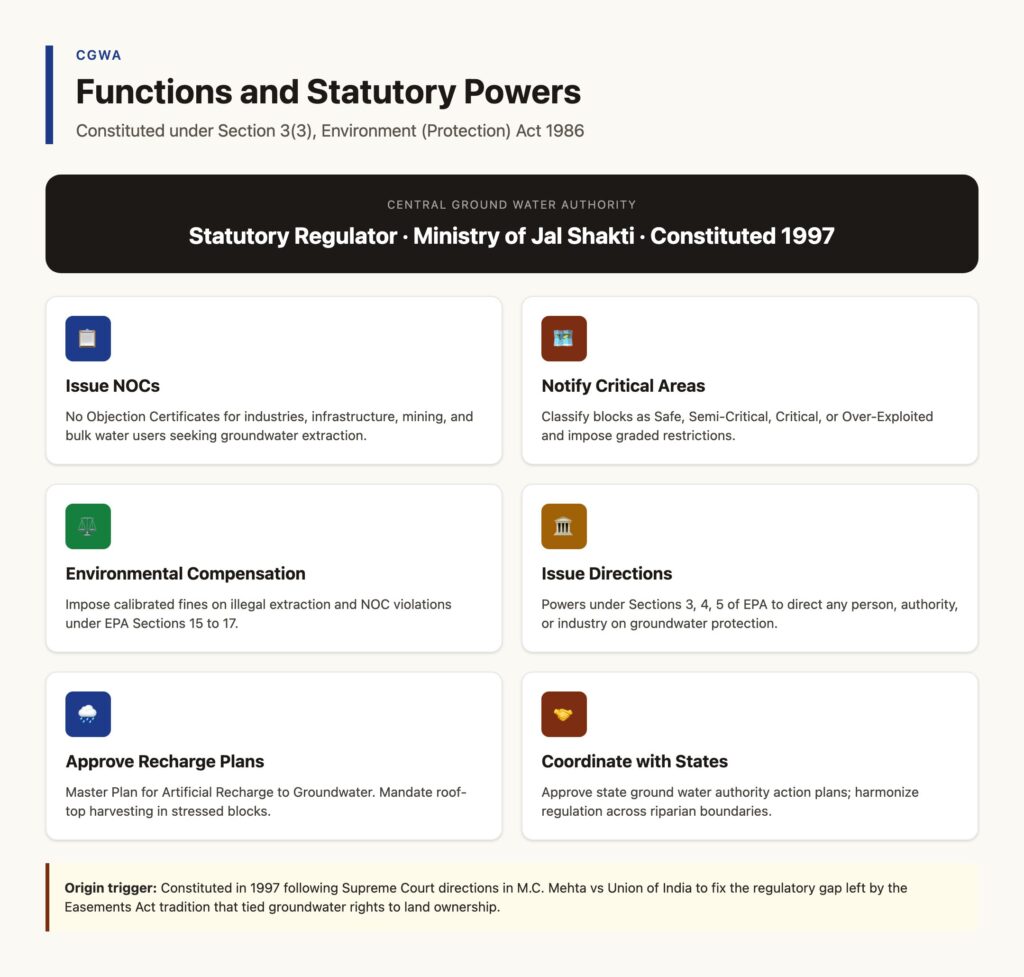
The Authority’s powers flow from the Environment (Protection) Act, which lets it do almost anything reasonably required for groundwater protection. The notification that constituted the CGWA explicitly empowered it to perform the following functions.
- Regulate and control development and management of groundwater resources in any area in the country.
- Exercise the powers of the central government under Sections 3, 4, and 5 of the Environment (Protection) Act, 1986, for the purpose of issuing directions and taking measures.
- Resort to penal provisions of the EPA, which include imprisonment up to five years and fine.
- Issue No Objection Certificates to industries, infrastructure projects, mining operations, and bulk water suppliers proposing to extract groundwater in notified or critical areas.
- Notify areas as critical or over-exploited and impose restrictions on new bore-wells, recharge requirements, water audit, and metering.
- Impose Environmental Compensation on entities that extract groundwater illegally or violate NOC conditions.
- Coordinate with state ground water authorities, where they exist, and approve their action plans.
The CGWA also publishes the Master Plan for Artificial Recharge to Ground Water and approves the National Aquifer Mapping and Management Programme outputs that the CGWB feeds in.
Why the CGWA Matters
India is the world’s largest user of groundwater, extracting more than the United States and China combined. Groundwater supports nearly two-thirds of irrigation, more than 85 per cent of rural drinking water, and about half of urban water supply. As per latest available data from the periodic Dynamic Ground Water Resources assessments, a large share of assessment units in north-west India and parts of peninsular India fall in the Critical or Over-Exploited categories.
That makes the CGWA the most consequential environmental regulator that most aspirants have never heard of. Its NOC decisions can stall or shape industrial investment in water-stressed districts. Its notifications can change the cropping pattern of a sub-basin. Its fines, when actually collected, can fund recharge structures.
For UPSC mains, the Authority is also a study in regulatory federalism. Water is a State List subject under Entry 17 of List II, but the Centre’s environmental jurisdiction under Entry 13 of List I and the Environment (Protection) Act gives the CGWA pan-India scope. States have their own ground water authorities under model bills, and the legal interface with CGWA continues to evolve.
Detailed Analysis: The NOC Regime and Block Classification
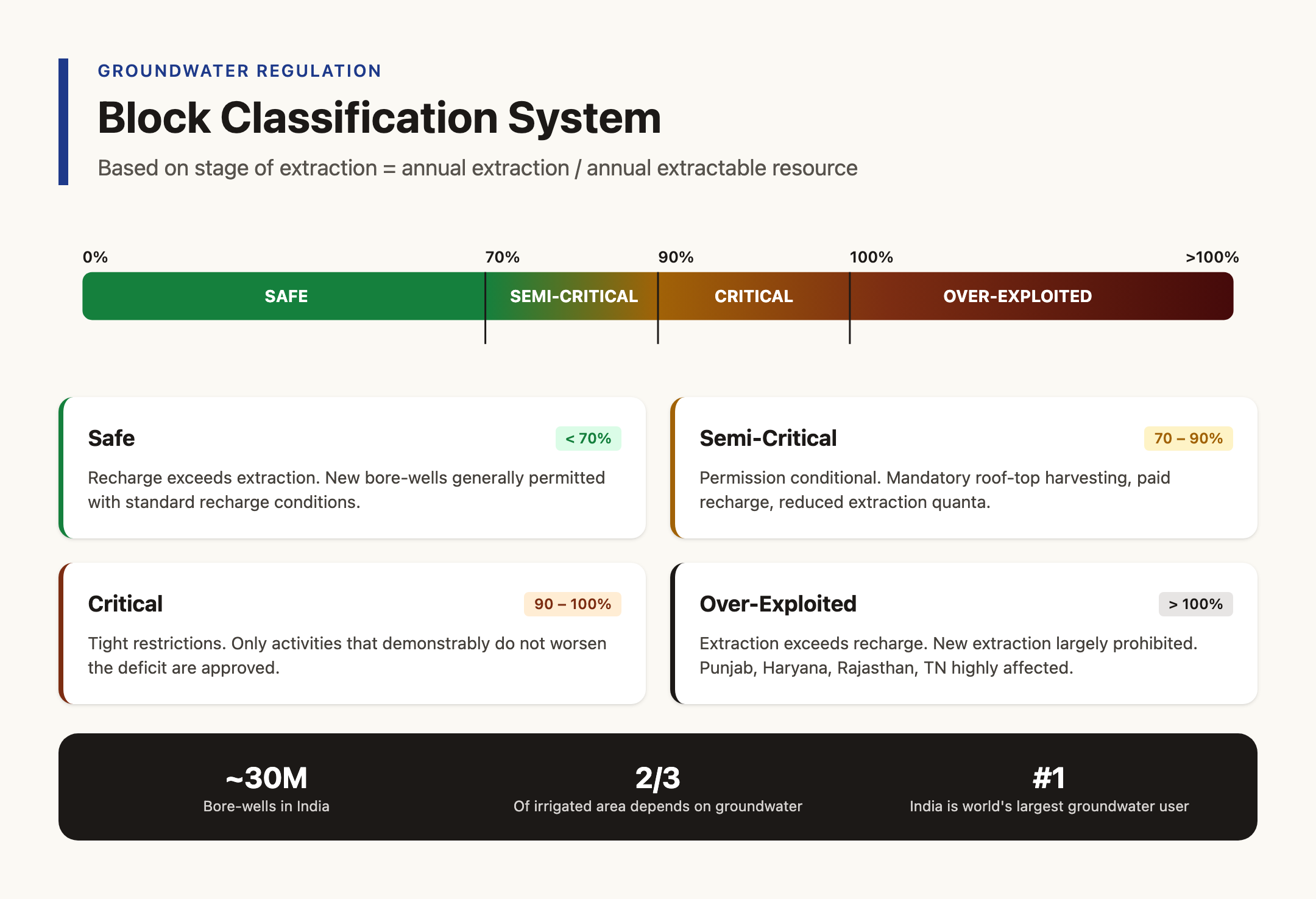
The operational engine of the CGWA is its NOC regime. Anyone seeking to extract groundwater for industrial, infrastructure, mining, or commercial use must apply on the NOC Application Portal. The Authority assesses the application against the block category in which the project is located. Blocks in India are classified into four categories based on the stage of groundwater extraction, calculated as the ratio of annual extraction to net annual extractable resource.
- Safe blocks have a stage of extraction below 70 per cent. Recharge exceeds use, and new extraction is generally permitted with standard conditions such as recharge structures and water audit.
- Semi-Critical blocks have a stage between 70 and 90 per cent. Permission is conditional and often requires roof-top rainwater harvesting, paid recharge, and reduced quanta of withdrawal.
- Critical blocks have a stage between 90 and 100 per cent. Restrictions tighten further, and only those activities are permitted that demonstrably do not worsen the deficit.
- Over-Exploited blocks have a stage above 100 per cent, meaning extraction is more than recharge. New extraction for most uses is prohibited, and existing users may face progressive metering, tariffs, and fines.
The classification is updated through the periodic Dynamic Ground Water Resources Assessment that CGWB conducts jointly with state ground water departments. As per latest available data, the share of Over-Exploited blocks remains particularly high in Punjab, Haryana, Rajasthan, and Tamil Nadu, while many districts in the central and eastern Ganga basin remain Safe.
The NOC regime also imposes Environmental Compensation, which is a calibrated fine that takes into account the volume of unauthorized extraction and the criticality of the block. Compensation is collected by the State Pollution Control Boards on behalf of the CGWA.
Comparative Perspective: CGWA versus CGWB
| Feature | Central Ground Water Board (CGWB) | Central Ground Water Authority (CGWA) |
|---|---|---|
| Nature | Scientific and technical body | Regulatory body |
| Year of establishment | 1970 by executive order | 1997 by notification |
| Legal status | Subordinate office of the ministry, not a statutory body | Statutory authority under Section 3(3) of EPA, 1986 |
| Primary function | Survey aquifers, drill exploratory wells, monitor water levels, conduct dynamic assessment | Issue NOCs, notify critical areas, impose environmental compensation |
| Ministry | Jal Shakti | Jal Shakti |
| Key initiative | National Aquifer Mapping and Management Programme (NAQUIM) | NOC Guidelines and notifications under EPA |
| Penal powers | None | Yes, through EPA Sections 15 to 17 |
The two bodies are sometimes described as the lab and the cop of Indian groundwater governance. The Board diagnoses, the Authority prescribes.
Challenges in Groundwater Regulation
The CGWA operates in a hard landscape. Roughly thirty million bore-wells are estimated to be active across India, and most of them are in agriculture, which is largely outside the NOC regime because individual farmers are not required to apply. The result is a regulatory frame that catches industries and developers but only weakly addresses the dominant user.
Other challenges include limited field capacity to verify compliance with NOC conditions, the political sensitivity of restricting agricultural extraction, weak metering infrastructure even where it is mandated, and inconsistent state-level regimes. Many states have not yet enacted their model groundwater bill, and where they have, coordination with CGWA can be patchy. Free or heavily subsidized agricultural electricity continues to drive over-extraction in several states. Climate variability is now compounding the stress, with recent dry years pushing more blocks into critical and over-exploited categories.
Prelims Pointers on CGWA
- The CGWA is a statutory authority constituted under Section 3(3) of the Environment (Protection) Act, 1986, not under the Water Act, 1974.
- It was constituted in 1997 following Supreme Court directions.
- It is administered by the Ministry of Jal Shakti.
- Block categories are Safe, Semi-Critical, Critical, and Over-Exploited.
- Stage of groundwater extraction is the ratio of annual extraction to net annual extractable resource.
- The Central Ground Water Board, established in 1970, is a subordinate office, not a statutory body.
- CGWB runs the National Aquifer Mapping and Management Programme.
- CGWA can impose Environmental Compensation under EPA penal provisions.
- India is the largest user of groundwater in the world.
- Common pollutants of Indian groundwater include arsenic, fluoride, nitrate, iron, salinity, and uranium.
Mains Practice Questions
- (GS-III) Examine the regulatory framework for groundwater management in India. Critically assess the role of the Central Ground Water Authority in addressing the country’s groundwater crisis.
- (GS-II) Discuss the constitutional and statutory basis for the Central Ground Water Authority. How does it interact with state-level groundwater regimes?
- (GS-III) The classification of blocks into Safe, Semi-Critical, Critical, and Over-Exploited categories drives groundwater regulation in India. Evaluate the effectiveness of this categorization and suggest reforms.
- (GS-III) Despite a regulatory authority and several missions, India’s groundwater stress continues to deepen. Identify structural drivers and suggest a policy roadmap.
Way Forward
A credible groundwater reform pathway begins with bringing agriculture into a graded regulatory frame, perhaps through Participatory Groundwater Management at the panchayat level rather than top-down NOC mandates. Direct Benefit Transfer for electricity, decoupled from pump-time, can reset incentives without hurting farmer income. Aquifer-level management plans driven by NAQUIM data should replace block-level rules of thumb in critical and over-exploited zones. The Atal Bhujal Yojana model of community-led demand management can be scaled into more states, with CGWA playing a steward role rather than a permits role. Real-time telemetry on industrial bore-wells, transparent online disclosure of NOC conditions, and stronger penalties for violations would close the compliance loop. Finally, integrating groundwater stress with crop-specific Minimum Support Price decisions and agro-climatic zone planning can shift cropping patterns away from high-water uses in stressed regions.
Frequently Asked Questions
Under which Act is the Central Ground Water Authority constituted?
The CGWA is constituted under Section 3(3) of the Environment (Protection) Act, 1986. It is not constituted under the Water (Prevention and Control of Pollution) Act, 1974. This distinction is a frequent point of confusion in prelims.
Which ministry administers the CGWA?
The Ministry of Jal Shakti, Department of Water Resources, River Development and Ganga Rejuvenation, is the administrative ministry for the CGWA. The same ministry also administers the Central Ground Water Board.
What is the difference between CGWA and CGWB?
The Central Ground Water Board is a scientific and technical body that surveys aquifers, drills exploratory wells, and monitors water levels. The Central Ground Water Authority is a regulatory body that issues NOCs, notifies critical areas, and imposes environmental compensation. The Board diagnoses, the Authority regulates.
What are Over-Exploited blocks?
Over-Exploited blocks are those where the stage of groundwater extraction exceeds 100 per cent of the net annual extractable resource. In simple terms, more water is being pumped out than nature is recharging. New extraction is largely prohibited, and existing users face tighter conditions.
What is the NOC regime under CGWA?
Industries, infrastructure projects, mining operations, and commercial bulk water users seeking to extract groundwater must apply for a No Objection Certificate from the CGWA on its online portal. The conditions attached depend on the block category, with stricter conditions in Critical and Over-Exploited blocks.
What is environmental compensation in groundwater context?
Environmental Compensation is a fine imposed on entities that extract groundwater without an NOC or in violation of NOC conditions. The amount depends on the volume of unauthorized extraction and the criticality of the block. State Pollution Control Boards collect the compensation on behalf of the CGWA.
Is groundwater a Union or State subject?
Water as such is a State List subject under Entry 17 of List II of the Seventh Schedule. However, the Centre regulates groundwater under its environmental jurisdiction through the Environment (Protection) Act, 1986. This dual character is why the CGWA operates pan-India even as states maintain their own ground water authorities.
What is NAQUIM?
NAQUIM is the National Aquifer Mapping and Management Programme, run by the Central Ground Water Board. It maps aquifers at a fine scale, characterizes their hydrogeology and water quality, and supports the development of aquifer management plans that the CGWA can use for regulation.
What pollutants are commonly found in Indian groundwater?
Common pollutants include arsenic in parts of West Bengal and Bihar, fluoride in parts of Rajasthan, Andhra Pradesh, and Telangana, nitrate from agriculture, iron, salinity in coastal aquifers, and uranium in some Punjab and Haryana districts.
How can India address its groundwater crisis?
A combination of demand management through participatory aquifer governance, supply augmentation through artificial recharge under the Master Plan, electricity tariff and DBT reforms in agriculture, real-time monitoring of major users, and integration of cropping pattern decisions with groundwater stress are the elements most experts converge on. The CGWA’s role is best repositioned as a strategic regulator rather than a project-level permitting agency.
Tell Google you want more of this.
Add Anantam IAS as a preferred sourceOne tap, and this site shows up more often in your own Top Stories, AI Overviews and AI Mode. Remove it any time.