
Indian Constitution: Salient Features & Preamble
The Indian Constitution is the supreme law of India — the longest written constitution in the world and one of the most ambitious. Adopted on 26 November 1949 and enforced from 26 January 1950, it has withstood the pressures of one of the world’s most diverse and complex democracies. Understanding the Constitution’s Preamble, salient features, sources, and drafting history is essential for every UPSC aspirant — it forms the bedrock of the Polity paper.
The Constitution at a Glance
| Feature | Detail |
|---|---|
| Adopted | 26 November 1949 (Constitution Day) |
| Enforced | 26 January 1950 (Republic Day) |
| Original articles | 395 articles, 22 parts, 8 schedules |
| Current articles | 470+ articles, 25 parts, 12 schedules |
| Words | Approximately 1,45,000 words — longest written constitution |
| Amendments | 106 Constitutional Amendments (as of 2024) |
| Drafting committee | Dr. B.R. Ambedkar (Chairman), with 6 other members |
The Preamble of the Indian Constitution
The Preamble is the introductory statement of the Constitution. It declares the source of the Constitution’s authority, the nature of the Indian state, and its objectives.
The Preamble (as amended by 42nd Amendment, 1976)
> “WE, THE PEOPLE OF INDIA, having solemnly resolved to constitute India into a SOVEREIGN SOCIALIST SECULAR DEMOCRATIC REPUBLIC and to secure to all its citizens: > > JUSTICE, social, economic and political; > > LIBERTY of thought, expression, belief, faith and worship; > > EQUALITY of status and of opportunity; > and to promote among them all > > FRATERNITY assuring the dignity of the individual and the unity and integrity of the Nation; > > IN OUR CONSTITUENT ASSEMBLY this twenty-sixth day of November, 1949, do HEREBY ADOPT, ENACT AND GIVE TO OURSELVES THIS CONSTITUTION.”
Key Words in the Preamble
SOVEREIGN — India is completely independent, not subject to any external authority. No foreign power can dictate to India.
SOCIALIST — Added by the 42nd Amendment, 1976 (during the Emergency). Means a commitment to economic equality, welfare state, and reduction of concentration of wealth. But it doesn’t mandate a Soviet-style state socialism — India has a mixed economy. The Supreme Court in Excel Wear v. Union of India (1979) held that socialism doesn’t prohibit private enterprise.
SECULAR — Also added by the 42nd Amendment, 1976. India gives equal respect to all religions (positive secularism) rather than strict separation of state from religion (negative secularism of the US). The state neither promotes nor discriminates against any religion. “Secularism” was already implicit in the Constitution through Fundamental Rights (Arts 25–28), but the 42nd Amendment made it explicit.
DEMOCRATIC — India is a democracy — both political (one person, one vote) and social (no discrimination based on birth, caste, sex). Power ultimately flows from the people.
REPUBLIC — India’s head of state (the President) is an elected person, not a hereditary monarch. This distinguishes India from constitutional monarchies like the UK.
JUSTICE (Social, Economic, Political) — Comprehensive justice: social (no discrimination), economic (equitable distribution of resources), political (equal participation in governance).
LIBERTY — Liberty of thought, expression, belief, faith, and worship. Connected to Part III Fundamental Rights, especially Articles 19 (freedom of speech) and 25–28 (freedom of religion).
EQUALITY — Equality of status and opportunity. Connected to Articles 14–18 — right to equality and prohibition of discrimination.
FRATERNITY — A unique addition, reflecting Ambedkar’s vision of a nation where citizens see each other as brothers and sisters regardless of caste, religion, or region. Fraternity assures the dignity of the individual and the unity and integrity of the nation.
Is the Preamble Part of the Constitution?
This was initially debated. The Supreme Court in:
- Berubari Union (1960) — held the Preamble is NOT part of the Constitution
- Kesavananda Bharati v. State of Kerala (1973) — overruled this; held the Preamble IS part of the Constitution
- LIC of India v. Consumer Education & Research Centre (1995) — reaffirmed that Preamble is part of the Constitution
The Preamble is a legitimate aid in interpretation but cannot override explicit provisions.
Can the Preamble Be Amended?
Yes. The 42nd Amendment (1976) amended the Preamble by inserting “Socialist,” “Secular,” and changing “unity of the nation” to “unity and integrity of the nation.” The Kesavananda Bharati judgment confirmed that Parliament can amend the Preamble — but cannot destroy the Basic Structure (sovereign, democratic, secular, republic character).
Salient Features of the Indian Constitution
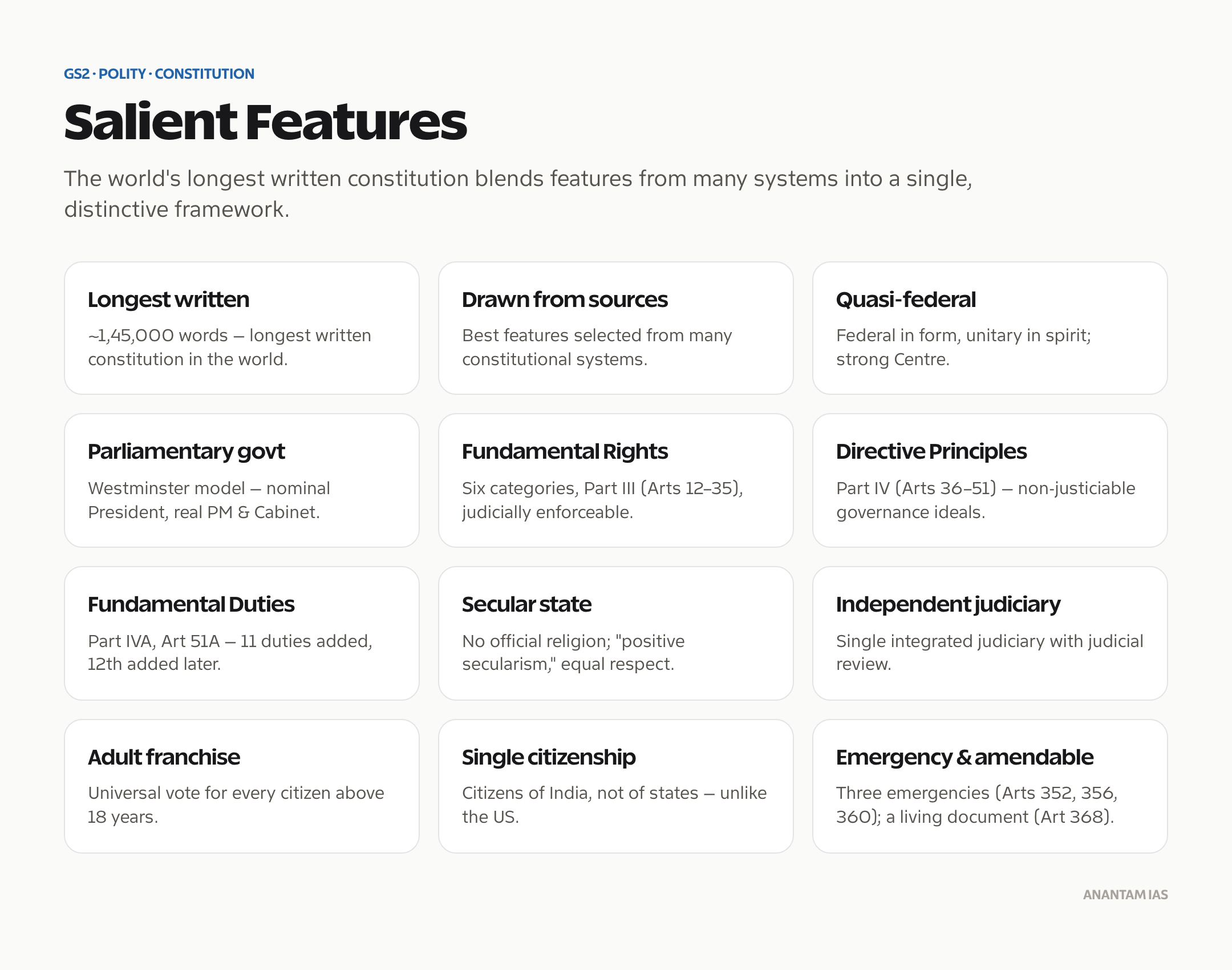
1. Longest Written Constitution
India’s Constitution is the longest written constitution in the world — ~1,45,000 words. This is partly because the framers included both the federal and the state-level administrative structures in a single document (unlike the US, which is federal only). The Government of India Act, 1935 provided the detailed bureaucratic framework that was incorporated.
2. Drawn from Multiple Sources
The Indian Constitution is often called a “bag of borrowings” — though this is reductive. The framers deliberately selected the best features from different constitutional systems. (See the Sources Table below.)
3. Federal with Strong Unitary Bias (or “Quasi-Federal”)
India is federal in form but unitary in spirit — a description frequently used in exams. Features of federalism include:
- Dual government (Union + States)
- Division of powers (Union List, State List, Concurrent List — 7th Schedule)
- Independent judiciary
- Bicameral Parliament (Rajya Sabha representing states)
- Written Constitution
But unitary features dominate:
- Single citizenship
- Flexible constitution (most parts need only simple majority)
- Strong Centre in Emergency
- Governor appointed by and serving at pleasure of Centre
- Integrated judiciary (single unified judiciary, unlike the US)
- All-India Services (IAS, IPS) controlled by Centre
- Parliament can alter state boundaries, create/merge states (Art 3) — without state consent
- Residuary powers with Centre (Art 248)
K.C. Wheare called India “quasi-federal.” The Supreme Court in S.R. Bommai (1994) described India as “an indestructible union of indestructible states” (borrowing from the US case Texas v. White, but with modifications).
4. Parliamentary Government (Westminster Model)
India follows the Cabinet form of government — not the Presidential system. Key features:
- Nominal head (President) and real head (Prime Minister + Cabinet)
- Executive is responsible to the legislature (especially Lok Sabha)
- PM and Cabinet collectively responsible to Lok Sabha
- PM can be removed by a vote of no-confidence
- Fusion of executive and legislative powers (Ministers are MPs)
The Presidential system was considered but rejected — partly because India’s diverse and largely illiterate electorate (in 1950) was seen as better served by parliamentary accountability.
5. Fundamental Rights (Part III, Arts 12–35)
Six categories of Fundamental Rights:
- Right to Equality (Arts 14–18)
- Right to Freedom (Art 19–22)
- Right Against Exploitation (Arts 23–24)
- Right to Freedom of Religion (Arts 25–28)
- Cultural and Educational Rights (Arts 29–30)
- Right to Constitutional Remedies (Art 32)
The right to property was a Fundamental Right originally (Art 31) but was deleted by the 44th Amendment, 1978 — it’s now a constitutional right under Art 300A.
6. Directive Principles of State Policy (Part IV, Arts 36–51)
DPSP are non-justiciable guidelines for the government — ideals to be achieved as conditions improve. They represent the social and economic democracy the Constitution aspires to, while FRs represent political democracy. Article 37 says DPSPs are not enforceable in courts but are “fundamental in governance” and it shall be the duty of the State to apply them.
DPSPs are inspired by the Irish Constitution (itself inspired by the Spanish Constitution). They cover socialist principles (Art 39), Gandhian principles (village panchayats, Art 40; cottage industries, Art 43), and liberal-intellectual principles (uniform civil code, Art 44; international peace, Art 51).
Directive Principles of State Policy
7. Fundamental Duties (Part IVA, Art 51A)
Added by the 42nd Amendment, 1976 (11 duties). The 86th Amendment, 2002 added a 12th duty — parents/guardians to provide education opportunities for children between 6–14 years.
Originally there were no Fundamental Duties in the Constitution — these were added following the Swaran Singh Committee recommendation (1976). They are non-justiciable but courts use them as aids in interpretation.
8. Secular State
India is a secular state — not theocratic, not officially atheist. The state doesn’t have an official religion. But it’s “positive secularism” — the state can intervene in religious matters to remove social evils (like the practice of untouchability), promote social reform, and regulate religious endowments.
Articles 25–28 provide freedom of religion while Articles 14–15 prohibit discrimination on the basis of religion. The tension between individual religious liberty and the state’s right to reform is an ongoing constitutional conversation.
9. Independent Judiciary
India has a single integrated judiciary with the Supreme Court at the apex. The judiciary is independent through:
- Security of tenure for judges
- Salaries charged to Consolidated Fund (not voted by Parliament)
- Power of judicial review
- Original, appellate, and advisory jurisdiction
- Power to strike down unconstitutional laws (Art 13)
The Supreme Court’s power of judicial review extends to constitutional amendments — established by Kesavananda Bharati (1973) through the Basic Structure doctrine.
10. Universal Adult Franchise
Every citizen above 18 years has the right to vote — regardless of education, property, sex, caste, religion. The voting age was 21 until the 61st Amendment, 1989 lowered it to 18.
11. Single Citizenship
Unlike the US (federal and state citizenship), India has single citizenship — citizens of India, not of states. This promotes national unity over regional identity.
12. Emergency Provisions
The Constitution contains provisions for three types of emergencies (Arts 352, 356, 360) that can transform the federal structure into a unitary one in times of crisis.
13. A Living Document: The Amendment Procedure
Article 368 provides for constitutional amendment. The procedure is partly flexible, partly rigid:
- Simple majority (like any ordinary law) — can alter certain provisions (salaries of judges, citizenship, election of President, etc.)
- Special majority (2/3rd of members present and voting + majority of total membership of each House) — for most provisions
- Special majority + ratification by at least half the States — for provisions related to the federal structure (election of President, extent of executive/legislative powers, SC/HC powers, Seventh Schedule, Art 368 itself)
India’s constitution is easier to amend than the US Constitution but harder than ordinary legislation — this flexibility has allowed 106 amendments in 74 years.
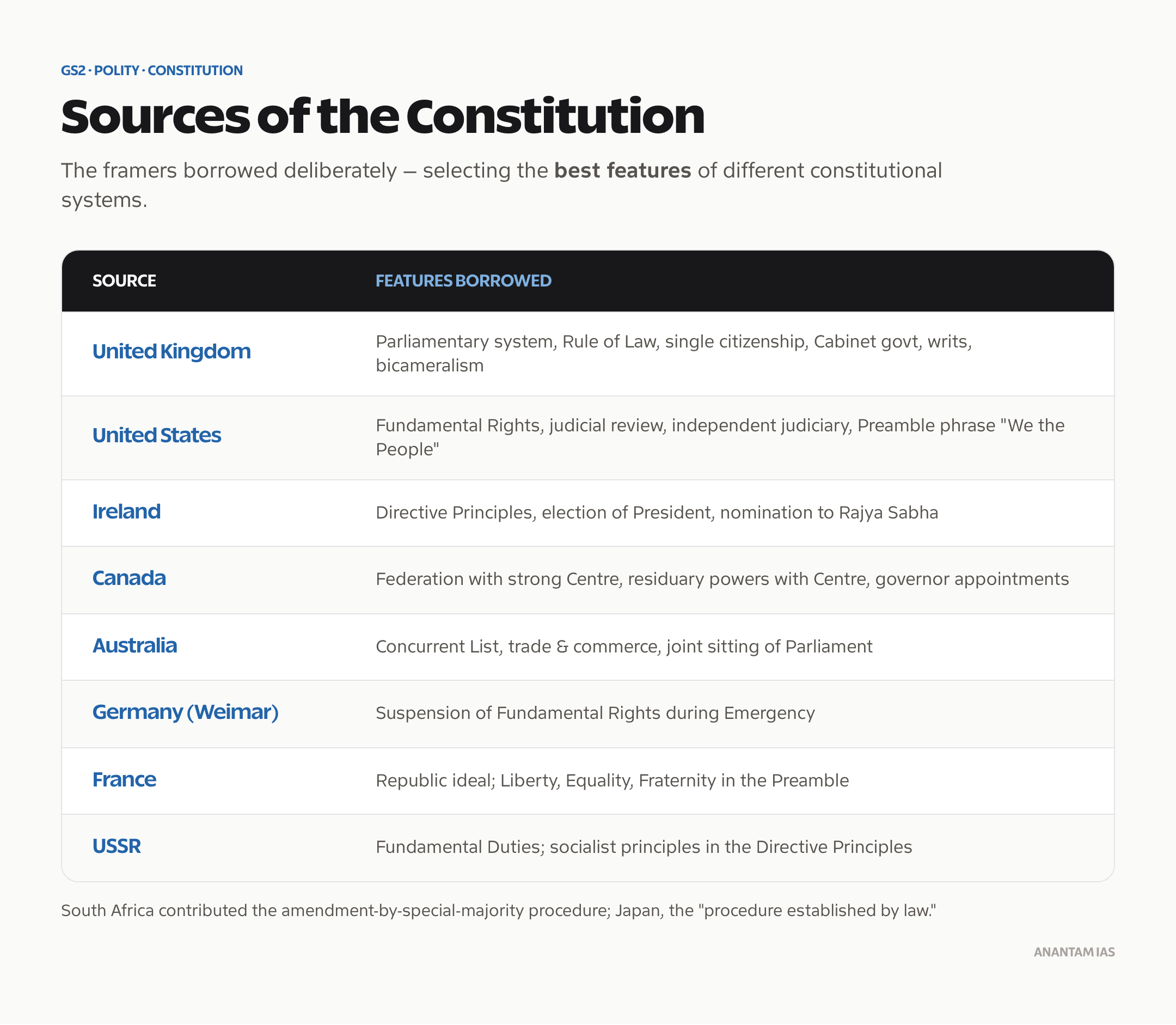
Sources of the Indian Constitution
| Country/Source | Features Borrowed |
|---|---|
| United Kingdom (British Constitution) | Parliamentary system, Rule of Law, single citizenship, Cabinet government, writs (Habeas Corpus etc.), bicameralism |
| United States of America | Fundamental Rights, judicial review, independence of judiciary, President as Supreme Commander, removal of SC judges, Preamble phrase (“We the People”) |
| Ireland | Directive Principles of State Policy, method of election of President, nomination to Rajya Sabha |
| Canada | Federal structure with strong Centre, distribution of powers (residuary with Centre), Council of States (Rajya Sabha concept), appointment of state governors |
| Australia | Concurrent List, trade and commerce provisions, joint sitting of Parliament |
| Germany (Weimar Constitution) | Suspension of Fundamental Rights during Emergency |
| South Africa | Amendment procedure (by special majority) |
| Japan | Procedure established by law (Art 21’s due process element) |
| France | Republic ideal, Liberty, Equality, Fraternity in Preamble |
| Soviet Union (USSR) | Fundamental Duties (42nd Amendment); socialist principles in DPSPs |
The Constituent Assembly
Formation and Composition
The Constituent Assembly was formed under the Cabinet Mission Plan, 1946. It had 389 members initially — but after Partition, the number reduced to 299 (those from the Indian territory).
First meeting: 9 December 1946 Dr. Rajendra Prasad: President of the Constituent Assembly Dr. B.R. Ambedkar: Chairman of the Drafting Committee
Key Committees
| Committee | Chairperson |
|---|---|
| Drafting Committee | Dr. B.R. Ambedkar |
| Union Constitution Committee | Pt. Jawaharlal Nehru |
| Provincial Constitution Committee | Sardar Patel |
| Fundamental Rights Sub-Committee | J.B. Kripalani |
| Minorities Sub-Committee | H.C. Mookerjee |
| Advisory Committee on Fundamental Rights | Sardar Patel |
Timeline
- Constituent Assembly first met: 9 December 1946
- Objectives Resolution moved by Nehru: 13 December 1946
- Adopted the Constitution: 26 November 1949
- Constitution enforced: 26 January 1950
- Total time to draft: 2 years, 11 months, 18 days
- Sessions: 11 sessions, total sitting days: 166 days
Dr. B.R. Ambedkar’s Contribution
Dr. Bhimrao Ramji Ambedkar is rightly called the “Chief Architect of the Indian Constitution.” As Chairman of the Drafting Committee, he coordinated the entire drafting process, synthesised the work of various committees, and delivered the final draft with extraordinary intellectual rigour.
His contributions included:
- Ensuring constitutional protection against caste discrimination (Arts 15, 16, 17)
- Right to Constitutional Remedies (Art 32) — “heart and soul of the Constitution”
- Detailed provisions on reservations (Art 16(4), Art 335)
- Framing the fundamental rights provisions
- Championing universal adult franchise
- The provision for an independent judiciary
In his closing speech on 25 November 1949, Ambedkar famously warned: > “However good a Constitution may be, if those who are implementing it are not good, it will prove to be bad. However bad a Constitution may be, if those implementing it are good, it will prove to be good.”
He also warned about “bhakti” (hero worship) in politics: > “Bhakti in religion may be a road to the salvation of the soul. But in politics, bhakti or hero-worship is a sure road to degradation and to eventual dictatorship.”
The Basic Structure Doctrine
The most important constitutional law development after the Constitution was adopted is the Basic Structure Doctrine, established in Kesavananda Bharati v. State of Kerala (1973) (13-judge bench, 7:6 majority).
The court held that Parliament can amend any provision of the Constitution under Art 368 — but cannot destroy its “Basic Structure.” What constitutes basic structure? The court gave examples but didn’t exhaustively define it:
- Supremacy of the Constitution
- Republican and democratic form of government
- Secular character
- Separation of powers
- Federal character
- Unity and integrity of India
- Judicial review
- Free and fair elections (added later)
- Rule of law
The Basic Structure doctrine is one of India’s greatest contributions to global constitutional law — ensuring that constitutional amendments cannot be used to fundamentally undermine the Constitution itself.
UPSC Exam Focus Points
Essential Prelims facts:
- Constitution adopted: 26 November 1949 (Constitution Day); enforced: 26 January 1950
- “Socialist” and “Secular” added to Preamble by 42nd Amendment 1976
- Preamble is part of Constitution — Kesavananda Bharati (1973)
- Fundamental Duties added by 42nd Amendment (11 duties); 12th by 86th Amendment (2002)
- Right to Property: removed from FRs by 44th Amendment 1978 — now Art 300A
- Voting age: lowered from 21 to 18 by 61st Amendment 1989
- Single citizenship — not dual (unlike US)
- Residuary powers: with Centre (unlike Australia/Canada where unclear or state-leaning)
- Basic Structure: Kesavananda Bharati 1973 (7:6 majority, 13-judge bench)
Frequently Asked Questions
What are the salient features of the Indian Constitution?
The Indian Constitution’s key features include being the world’s longest written constitution, drawn from multiple international sources, establishing a federal structure with strong unitary bias, a parliamentary form of government, justiciable Fundamental Rights, non-justiciable Directive Principles, Fundamental Duties, a secular state, an independent judiciary with judicial review, universal adult franchise, single citizenship, and emergency provisions. The Basic Structure doctrine protects core constitutional values from amendment.
What does the Preamble of the Indian Constitution say?
The Preamble declares India to be a Sovereign, Socialist, Secular, Democratic Republic. It commits to securing Justice (social, economic, political), Liberty (of thought, expression, belief, faith, worship), Equality (of status and opportunity), and promoting Fraternity (assuring individual dignity and national unity and integrity). u0022Socialistu0022 and u0022Secularu0022 were added by the 42nd Amendment in 1976.
What was the role of Dr. Ambedkar in drafting the Constitution?
Dr. B.R. Ambedkar chaired the seven-member Drafting Committee of the Constituent Assembly and is rightly called the u0022Chief Architect of the Indian Constitution.u0022 He synthesised input from all sub-committees, drafted the constitutional text, and made sure it addressed caste discrimination through Articles 15, 16, and 17. He championed Article 32 (right to constitutional remedies) as the u0022heart and soulu0022 of the Constitution and advocated for universal adult franchise irrespective of education or property.
What are the sources of the Indian Constitution?
The Constitution borrowed from multiple sources: the UK (parliamentary system, Cabinet government, single citizenship, Rule of Law), the USA (Fundamental Rights, judicial review, independent judiciary), Ireland (Directive Principles, election of President), Canada (strong federal centre, residuary powers with Centre), Australia (Concurrent List, joint sitting), Germany (emergency provisions), South Africa (amendment by special majority), and USSR (Fundamental Duties). The Government of India Act, 1935 provided much of the administrative framework.
What is the Basic Structure doctrine?
Established in Kesavananda Bharati v. State of Kerala (1973) by a 7:6 majority of a 13-judge bench, the Basic Structure doctrine holds that Parliament can amend any provision of the Constitution under Article 368 — but cannot destroy its essential/basic structure. Core elements include supremacy of the Constitution, democracy, secularism, federalism, separation of powers, judicial review, and free elections. The doctrine is India’s most significant contribution to global constitutional jurisprudence.
Tell Google you want more of this.
Add Anantam IAS as a preferred sourceOne tap, and this site shows up more often in your own Top Stories, AI Overviews and AI Mode. Remove it any time.