Disclosure: this guide contains Amazon affiliate links. As an Amazon Associate, Anantam IAS earns from qualifying purchases — at no extra cost to you.
If you’re prepping UPSC Polity, the indian constitution fundamental duties chapter looks deceptively simple — eleven bullet points, one article number, one amendment year. Read once, score 4 marks, move on. That’s the trap. Most aspirants memorise the duties verbatim and then collapse the moment a Mains question asks about Verma Committee, AIIMS Students’ Union case, or how 51A(g) was invoked in the 2024 climate ruling. Every Mains review I’ve done shows the same gap — the candidate quotes the duty, then has nothing else. This guide gives you the duty + the case + the statute that enforces it. Memorise the eleven, learn the four cases, and you’ll cross the average answer by 5-6 marks.
What are the indian constitution fundamental duties?
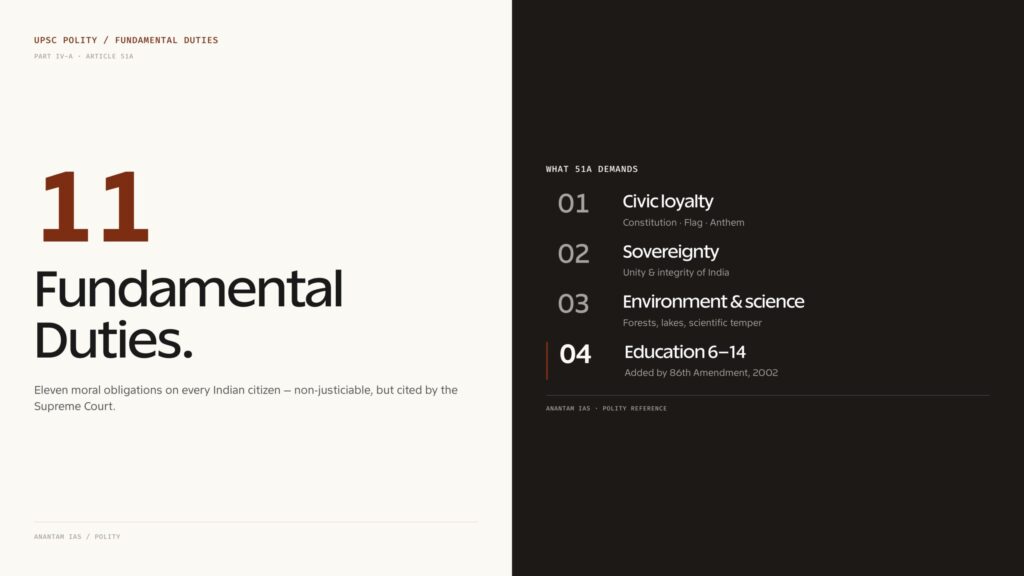
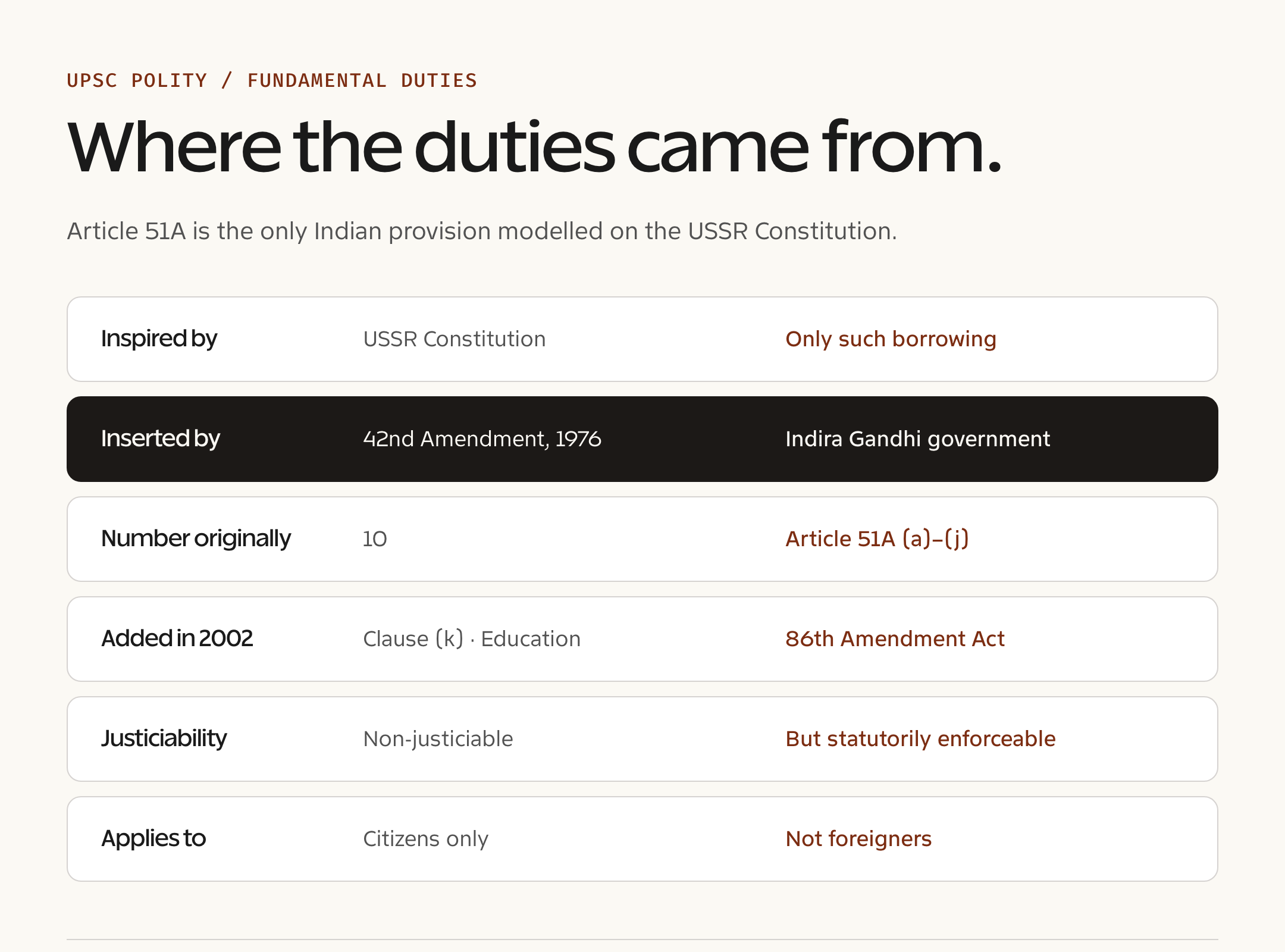
The indian constitution fundamental duties are eleven moral and civic obligations imposed on every Indian citizen by Article 51A in Part IV-A of the Constitution. They were not part of the original 1950 Constitution; they were added by the 42nd Amendment Act, 1976, with one more added by the 86th Amendment Act, 2002. Duties are non-justiciable — courts cannot directly compel a citizen to perform them — but Parliament can and has passed statutes to enforce them.
- Article 51A — sole article — lists all 11 fundamental duties.
- Part IV-A — added by 42nd Amendment, 1976.
- Original count — 10 duties — based on Sardar Swaran Singh Committee, 1976.
- Current count — 11 duties — 51A(k) added by 86th Amendment, 2002.
- Inspiration — drawn from the (then) USSR Constitution.
How fundamental duties entered the Constitution
Originally, the Constitution carried no duties chapter. Why? Because the framers, especially Ambedkar, were wary of using the constitution as a tool of citizen control. The Bill of Rights model — rights guarded against the State — was the priority for a country newly independent from colonial rule.
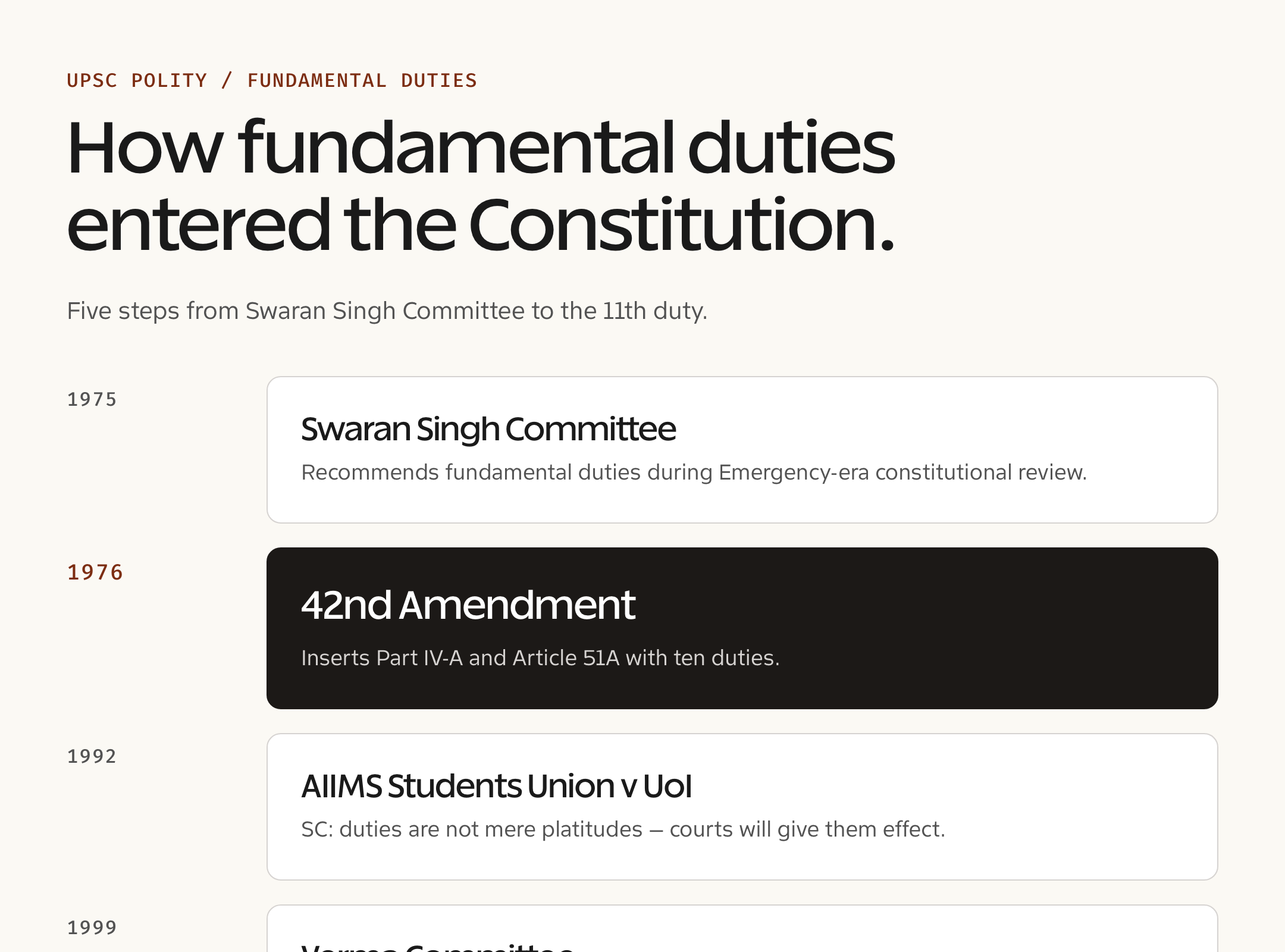
The shift came during the Emergency. In 1976, the Sardar Swaran Singh Committee was constituted to recommend constitutional amendments. The committee suggested adding fundamental duties. Parliament accepted the proposal and enacted the 42nd Amendment Act, 1976 — which created Part IV-A and Article 51A with 10 duties. Year + Subject + Effect: 1976 — 42nd Amendment — added Part IV-A (10 fundamental duties) to the Constitution.
The 11th duty came 26 years later. The 86th Amendment Act, 2002, which made the right to education a fundamental right under Article 21A, also added Article 51A(k) — the duty of parents to provide education to children aged 6 to 14.
For the parent constitutional document, see Indian Constitution: Salient Features & Preamble and Preamble of the Indian Constitution.
The 11 fundamental duties — Article 51A in full
Number every list. Aspirants memorise lists.
It shall be the duty of every citizen of India:
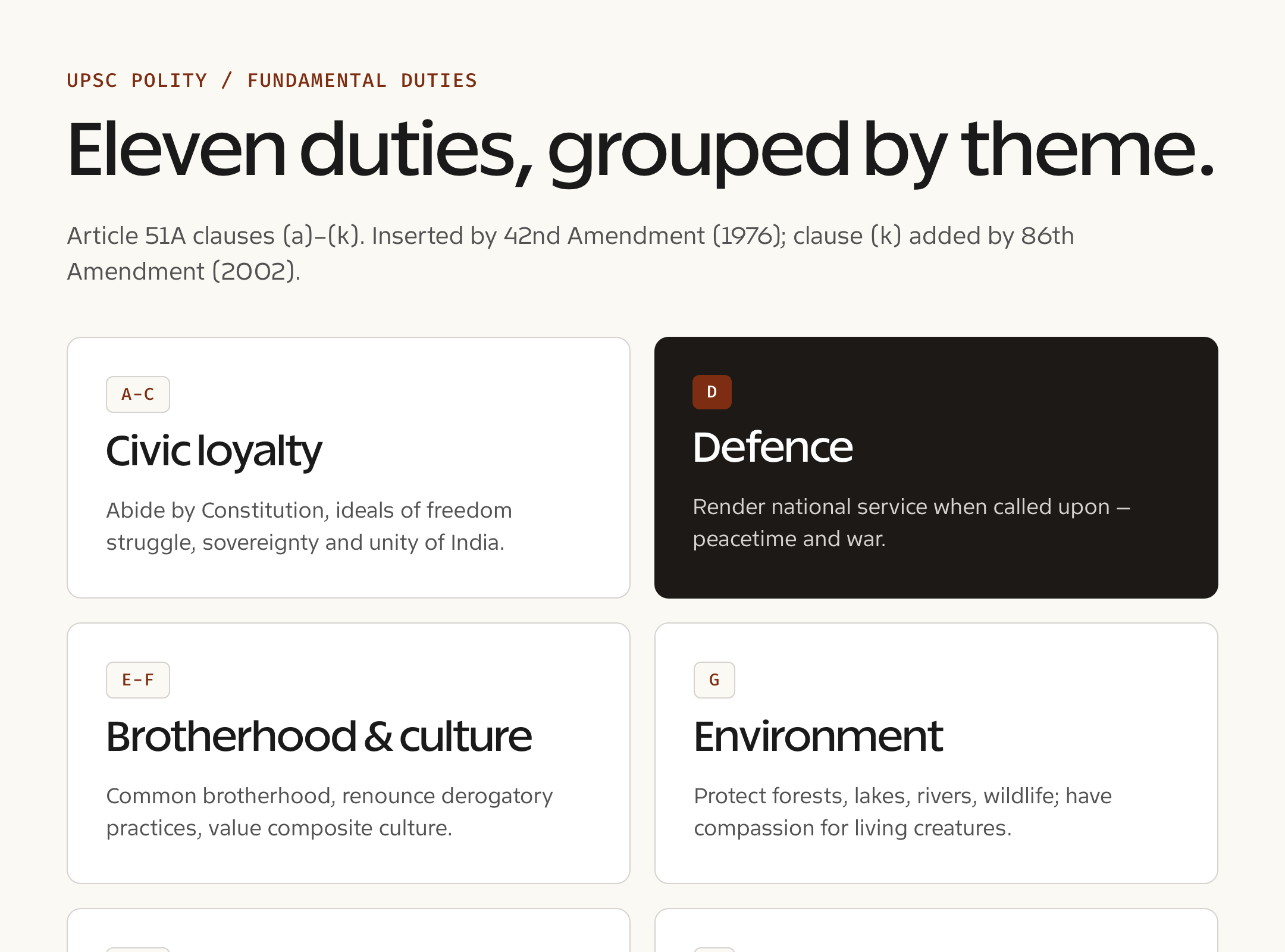
- 51A(a) — to abide by the Constitution and respect its ideals and institutions, the National Flag, and the National Anthem.
- 51A(b) — to cherish and follow the noble ideals which inspired our national struggle for freedom.
- 51A(c) — to uphold and protect the sovereignty, unity, and integrity of India.
- 51A(d) — to defend the country and render national service when called upon to do so.
- 51A(e) — to promote harmony and the spirit of common brotherhood among all the people of India transcending religious, linguistic, regional, or sectional diversities; to renounce practices derogatory to the dignity of women.
- 51A(f) — to value and preserve the rich heritage of our composite culture.
- 51A(g) — to protect and improve the natural environment, including forests, lakes, rivers, and wildlife, and to have compassion for living creatures.
- 51A(h) — to develop scientific temper, humanism, and the spirit of inquiry and reform.
- 51A(i) — to safeguard public property and to abjure violence.
- 51A(j) — to strive towards excellence in all spheres of individual and collective activity so that the nation constantly rises to higher levels of endeavour and achievement.
- 51A(k) — to provide opportunities for education to children between the ages of 6 and 14 years (added by the 86th Amendment Act, 2002).
For a Mains-style writing template using these duties, see Fundamental Duties of India: Article 51A Explained.
Are fundamental duties enforceable? The honest answer
This is where most coaching notes get sloppy. The full picture has three layers.
Layer 1 — Direct enforcement. No. Duties are non-justiciable. You can’t be sued for failing to develop scientific temper. Article 51A is a moral compass, not a court-issued summons.
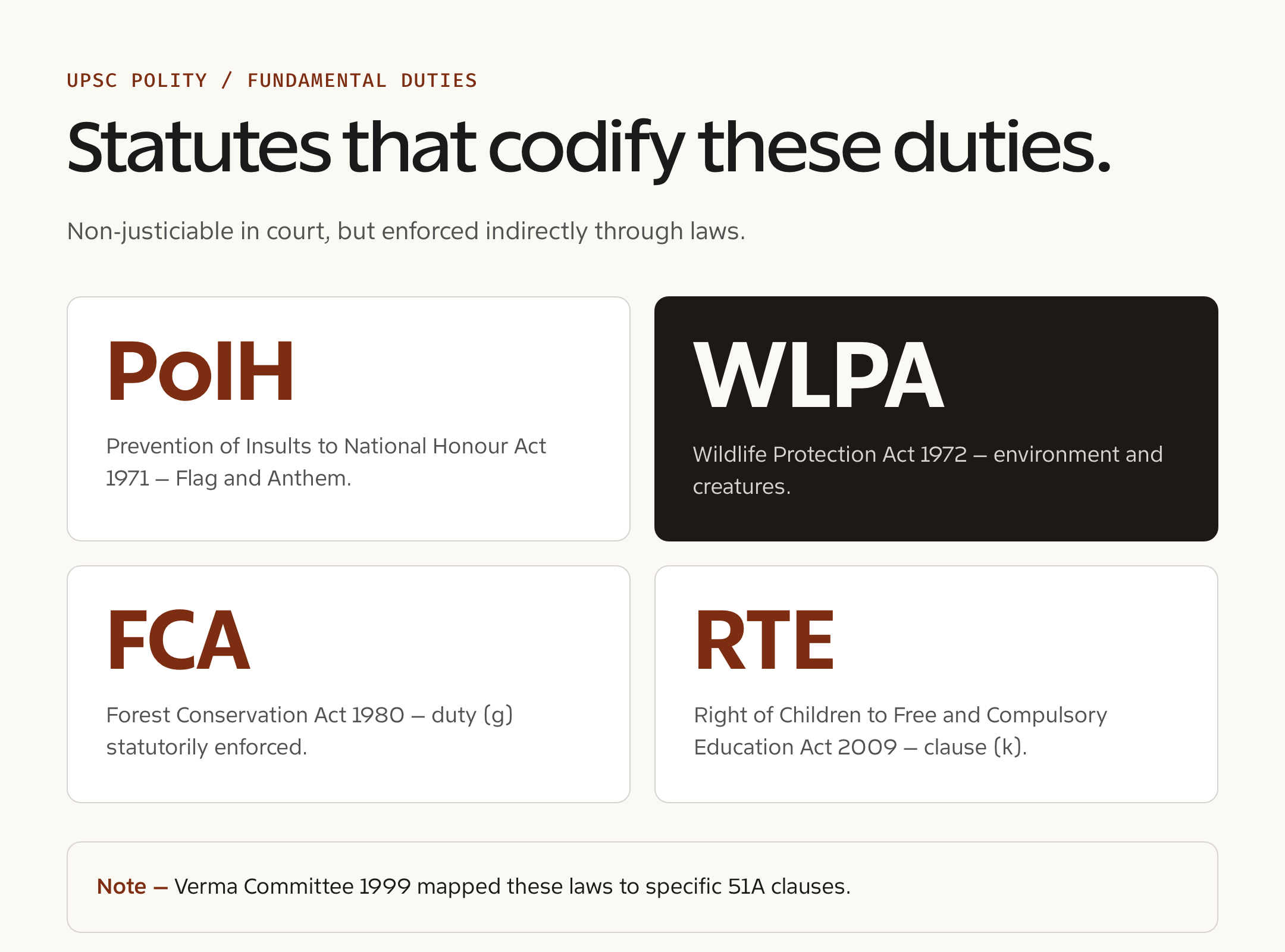
Layer 2 — Statutory enforcement. Yes — many duties have backing legislation. Parliament has enacted at least five statutes that operationalise specific duties:
- 51A(a) — Prevention of Insults to National Honour Act, 1971.
- 51A(g) — Wildlife Protection Act, 1972; Environment Protection Act, 1986; Forest Conservation Act, 1980.
- 51A(i) — Prevention of Damage to Public Property Act, 1984.
- 51A(k) — Right of Children to Free and Compulsory Education Act, 2009 (RTE).
- 51A(c) — Unlawful Activities (Prevention) Act, 1967.
Layer 3 — Interpretive use by courts. Yes — and growing. The Supreme Court in AIIMS Students’ Union v. AIIMS (2002) held that fundamental duties are equally important as fundamental rights and can be used to interpret ambiguous statutes. In the 2024 M.K. Ranjitsinh case (climate rights), the Court read 51A(g) alongside Articles 14 and 21 to recognise the right against climate-change harm.
For comparison with the rights side, study Right to Equality: Articles 14-18 of Indian Constitution and Article 21 of the Indian Constitution: Right to Life and Personal Liberty.
Verma Committee, 1999 — making duties operational
In 1998, the Supreme Court asked the Centre to clarify how it intended to operationalise fundamental duties. The Centre constituted the Justice J.S. Verma Committee the same year. The committee submitted its report in 1999.
Three Verma Committee recommendations to remember:
- Civic education — fundamental duties must be taught in schools and colleges as a structured part of the curriculum.
- Public servants — duties must guide all holders of public office; integrity, accountability, and openness should be the norm in administrative conduct.
- Statutory reinforcement — existing laws like the Wildlife Protection Act, the Civil Rights Protection Act, the Representation of People Act, and Indian Penal Code provisions should be invoked to enforce duties.
The committee identified roughly 20 existing statutes that effectively give duties under Article 51A direct legal weight. Examiners love this exact framing — they’ve asked variants in 2019 and 2022.
Significance of fundamental duties
Honestly, this is where most aspirants under-write. Significance is not just “they remind citizens of their obligations.” Six concrete points:
- Counterbalance to rights — the Constitution is no longer rights-only; citizens have responsibilities too.
- Constitutional patriotism — duties cultivate civic loyalty without resorting to coercive nationalism.
- Environmental conscience — 51A(g) became the basis for landmark green jurisprudence, from M.C. Mehta cases to the 2024 climate ruling.
- Education imperative — 51A(k) was the constitutional anchor for the RTE Act, 2009.
- Gender dignity — 51A(e) explicitly mentions renouncing practices derogatory to women — the only place in Part III/IV where such a duty is named.
- Interpretive aid for courts — the AIIMS Students’ Union (2002) and Ranjitsinh (2024) line of cases shows duties shaping rights-interpretation.
Original 10 vs current 11 — what changed
| # | Duty (clause) | Year added |
|---|---|---|
| 1 | (a) Abide by Constitution, respect Flag and Anthem | 1976 |
| 2 | (b) Cherish freedom-struggle ideals | 1976 |
| 3 | (c) Sovereignty, unity, integrity | 1976 |
| 4 | (d) Defence and national service | 1976 |
| 5 | (e) Harmony, brotherhood, women’s dignity | 1976 |
| 6 | (f) Composite culture | 1976 |
| 7 | (g) Natural environment, compassion for life | 1976 |
| 8 | (h) Scientific temper, humanism, inquiry | 1976 |
| 9 | (i) Safeguard public property, abjure violence | 1976 |
| 10 | (j) Strive for excellence | 1976 |
| 11 | (k) Education for children aged 6–14 | 2002 |
Why this matters for UPSC
For Prelims, expect at least one direct question on the article number, the amendment year, or which committee recommended duties. Common 2024–2026 trap: the question lists 11 duties and asks which was added by the 86th Amendment. Answer: 51A(k).
For Mains GS-2, the topic appears under “Indian Constitution — historical underpinnings, evolution, features, amendments, significant provisions and basic structure.” Expect 10–15 mark questions on operationalisation, justiciability, or comparison with rights.
For Essay, fundamental duties power essays on civic ethos, environmental responsibility, and constitutional patriotism. For Ethics (GS-IV), Article 51A maps cleanly to integrity, accountability, and civic virtue case studies.
For the comparative angle, see Fundamental Rights vs Directive Principles: Key Differences and Directive Principles of State Policy: Complete Guide.
Common misconceptions
- “Fundamental duties were in the original Constitution.” No. They were added by the 42nd Amendment, 1976.
- “There are 10 fundamental duties.” Outdated. The 86th Amendment, 2002, added the 11th. Current count: 11.
- “Duties cannot be enforced in any way.” Wrong. They are non-justiciable directly, but Parliament has enacted at least five statutes that operationalise them.
- “Duties apply to all persons living in India.” No. Article 51A applies only to citizens of India. Foreigners are bound by Indian law but not by Article 51A.
How to revise this in 30 minutes
- Laxmikanth, Chapter 9 — read the eleven duties verbatim. Mark each. 10 minutes.
- One-page chart — duty + statute + landmark case (where it exists). 10 minutes.
- Verma Committee + Swaran Singh Committee + 86th Amendment — three lines each, year, recommendation. 5 minutes.
- Skim 2024 SC ruling — M.K. Ranjitsinh v. UoI on climate rights, where 51A(g) was cited. 5 minutes.
Frequently Asked Questions
How many fundamental duties are there in the Indian Constitution in 2026?
Eleven. Originally 10 added by the 42nd Amendment, 1976; the 11th was added by the 86th Amendment, 2002.
Which article of the Indian Constitution lists fundamental duties?
Article 51A, in Part IV-A. It is the only article in Part IV-A.
Are fundamental duties legally binding?
Not directly. They are non-justiciable. But Parliament has enacted statutes — Wildlife Protection Act, RTE Act, Prevention of Insults to National Honour Act — that give specific duties direct legal effect.
Which committee recommended adding fundamental duties?
The Sardar Swaran Singh Committee, 1976. The Verma Committee, 1999, later recommended steps to operationalise them.
Which fundamental duty was added by the 86th Amendment?
51A(k) — the duty of parents and guardians to provide opportunities for education to children aged 6 to 14.
Where were fundamental duties borrowed from?
The framers drew the idea from the Constitution of the (then) USSR. Most other major constitutions, including the US, do not carry an explicit duties chapter.
Which fundamental duty deals with environmental protection?
Article 51A(g) — to protect and improve the natural environment including forests, lakes, rivers, wildlife, and to have compassion for living creatures.
Tell Google you want more of this.
Add Anantam IAS as a preferred sourceOne tap, and this site shows up more often in your own Top Stories, AI Overviews and AI Mode. Remove it any time.