Disclosure: this guide contains Amazon affiliate links. As an Amazon Associate, Anantam IAS earns from qualifying purchases — at no extra cost to you.
You searched for directive principles of the state policy because you want one place that maps Part IV cleanly — articles, classification, the FR vs DPSP fight, and the landmark cases that settled it. Most coaching notes still treat DPSPs as “non-justiciable, so don’t worry too much”… that’s the laziest reading possible. After Minerva Mills (1980) and I.R. Coelho (2007), DPSPs sit at the heart of every Mains question on socio-economic justice. I’ve watched aspirants drop 6 marks because they couldn’t quote Article 39(b)/(c) in a 15-mark answer on land reforms. This guide closes that gap — Articles 36–51 in order, three classification buckets, and the FR-DPSP harmony principle the SC actually applies.
What are the Directive Principles of State Policy?
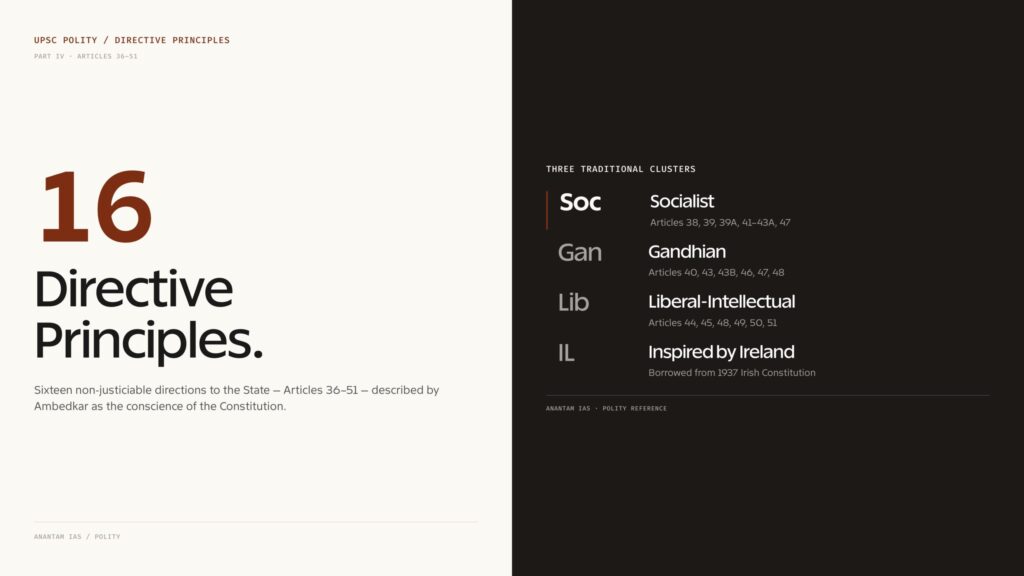
The Directive Principles of State Policy (DPSP) are guidelines for governance contained in Part IV (Articles 36–51) of the Indian Constitution. They direct the State — Union, States, local bodies — to establish a socio-economic democracy. They are non-justiciable under Article 37, meaning courts cannot enforce them directly. But the same Article 37 also calls them “fundamental in the governance of the country” and a “duty of the State”. Borrowed from the Irish Constitution (1937), which itself borrowed from Spain (1931).
- DPSP — Part IV — Articles 36 to 51 — non-justiciable but fundamental to governance.
- Source — Irish Constitution, 1937 (Article 45).
- Classification — Socialist, Gandhian, Liberal-Intellectual (academic, not constitutional).
Constitutional basis — Articles 36 to 51, in order
Read once… you’ll need this in your head for Prelims.
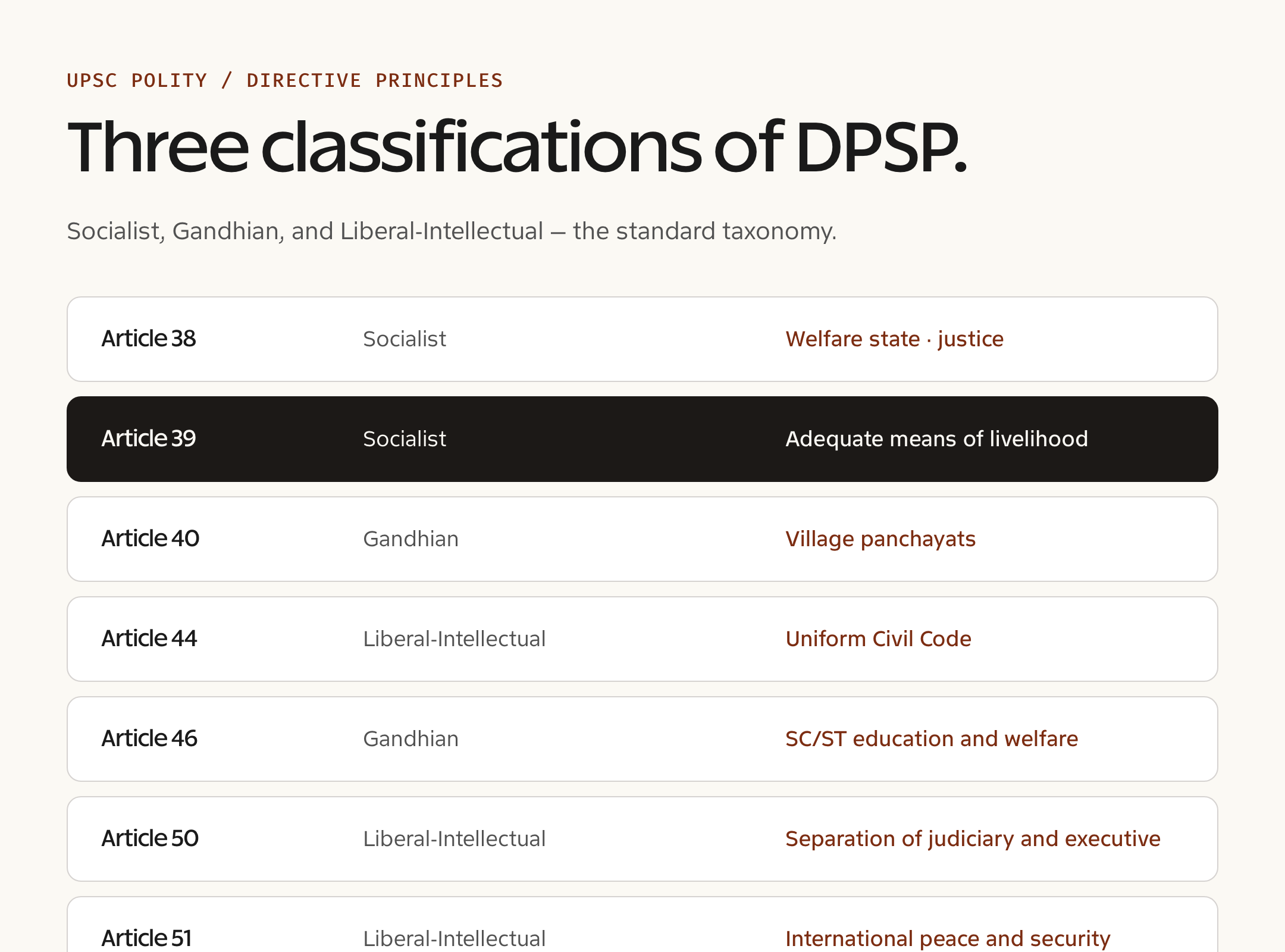
- Article 36 — Defines “State” for Part IV (same as Article 12).
- Article 37 — Application: non-justiciable, but fundamental to governance.
- Article 38 — State to secure social, economic, and political justice; minimise inequalities.
- Article 39 — Six directives, including:
- 39(a) — adequate means of livelihood for all
- 39(b) — material resources distributed to subserve common good
- 39(c) — operation of economic system not to result in concentration of wealth
- 39(d) — equal pay for equal work
- 39(e) — protection of workers’ health
- 39(f) — protection of childhood and youth
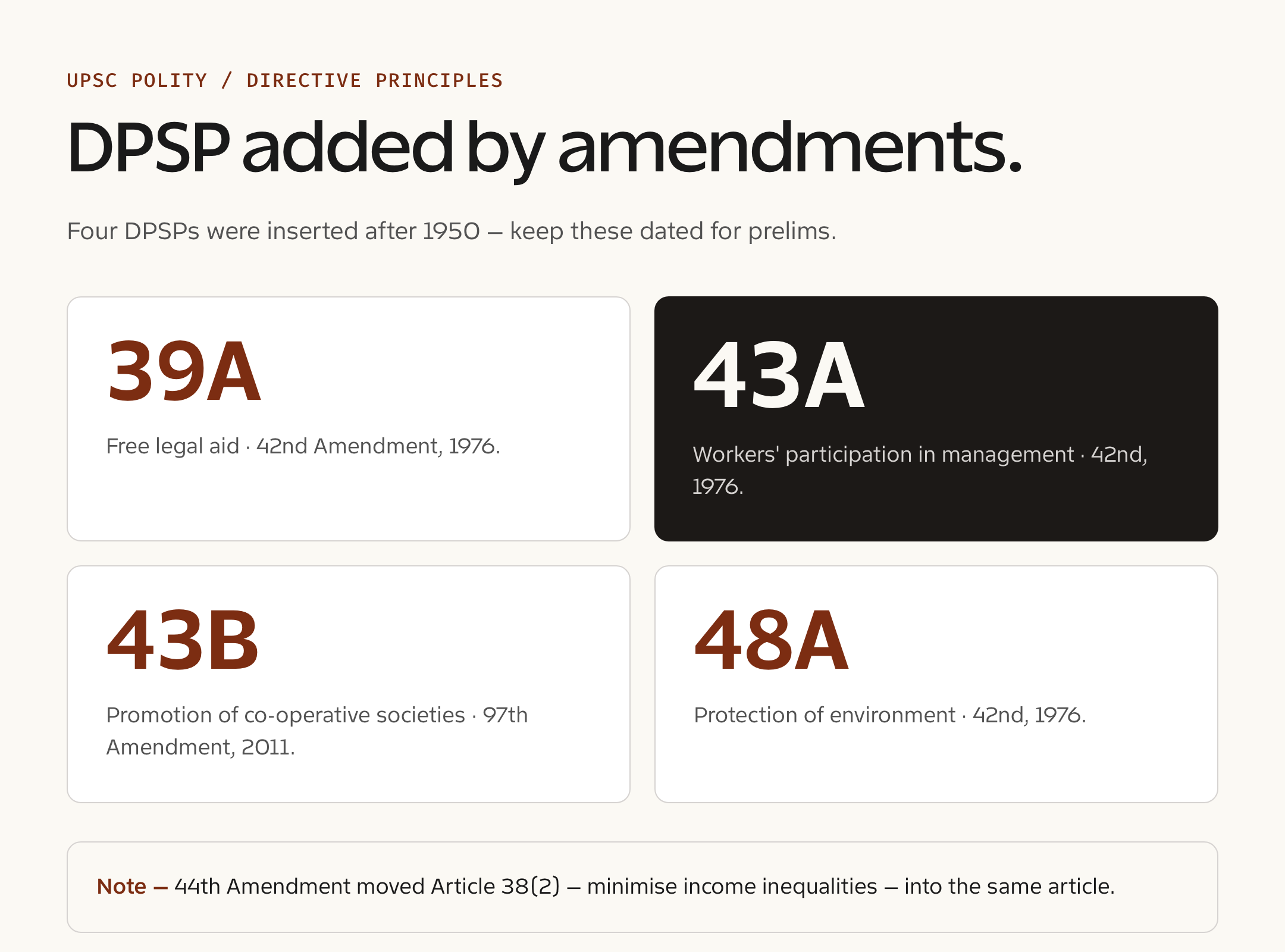
- Article 39A — Equal justice and free legal aid (added by 42nd Amendment, 1976).
- Article 40 — Organisation of village panchayats.
- Article 41 — Right to work, education, public assistance.
- Article 42 — Just and humane work conditions, maternity relief.
- Article 43 — Living wage, decent standard of life.
- Article 43A — Workers’ participation in management (42nd Amendment, 1976).
- Article 43B — Promotion of cooperative societies (97th Amendment, 2011).
- Article 44 — Uniform Civil Code.
- Article 45 — Free and compulsory education for children below 6 years (changed by 86th Amendment, 2002 — earlier covered children up to 14 years; that responsibility moved to Article 21A as a Fundamental Right).
- Article 46 — Promotion of educational and economic interests of SCs, STs, weaker sections.
- Article 47 — Raise nutrition, standard of living, public health; prohibit intoxicating drinks.
- Article 48 — Organise agriculture and animal husbandry on modern lines; ban cow slaughter.
- Article 48A — Protect environment, forests, wildlife (42nd Amendment, 1976).
- Article 49 — Protection of monuments of national importance.
- Article 50 — Separation of judiciary from executive.
- Article 51 — Promotion of international peace and security.
That’s 16 originals + four added (39A, 43A, 43B, 48A) — total 20 directives in Part IV today… and yes, examiners ask the exact count.
Classification — three buckets
The Constitution itself doesn’t classify DPSPs. The classification you’ll see in Laxmikanth and every coaching book is academic, but examiners use it.
1. Socialist Principles
Aimed at socio-economic justice and the welfare state. These reflect Nehru’s vision.
- Article 38 — minimise inequality
- Article 39 — economic justice (resources, livelihood, equal pay)
- Article 39A — free legal aid
- Article 41 — right to work and education
- Article 42 — humane work conditions
- Article 43 — living wage
- Article 43A — workers’ participation
- Article 47 — nutrition, public health
2. Gandhian Principles
Reflect Gandhi’s vision of decentralised, village-based, prohibition-and-cottage-industry India.
- Article 40 — village panchayats
- Article 43 — cottage industries (also socialist)
- Article 43B — cooperatives
- Article 46 — SC/ST/weaker sections
- Article 47 — prohibition of intoxicants
- Article 48 — cow protection / agriculture
3. Liberal-Intellectual Principles
Reflect classical liberal political theory and the independence of institutions.
- Article 44 — Uniform Civil Code
- Article 45 — early childhood education
- Article 48 — modern agriculture
- Article 48A — environment
- Article 49 — monuments
- Article 50 — separation of judiciary from executive
- Article 51 — international peace
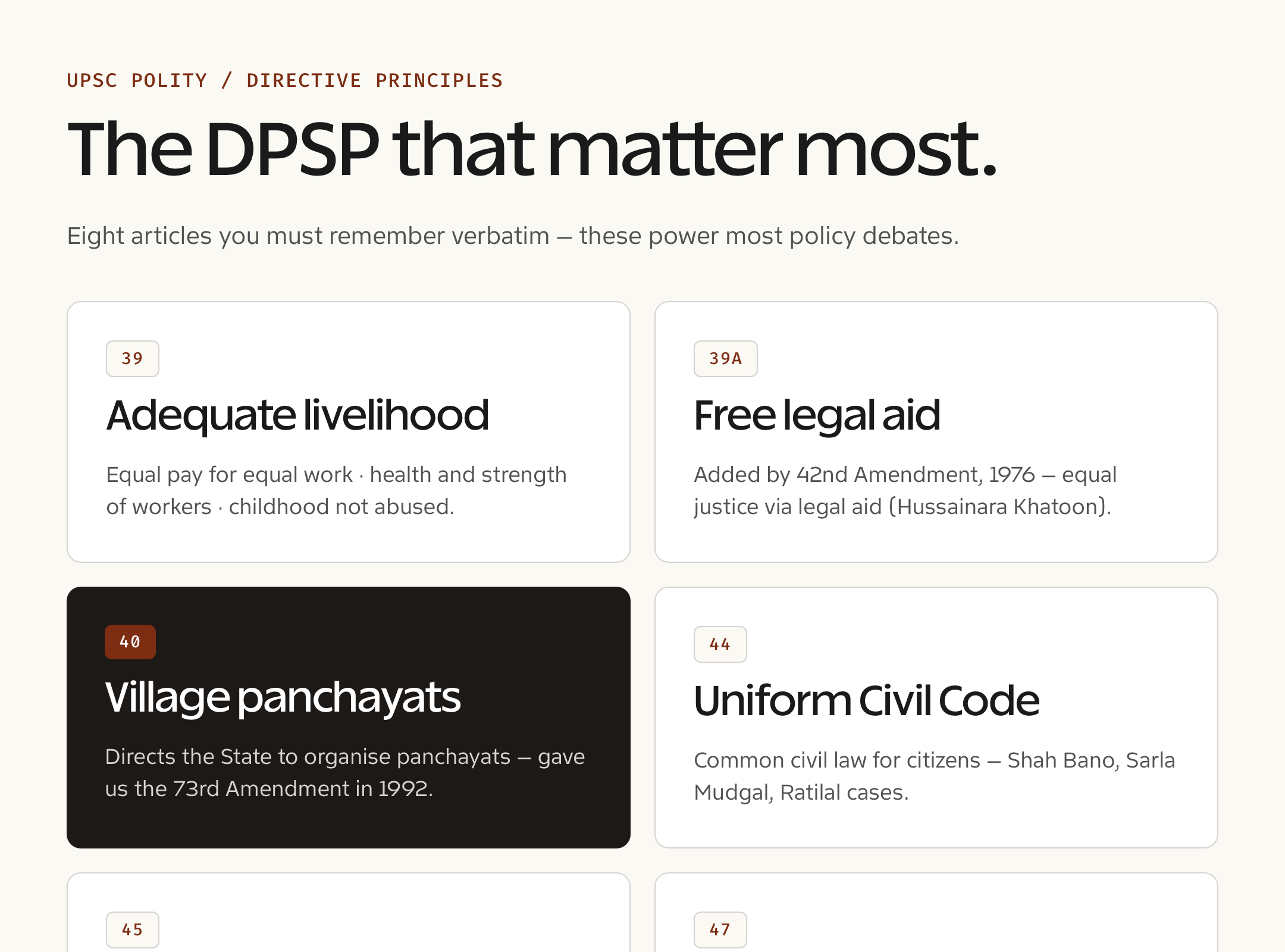
Some articles fit two buckets — that’s fine… examiners care that you can defend the bucket you put it in.
Fundamental Rights vs DPSP — the conflict and the harmony
This is the core of every Mains question. Be careful with the timeline.
Phase 1: Champakam Dorairajan (1951) — FR supreme
The SC held that DPSPs are subsidiary to Fundamental Rights. If a law passed to implement a DPSP violates an FR, the FR prevails. This led directly to the First Amendment, 1951 which inserted Article 31A and Article 31B (the Ninth Schedule).
Phase 2: Golak Nath (1967) — Parliament can’t amend FRs
A six-five bench held Parliament cannot amend Part III (Fundamental Rights). This collapsed several DPSP-driven amendments. The 24th Amendment (1971) overruled it.
Phase 3: Kesavananda Bharati (1973) — Basic Structure
Thirteen-judge bench. The court allowed Parliament to amend any part of the Constitution but not the basic structure. Importantly, it struck down the second part of Article 31C — which had said laws giving effect to Article 39(b) and (c) cannot be challenged on Articles 14, 19, 31 grounds and shall not be questioned on the ground that it does not give effect to those policies. The “no court can question” part was struck down because judicial review is part of basic structure.
Phase 4: 42nd Amendment (1976) — DPSP supreme
The Indira Gandhi government amended Article 31C to give all DPSPs (not just 39(b)(c)) primacy over Articles 14, 19, 31.
Phase 5: *Minerva Mills v. Union of India* (1980) — harmony restored
A five-judge bench struck down the 42nd Amendment’s expansion of Article 31C. Justice Y.V. Chandrachud wrote: “The Indian Constitution is founded on the bedrock of the balance between Parts III and IV. To give absolute primacy to one over the other is to disturb the harmony of the Constitution.”
The current position:
- Only Article 39(b) and 39(c) can be given primacy over Articles 14 and 19.
- Even then, judicial review survives.
- FR–DPSP harmony is part of the basic structure.
Phase 6: I.R. Coelho v. State of TN (2007) — Ninth Schedule subject to basic structure
Nine-judge bench. Held that any law placed in the Ninth Schedule after April 24, 1973 (the Kesavananda date) is open to basic-structure challenge. DPSP-driven Ninth-Schedule protection isn’t absolute.
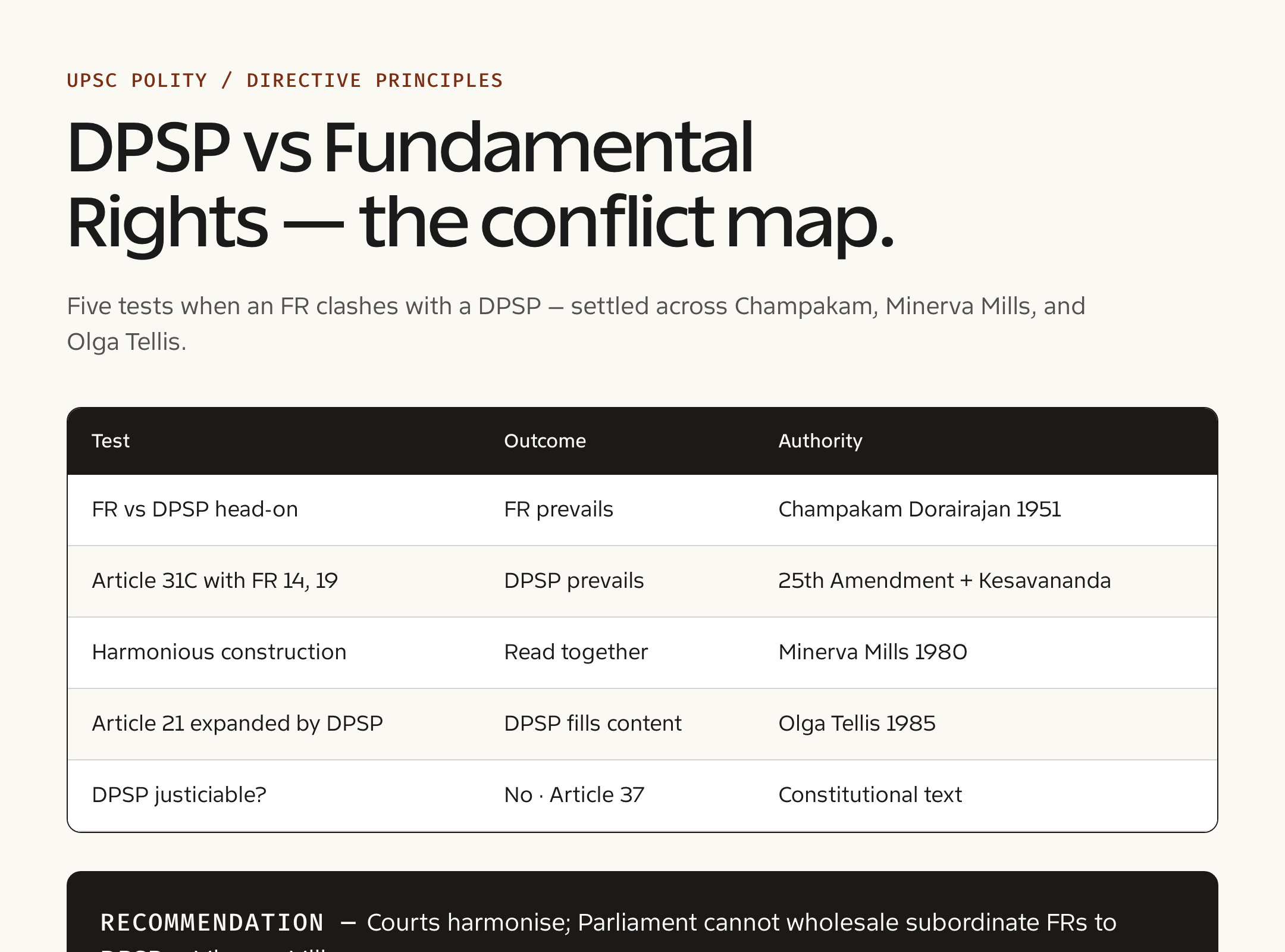
The doctrine that emerged is the harmonious construction principle — first hinted at in Re Kerala Education Bill (1957) and made formal in Minerva Mills. Courts read FR and DPSP together, not against each other.
FR vs DPSP — the comparison table
This is the table examiners want.
| Feature | Fundamental Rights | Directive Principles |
|---|---|---|
| Part | Part III (12–35) | Part IV (36–51) |
| Source | US Bill of Rights | Irish Constitution (1937) |
| Justiciable | Yes — Article 32 | No — Article 37 |
| Nature | Negative — restrains State | Positive — instructions to State |
| Aim | Political democracy | Socio-economic democracy |
| Suspension | Yes, in emergency | Cannot be suspended |
| Conflict resolution | Generally prevail (post-Minerva Mills) | Article 39(b)(c) prevail over Art 14/19 |
| Amendable | Yes, subject to basic structure | Yes |
Implementation record — what’s been done
DPSPs aren’t just paper… track the implementation. Examiners reward concrete examples.
- Article 39A — Legal Services Authorities Act, 1987 → NALSA, Lok Adalats.
- Article 40 — 73rd Amendment, 1992 → Panchayati Raj.
- Article 41 — MGNREGA, 2005; National Food Security Act, 2013.
- Article 43 — Minimum Wages Act, 1948; Code on Wages, 2019.
- Article 43B — 97th Amendment, 2011 → cooperatives as fundamental right under 19(1)(c).
- Article 44 — Uttarakhand UCC, 2024 (first state to enact). See our Uttarakhand UCC explainer.
- Article 45 — 86th Amendment, 2002 → moved 6–14 years to Article 21A as FR; left under-6 to Article 45.
- Article 47 — Prohibition policy in Gujarat, Bihar, Nagaland.
- Article 48A + 51A(g) — Forest Conservation Act, Wildlife Protection Act, NGT.
- Article 50 — Separation accomplished at the district level via the CrPC, 1973.
Why this matters for UPSC
DPSPs are unavoidable.
- Prelims — Articles 36, 37, 39(b)/(c), 40, 44, 48A, 50 — all have appeared as direct factual questions.
- Mains GS-II — “Examine the relationship between FR and DPSP.” Almost every other year.
- Mains GS-IV (Ethics) — DPSPs as moral instructions to the State.
- Essay — “Welfare state in India” / “Constitutional vision and social transformation”.
- Interview — Be ready for “Should DPSPs be made justiciable?” Don’t say a flat yes — argue both sides.
Common misconceptions
- “DPSPs are useless because they’re not justiciable.” Wrong. Article 37 makes them “fundamental in governance”. Courts use them to interpret FR (e.g., Olga Tellis, 1985 — right to livelihood).
- “DPSPs cannot be enforced.” They cannot be enforced directly. But once enacted into law, the law is enforceable. MGNREGA is enforceable; Article 41 itself is not.
- “FR always overrides DPSP.” Outdated. Post-Minerva Mills, Article 39(b)/(c) overrides Articles 14 and 19. Harmony is the rule.
- “DPSPs are part of the basic structure.” The harmony between FR and DPSP is part of basic structure (per Minerva Mills). DPSPs themselves are not.
- “Article 44 means UCC is mandatory.” Article 44 is a directive. The State should try. It is not a Fundamental Right.
How to revise this in 30 minutes
The right stack:
- Laxmikanth — Chapter on DPSP — 25 minutes. Memorise the article numbers and the 42nd Amendment changes.
- Bare Constitution — Part IV — Read Articles 36, 37, 39, 39A, 40, 44, 48A, 51 in original text. 5 minutes.
- D.D. Basu — for the Minerva Mills phrasing.
- PRS Brief on the 86th and 97th Amendments — for the Article 45 and 43B updates.
- Drishti / Vision IAS — Minerva Mills case summary — for Mains-quality writing.
Frequently Asked Questions
From which country are DPSPs borrowed?
The Irish Constitution of 1937 (Article 45). Ireland borrowed the idea from the Spanish Constitution of 1931.
Are DPSPs justiciable?
No. Article 37 explicitly says they are not enforceable by any court. But they are u0022fundamental in the governance of the countryu0022.
How many directive principles are there in the Constitution?
The original Constitution had 16 articles in Part IV. Four were added later — Article 39A (1976), Article 43A (1976), Article 48A (1976), and Article 43B (2011). Total: 20.
Which DPSP article was struck off and made a Fundamental Right?
Free and compulsory education for children aged 6–14 was moved from Article 45 to Article 21A by the 86th Amendment, 2002. Article 45 now covers under-6 only.
What is the harmonious construction doctrine?
First hinted in Re Kerala Education Bill (1957) and formalised in Minerva Mills (1980) — courts must read FR and DPSP together and avoid declaring one superior to the other.
What does Article 39(b) and 39(c) say?
39(b) — material resources of the community to be distributed to subserve the common good. 39(c) — economic system not to result in concentration of wealth and means of production. These two enjoy primacy over Articles 14 and 19 under Article 31C.
Which DPSP is most associated with Gandhi?
Article 40 (village panchayats) is the strongest Gandhian directive. Articles 43, 47, and 48 (prohibition, cottage industry, cow protection) round it out.
Tell Google you want more of this.
Add Anantam IAS as a preferred sourceOne tap, and this site shows up more often in your own Top Stories, AI Overviews and AI Mode. Remove it any time.