Disclosure: this guide contains Amazon affiliate links. As an Amazon Associate, Anantam IAS earns from qualifying purchases — at no extra cost to you.
If you’re prepping UPSC Polity, the fundamental rights of the constitution of india are the one chapter you cannot skip. Most aspirants memorise Articles 12 to 35 the night before Prelims and forget them by Mains. Then they stare at a 15-mark Article 21 question wondering why their three-line answer didn’t cross 4 marks. I’ve watched aspirants lose marks on this in three consecutive Mains years… not because they didn’t know the rights, but because they couldn’t connect the article number to a landmark case to a 2024 ruling. This guide fixes that. One read, and you’ll have the full Part III map — six categories, every article, the cases examiners love, and the 2025 climate-rights twist no coaching note has updated yet.
What are the fundamental rights of the constitution of india?
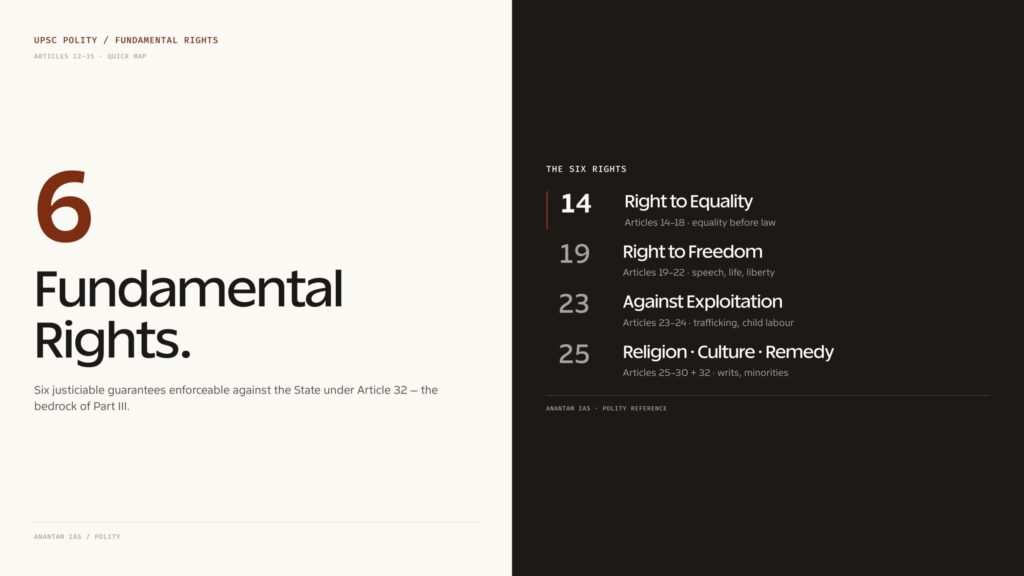
The fundamental rights of the constitution of india are six justiciable civil liberties guaranteed by Part III (Articles 12–35) of the Constitution, enforceable directly through the Supreme Court under Article 32. They protect every person — citizen and, in many cases, foreigner — against arbitrary State action, and they form what Dr B.R. Ambedkar called the “Magna Carta of Indian Constitution.”
Quick factual triples for fast recall:
- Part III — Articles 12–35 — covers fundamental rights.
- Article 12 — defines “State” — includes Union, States, local bodies, and other authorities under government control.
- Article 32 — right to constitutional remedies — Ambedkar called it the “heart and soul” of the Constitution.
- Total categories — six — after Right to Property was removed by the 44th Amendment, 1978.
- Most-cited fundamental right in Mains — Article 21 (Right to Life and Personal Liberty).
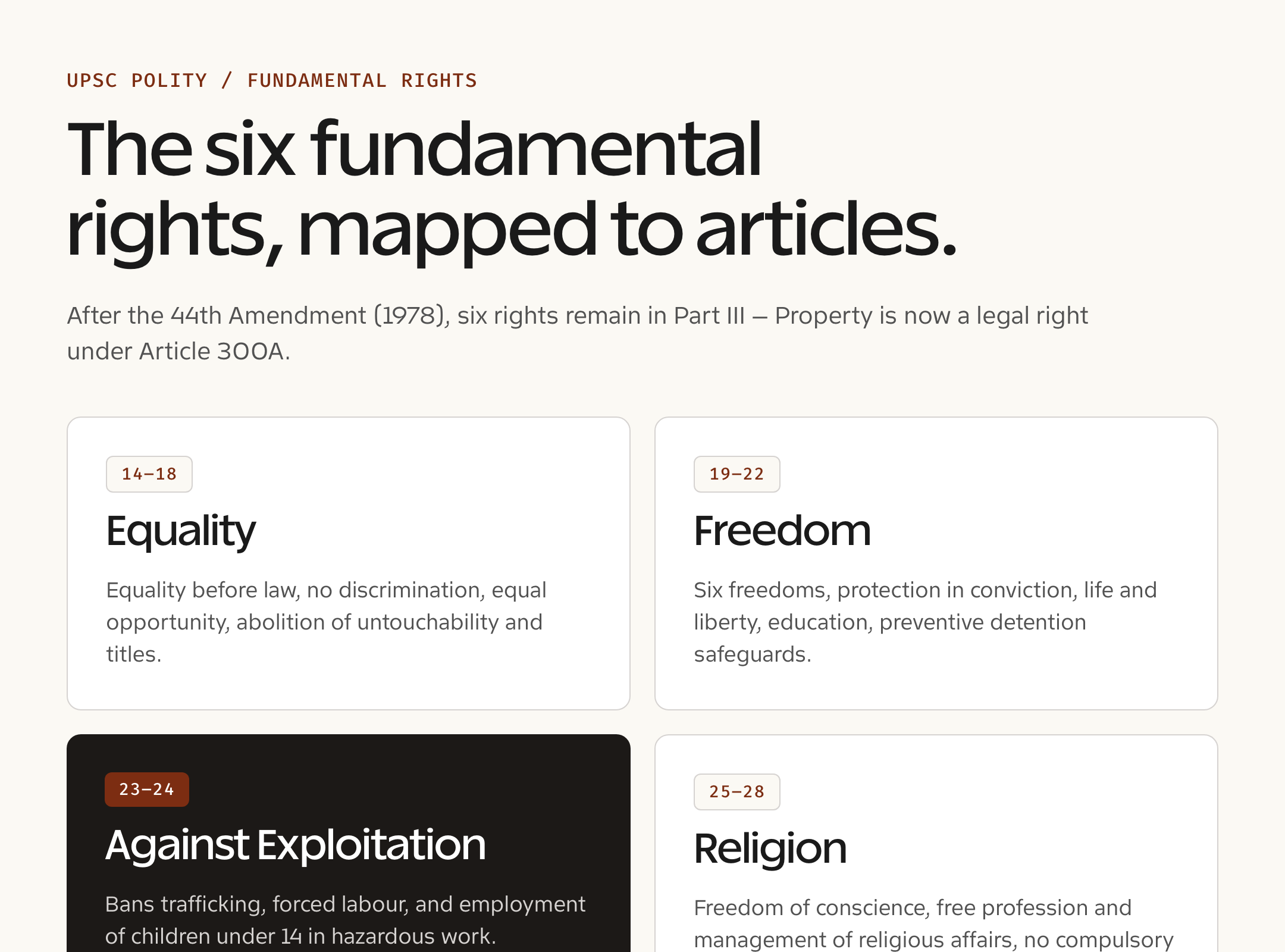
The constitutional foundation: Part III, Articles 12–35
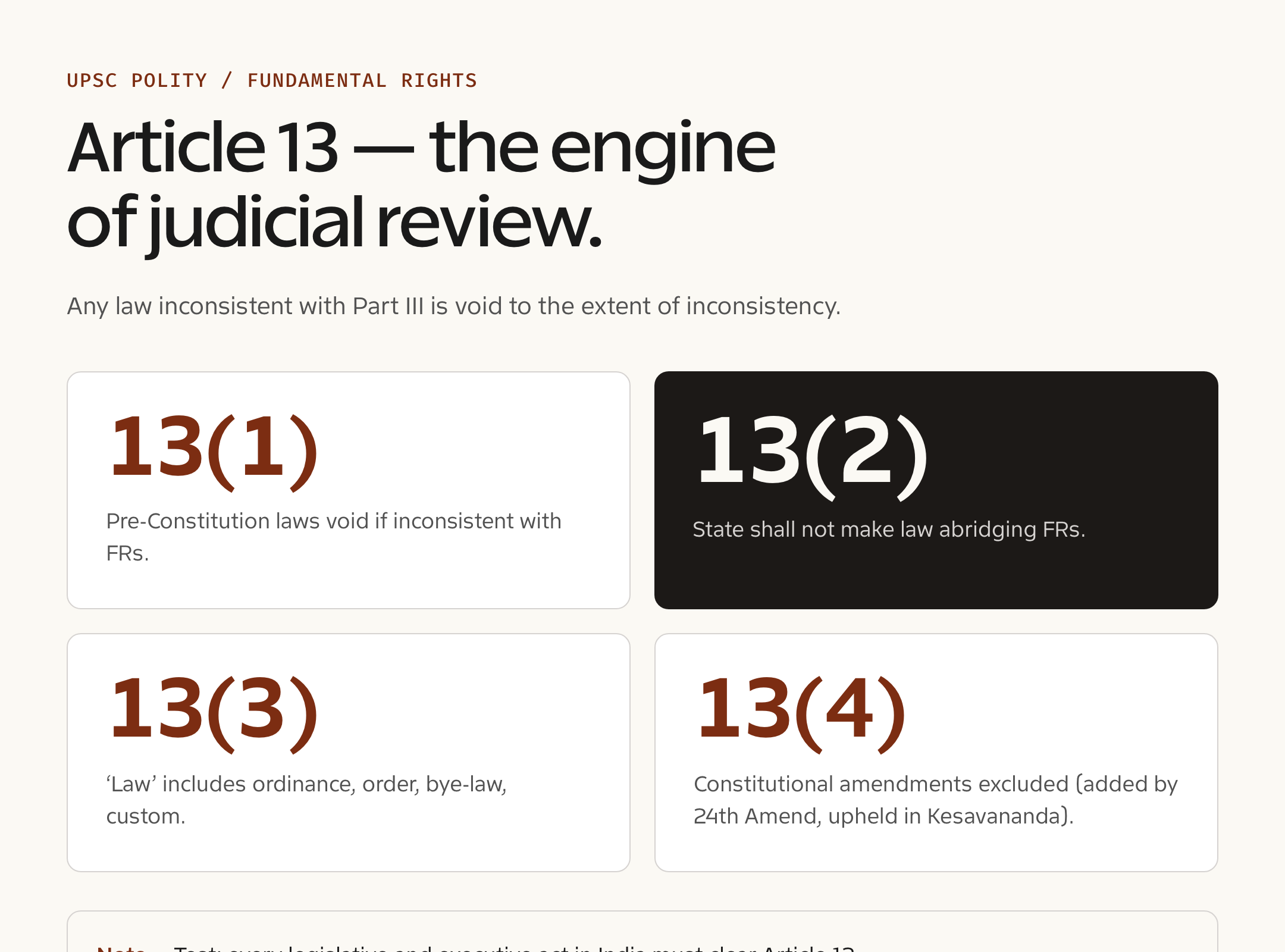
Part III sits between the Preamble and the Directive Principles (Part IV) — and that placement matters. The framers wanted enforceable rights before policy goals. Look at how Article 13 frames it: any law inconsistent with fundamental rights is void to the extent of inconsistency. That single article gave the Supreme Court the power of judicial review over Parliament itself.
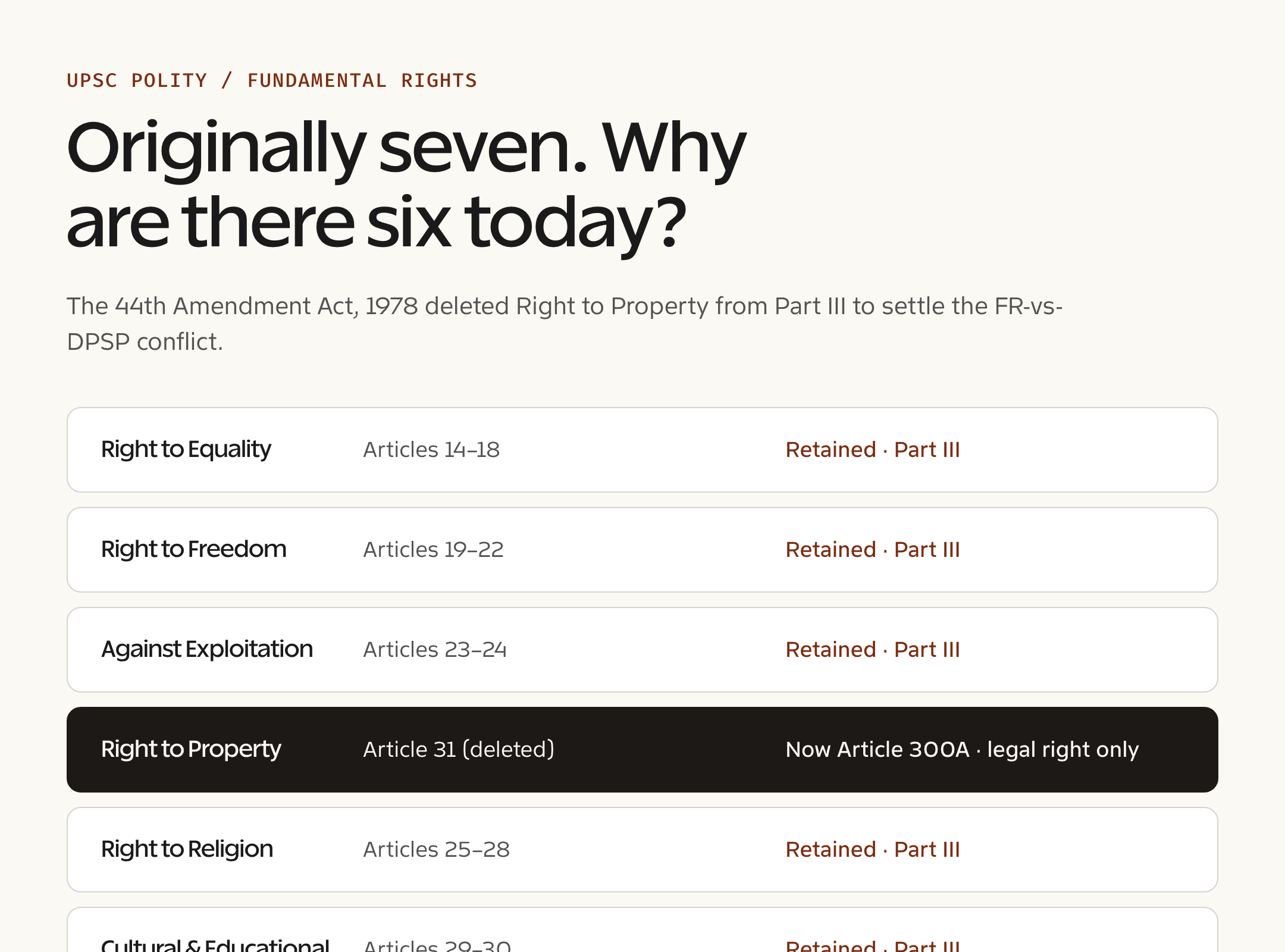
Originally, the Constitution recognised seven fundamental rights. The 44th Amendment Act, 1978 removed Right to Property from Part III and parked it as a constitutional right under Article 300A. So when someone says “there are seven fundamental rights,” they’re quoting a pre-1978 textbook. The current count, in 2026, is six.
The relationship between Part III and the rest of the Constitution is also worth pinning down. Read this alongside the Preamble of the Indian Constitution — which sets the values of justice, liberty, equality, and fraternity that Part III then operationalises.
Types of fundamental rights — the six categories
Number every list. Aspirants memorise lists.
- Right to Equality — Articles 14 to 18.
- Right to Freedom — Articles 19 to 22.
- Right against Exploitation — Articles 23 and 24.
- Right to Freedom of Religion — Articles 25 to 28.
- Cultural and Educational Rights — Articles 29 and 30.
- Right to Constitutional Remedies — Articles 32 to 35.
1. Right to Equality (Articles 14–18)
This is where most Prelims questions originate. Article 14 — equality before law and equal protection of laws — applies to all persons, not just citizens. Article 15 prohibits discrimination on grounds of religion, race, caste, sex, or place of birth (citizens only). Article 16 guarantees equal opportunity in public employment. Article 17 abolishes untouchability — and crucially, this is the only fundamental right enforceable against private individuals, not just the State. Article 18 abolishes titles.
For depth on the equality cluster, read Right to Equality: Articles 14-18 of Indian Constitution and Articles 15 and 16 of the Indian Constitution.
2. Right to Freedom (Articles 19–22)
Article 19 lists six freedoms — speech and expression, assembly, association, movement, residence, and profession. The original article had seven freedoms; right to property under 19(1)(f) was removed in 1978. Article 20 protects against ex post facto laws, double jeopardy, and self-incrimination. Article 21 — the right to life and personal liberty — has expanded more than any other fundamental right. Article 22 covers protection against arbitrary arrest and detention. For the deep dive, see Article 19 of the Indian Constitution and Article 21 of the Indian Constitution: Right to Life and Personal Liberty.
3. Right against Exploitation (Articles 23–24)
Article 23 prohibits trafficking in human beings and forced labour (begar). Article 24 bans employment of children under 14 in factories, mines, or hazardous work. Both apply against the State and private individuals.
4. Right to Freedom of Religion (Articles 25–28)
Article 25 — freedom of conscience, profession, practice, and propagation. Article 26 — freedom to manage religious affairs. Article 27 — freedom from religious taxation. Article 28 — freedom from religious instruction in wholly state-funded institutions.
5. Cultural and Educational Rights (Articles 29–30)
Article 29 protects the language, script, and culture of any minority section. Article 30 grants minorities the right to establish and administer educational institutions of their choice. The 2024 AMU verdict expanded this — the Supreme Court, in a 4:3 ruling, overruled the older five-judge bench and held that statutorily-incorporated institutions can still claim minority status.
6. Right to Constitutional Remedies (Articles 32–35)
Article 32 lets you approach the Supreme Court directly for enforcement. The Court can issue five writs — habeas corpus, mandamus, prohibition, certiorari, quo warranto. Article 33 lets Parliament modify FRs for armed forces. Article 34 covers martial law. Article 35 vests Parliament with the power to legislate on FR-related matters.
Landmark fundamental rights cases — the seven you must know
If you remember one case from this chapter, make it Kesavananda Bharati. But seven cases together cover roughly 70% of FR-related Mains questions over the last decade.
| # | Case | Year | What it settled |
|---|---|---|---|
| 1 | A.K. Gopalan v. State of Madras | 1950 | FRs read in isolation; later overruled. |
| 2 | Golaknath v. State of Punjab | 1967 | Parliament cannot amend FRs; later overruled. |
| 3 | Kesavananda Bharati v. State of Kerala | 1973 | Basic structure doctrine — Parliament can amend, but not destroy basic features. |
| 4 | Maneka Gandhi v. Union of India | 1978 | Article 21 expanded; “procedure established by law” must be just, fair, reasonable. |
| 5 | Minerva Mills v. Union of India | 1980 | Judicial review and balance between FRs and DPSPs are basic structure. |
| 6 | Justice K.S. Puttaswamy v. Union of India | 2017 | Right to privacy is a fundamental right under Article 21. |
| 7 | M.K. Ranjitsinh v. Union of India | 2024 | Right against adverse effects of climate change recognised under Articles 14 and 21. |
For the basic structure case in full depth, read Kesavananda Bharati Case (1973): Basic Structure Doctrine Explained. For the privacy line, see Right to Privacy in India — Puttaswamy, Aadhaar, DPDP Act 2023.
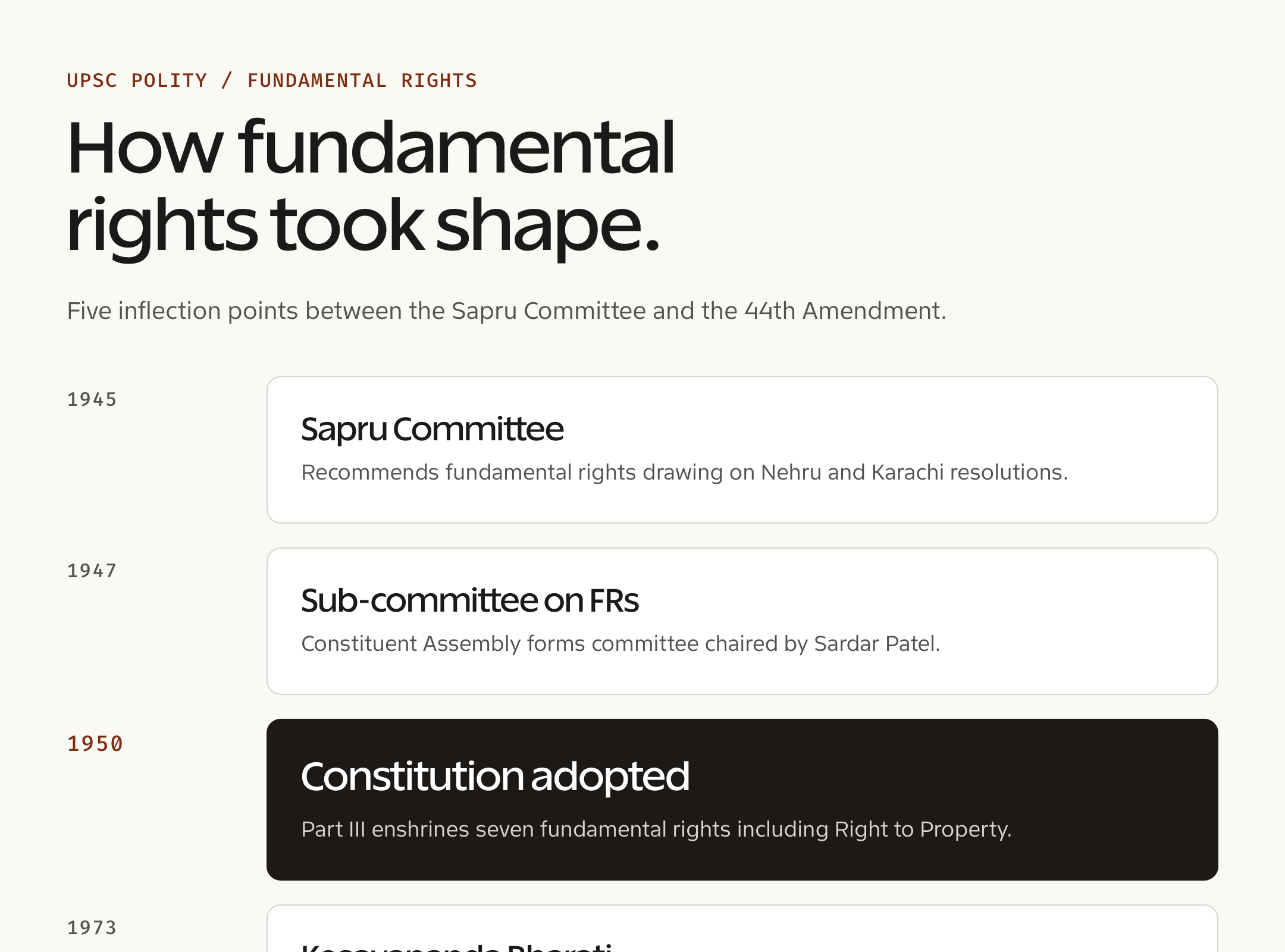
What 2024–2025 added to the FR landscape
Coaching notes printed before March 2024 are missing three big developments. Make a note.
- Climate change as a fundamental right — In M.K. Ranjitsinh v. Union of India (March 2024), the Supreme Court held that protection against the adverse effects of climate change is integral to Articles 14 and 21. This is the first time climate rights have been read into Part III.
- AMU verdict (November 2024) — The seven-judge bench overruled the 1967 Azeez Basha judgment and allowed Aligarh Muslim University to argue minority status under Article 30.
- Electoral Bonds struck down (February 2024) — In ADR v. Union of India, the Court held the Electoral Bonds Scheme violated Article 19(1)(a)’s right to information about political funding.
These three rulings will dominate Mains 2026 and 2027. Examiners love this exact framing — they’ve asked variants in 2019, 2022, and 2024.
Why this matters for UPSC
For Prelims, expect at least 2–3 direct article-number questions every year. Article 14, Article 21, and Article 32 are the most frequent. For Mains GS-2, the FR section maps directly to the syllabus phrase “Indian Constitution — historical underpinnings, evolution, features, amendments, significant provisions and basic structure.” For the Essay paper, FR cases give you ready-made introductions on liberty, equality, and judicial activism. For Interview, Kesavananda and Puttaswamy are evergreen — the panel will ask if you can defend your position with one principle.
For the FR vs DPSP comparison in Mains-answer form, see Fundamental Rights vs Directive Principles: Key Differences and Directive Principles of State Policy: Complete Guide.
Common misconceptions about fundamental rights
- “All FRs apply only to citizens.” Wrong. Articles 14, 20, 21, 22, 23, 24, 25, 27, 28 apply to all persons. Only Articles 15, 16, 19, 29, 30 are citizen-only.
- “There are seven fundamental rights.” Old textbooks say seven. After the 44th Amendment, 1978, there are six. Right to Property is now under Article 300A — a constitutional right, not fundamental.
- “FRs are absolute.” None of them are. Each carries reasonable restrictions. Article 19’s six freedoms have eight grounds of restriction listed in clauses (2) to (6).
- “Article 32 is the only way to enforce FRs.” No. High Courts under Article 226 have wider writ jurisdiction than the Supreme Court — they can issue writs for any legal right, not just FRs.
How to revise this in 30 minutes
- Open Laxmikanth, Chapter 7 — read article-numbers + categories only. 10 minutes.
- Make a one-pager — six categories, six anchor articles (14, 19, 21, 25, 30, 32), seven cases. 10 minutes.
- Read PRS Legislative Brief on the 44th Amendment — to nail Right to Property. 5 minutes.
- Skim the latest Indian Express explainer on the 2024 climate rights ruling. 5 minutes.
That’s it. Source priority: Laxmikanth → NCERT Class 11 Indian Constitution at Work → PRS → Indian Express. Skip everything else for revision.
Frequently Asked Questions
How many fundamental rights are there in the Indian Constitution in 2026?
Six. Right to Equality, Right to Freedom, Right against Exploitation, Right to Freedom of Religion, Cultural and Educational Rights, Right to Constitutional Remedies.
Which fundamental right did Ambedkar call the u0022heart and soulu0022 of the Constitution?
Article 32 — the Right to Constitutional Remedies. It allows direct approach to the Supreme Court for enforcement of FRs.
Are fundamental rights absolute?
No. Every fundamental right carries reasonable restrictions. Article 19’s freedoms have explicit grounds for limitation in sub-clauses (2) to (6).
Can fundamental rights be suspended?
Yes — during a national emergency under Article 359, except Articles 20 and 21, which cannot be suspended (44th Amendment, 1978).
Which fundamental rights are available to foreigners?
Articles 14, 20, 21, 22, 23, 24, 25, 27, and 28. Articles 15, 16, 19, 29, and 30 are citizen-only.
What is the difference between Article 32 and Article 226?
Article 32 — Supreme Court — only for enforcement of fundamental rights. Article 226 — High Courts — wider scope, covers FRs and legal rights.
What was added to fundamental rights in 2024?
Right against the adverse effects of climate change, recognised under Articles 14 and 21 in M.K. Ranjitsinh v. Union of India (March 2024).
Tell Google you want more of this.
Add Anantam IAS as a preferred sourceOne tap, and this site shows up more often in your own Top Stories, AI Overviews and AI Mode. Remove it any time.