The Vijayanagara Empire stands as the last great Hindu empire of medieval India — a 230-year political achievement that checked the southward expansion of the Delhi Sultanate and preserved a space for Brahminical culture, temple building, and classical arts at a time when much of northern India was under Sultanate and Mughal rule.
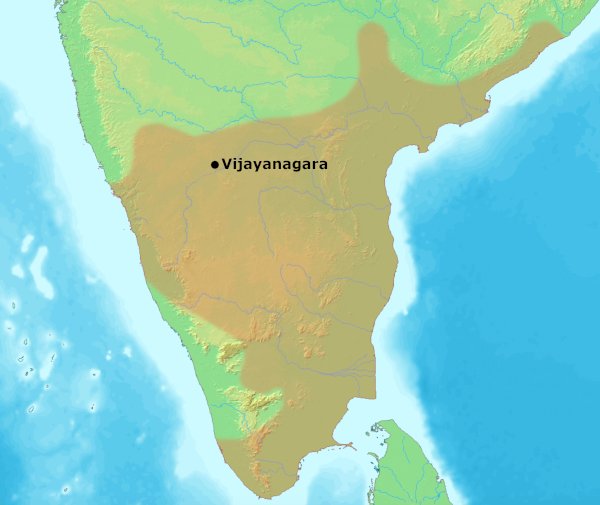
Founded in 1336 CE, it lasted until the catastrophic Battle of Talikota in 1565. At its peak under Krishnadevaraya (1509–1529 CE), it was one of the richest empires in Asia — and its capital Hampi was among the largest cities in the world.
For UPSC, Vijayanagara appears in Medieval History, Art and Culture, and sometimes in Ethics papers that discuss patronage of learning. Know the four dynasties, Krishnadevaraya’s reign, the administrative system, and the Battle of Talikota.
Founding of the Vijayanagara Empire
Origins: Harihara and Bukka
The traditional founding story is dramatic and politically significant. Harihara (also called Harihara I) and Bukka were brothers — officers, possibly of Telugu or Kannada origin — in the service of the Kakatiyas of Warangal. After the Kakatiyas were destroyed by the Delhi Sultanate under Alauddin Khilji's general Malik Kafur (1310) and by Muhammad bin Tughluq (1323), the brothers were taken to Delhi.
According to tradition, they were converted to Islam. They were then sent back south as Sultanate officers. But they reasserted Hindu identity under the influence of the sage Vidyaranya (associated with the Sringeri Matha), reconverted to Hinduism, and established an independent kingdom at Vijayanagara (City of Victory) on the south bank of the Tungabhadra River in 1336.
Harihara I ruled from 1336 to 1356 CE, establishing the capital at Hampi (in present-day Karnataka). His brother Bukka I (1356–1377) expanded the kingdom significantly, pushing against the Bahmani Sultanate to the north and the Hoysalas and Madurai Sultanate to the south.
The Tungabhadra location was strategically brilliant — the river formed a natural defensive barrier, the surrounding rocky terrain made the city difficult to assault, and the fertile plains south of the river provided agricultural wealth.
The Name "Vijayanagara"
"Vijayanagara" means "City of Victory" in Sanskrit and Kannada. The empire took its name from its capital. In Telugu, it was sometimes called Vidyanagara (City of Knowledge) — a name associated with Vidyaranya's influence.
The Four Dynasties
The Vijayanagara Empire was ruled by four successive dynasties over its 229-year history.
| Dynasty | Period | Key Rulers | Notes |
|---|---|---|---|
| Sangama | 1336–1485 CE | Harihara I, Bukka I, Deva Raya I, Deva Raya II | Founded the empire; Deva Raya II was the greatest Sangama ruler |
| Saluva | 1485–1505 CE | Saluva Narasimha, Thimma Bhupala | Short-lived; came to power through usurpation |
| Tuluva | 1505–1570 CE | Vira Narasimha, Krishnadevaraya, Achyuta Raya | Peak of the empire; Krishnadevaraya the greatest ruler |
| Aravidu | 1570–1650 CE | Tirumala, Sriranga I, Venkata II | Post-Talikota; reduced territory, capital shifted |
Sangama Dynasty (1336–1485 CE)
Deva Raya II (1424–1446 CE) was the most capable Sangama ruler after the founders. He reformed the army by recruiting Muslim archers and cavalry (acknowledging the military superiority of horse archery), built dams across the Tungabhadra, and consolidated the empire across South India. The Persian traveler Abdur Razzak visited during his reign and described Vijayanagara as one of the wonders of the world.
The Sangamas were replaced when Saluva Narasimha, a general, seized power to prevent the empire's fragmentation under weak Sangama successors.
Tuluva Dynasty and Krishnadevaraya
The Tuluva dynasty produced the greatest ruler in Vijayanagara history — Krishnadevaraya — and saw the empire at its absolute peak.
Krishnadevaraya (1509–1529 CE)
Krishnadevaraya is the defining figure of Vijayanagara history. His reign combined military genius, diplomatic skill, economic prosperity, and extraordinary cultural patronage — a combination rarely seen in Indian history.
Military Achievements
Krishnadevaraya was the dominant military power of his time in South India. His major campaigns:
- 1509 — Defeated the Bijapur Sultanate at the Battle of Diwani
- 1510 — Recaptured Raichur Doab from Bijapur (crucial for the empire's northern border and agricultural resources)
- 1512 — Defeated Bidar and forced the Bidar Sultan to become his vassal
- 1516 — Captured Udayagiri and Kondavidu from the Gajapati kingdom (Odisha), advancing into Telangana
- 1520 — Sacked Bidar again; described by contemporary sources as humiliating the Bahmani successor states
- 1523 — Campaign against the Gajapatis ended with a peace treaty; Krishnadevaraya married a Gajapati princess
He is notable for his alliance with the Portuguese — he allowed them to trade at Goa in exchange for horses and arms, recognising that quality horses from Arabia (imported through Goa) were essential for his cavalry.
Cultural Patronage: Ashtadiggajas
Krishnadevaraya was himself a distinguished poet — he wrote Amuktamalyada in Telugu, a devotional poem considered a masterpiece of Telugu literature. He was also a gifted musician and dancer.
His court hosted the Ashtadiggajas — eight celebrated Telugu poets (the "eight elephants in the eight cardinal directions"):
- Allasani Peddana — considered the greatest; wrote Manucharitra; called Andhra Kavita Pitamaha (grandfather of Telugu poetry)
- Nandi Timmana
- Madayyagari Mallana
- Dhurjati
- Ayyalaraju Ramabhadra
- Pingali Surana
- Ramarajabhushana (Bhattu Murthi)
- Tenali Ramakrishna (also called Tenali Rama — famous for his wit in folk tradition)
This level of concentrated literary patronage is comparable to Chandragupta II's Navaratnas or Akbar's court. The reign of Krishnadevaraya is called the Golden Age of Telugu literature.
Accounts of Vijayanagara Under Krishnadevaraya
Domingo Paes and Fernão Nunes — Portuguese travellers who visited during Krishnadevaraya's reign — left detailed accounts. Paes compared the city of Vijayanagara to Rome and described the king as the most feared and perfect king in all of India. He described the market streets, the festivals, the army's size, and the king's personal accessibility to petitioners.
Hampi: The Capital City
Hampi (the ruins of Vijayanagara) is today a UNESCO World Heritage Site in Karnataka. At its peak, it was one of the world's largest cities, with a population estimated between 300,000 and 500,000.
Key Structures at Hampi
Virupaksha Temple — dedicated to Shiva in his form as Virupaksha; the oldest structure at the site, predating the empire; it continues to be an active place of worship today.
Vittala Temple — the architectural masterpiece of Hampi. Its famous stone chariot (actually a chariot-shaped shrine to Garuda) is the symbol of Hampi. The temple's musical pillars (saregama pillars) — each carved pillar produces a different musical note when tapped — represent the height of Hoysala and Vijayanagara stonework.
Hazara Rama Temple — "Hazara" means thousand; the temple walls are covered with narrative friezes depicting the Ramayana and the royal processions of the Vijayanagara kings. It was the private chapel of the royal family.
Lotus Mahal — a pavilion in the zenana (women's quarters) area that combines Hindu and Indo-Islamic architectural styles — arched openings with Hindu tower forms.
Elephant Stables — a row of domed chambers where the royal elephants were housed; the domes show Deccan Sultanate architectural influence.
Administration of the Vijayanagara Empire
Central Government
The king was the supreme authority — Rayalu or Maharajadhiraja. The title used by Krishnadevaraya — Kannada Rajya Rama Ramana — emphasised his role as protector of Karnataka/Kannada country.
The central administration included:
- Pradhani (Prime Minister) — chief executive officer
- Dandanayaka (Military Commander)
- Mahanayakacharya — superintendent of feudal chiefs
- Karanakaryam — revenue and accounts
The empire was divided into provinces called Mandalas (later Rajyas), each under a governor — usually a royal prince or trusted noble. Below these were Nadus (districts) and Sthalas (sub-districts).
Nayankara System
The Nayankara system was the defining feature of Vijayanagara provincial administration. Nayakas were military commanders who were assigned land grants called Amara in exchange for maintaining a fixed number of troops and horses for the king's service. Think of it as a military-feudal arrangement.
The Nayaka paid a portion of his revenue to the centre, maintained troops, and was obligated to serve on campaign. If he failed, the grant was revoked. The system provided military manpower without the cost of a large standing army — but it also created regional powerbrokers who could become autonomous when central authority weakened.
Post-Talikota, the Nayakas became essentially independent — the Nayaka kingdoms of Tanjavur, Madurai, and Ikkeri/Keladi emerged from former Vijayanagara governors.
Trade and Economy
Vijayanagara was an extraordinarily wealthy empire. Its prosperity rested on:
- Textile trade — cotton and silk textiles were major exports
- Spice trade — pepper, cardamom, cinnamon from the Malabar coast
- Horse import — horses from Arabia and Persia, imported through Portuguese Goa and the Deccan ports, were essential for the cavalry
- Diamond mines — the Golconda region (which came under Vijayanagara influence) was the world's only known source of diamonds before the 18th century
- Temple economy — major temples functioned as economic institutions, employing thousands and managing large landholdings
Abdur Razzak described market streets in Hampi selling precious stones openly — a sign of extraordinary wealth and security.
Battle of Talikota (1565 CE)
Background
By 1565, the Vijayanagara king was Aliya Rama Raya — not a dynastic successor but the son-in-law of Krishnadevaraya and the dominant figure under the nominally ruling Aravidu dynasty. He was an able but provocative statesman who played the five Deccan Sultanates (Bijapur, Ahmadnagar, Golconda, Bidar, Berar — the successors of the Bahmani Sultanate) against each other.
But he overplayed his hand, at times supporting some Sultanates against others, humiliating Sultanate rulers, and earning their collective fear and hatred. By 1564, all five Sultanates had united against him in a coalition driven as much by religion as by politics.
The Battle
On January 23, 1565, the two armies met at Talikota (also called Rakkasa-Tangadi) near the Krishna River. The Vijayanagara army was enormous — perhaps the larger force — but it contained a critical weakness: two Muslim commanders in Rama Raya’s own army, Gilani brothers, defected to the Sultanate coalition mid-battle.
The defection triggered a rout. Aliya Rama Raya was captured and immediately beheaded by the Bijapur Sultan, Husain Nizam Shah. His head was displayed on a spear to demoralise the Vijayanagara forces — and it worked. The army collapsed.
Aftermath: Sack of Hampi
The Sultanate forces marched to Hampi and systematically destroyed it. For months, they broke temples, melted down treasures, and turned one of the world's greatest cities into the ruined landscape that exists today. The population fled. Hampi was never reoccupied as a major city.
The Aravidu dynasty survived and continued to rule from Penukonda and later Chandragiri with a much reduced territory, but Vijayanagara as an empire was effectively over. The Nayakas of Tanjavur, Madurai, and Ikkeri became independent kingdoms.
Legacy of the Vijayanagara Empire
The Vijayanagara Empire's legacy is substantial:
- Preservation of South Indian temple tradition — the elaborate Dravidian temple style with its towering gopurams (gateway towers) reached its fullest development under Vijayanagara patronage
- Telugu and Kannada literature — the empire was the greatest patron of Telugu and Kannada literary culture
- Nayaka kingdoms — the successor Nayaka states continued to patronise arts and build temples (Tanjavur, Madurai)
- Trade networks — established trade relationships with Portuguese, Arab, and Persian merchants that influenced the region's integration into global trade
Frequently Asked Questions About the Vijayanagara Empire
Who founded the Vijayanagara Empire and when?
The Vijayanagara Empire was founded in 1336 CE by Harihara I and his brother Bukka I of the Sangama dynasty. According to tradition, they were influenced by the sage Vidyaranya to reassert their Hindu identity and establish an independent kingdom on the banks of the Tungabhadra River at the site of present-day Hampi in Karnataka.
What were the four dynasties of the Vijayanagara Empire?
The four dynasties were: Sangama (1336–1485 CE, the founders), Saluva (1485–1505 CE, a short usurper dynasty), Tuluva (1505–1570 CE, the most powerful — produced Krishnadevaraya), and Aravidu (1570–1650 CE, post-Talikota decline).
Why is Krishnadevaraya considered the greatest Vijayanagara ruler?
Krishnadevaraya (1509–1529 CE) combined military dominance — defeating all his neighbours, recovering the Raichur Doab, humiliating the Deccan Sultanates — with extraordinary cultural patronage of the Ashtadiggajas (eight great Telugu poets) and personal literary achievement (Amuktamalyada). His reign was the empire's political, economic, and cultural peak.
What happened at the Battle of Talikota?
On January 23, 1565, a coalition of five Deccan Sultanates defeated the Vijayanagara army near Talikota. The decisive moment was the mid-battle defection of two Muslim commanders in Vijayanagara's army. Aliya Rama Raya was captured and beheaded. The victorious Sultanates then sacked and destroyed Hampi, ending Vijayanagara's role as a major power.
What is the Nayankara system?
The Nayankara system was the Vijayanagara Empire's method of provincial administration. Nayakas were military commanders granted land (Amara grants) in exchange for maintaining troops and horses for the king's campaigns. It was a military-feudal arrangement that provided manpower efficiently but created semi-autonomous regional powers who became independent Nayaka kingdoms after the Battle of Talikota.
Tell Google you want more of this.
Add Anantam IAS as a preferred sourceOne tap, and this site shows up more often in your own Top Stories, AI Overviews and AI Mode. Remove it any time.