Delhi Sultanate: Dynasty Timeline & Administration
The Delhi Sultanate lasted from 1206 to 1526 CE — 320 years of Turkish, Afghan, and Central Asian rule over much of north India. It was the first substantial Islamic political power in the subcontinent, and it transformed Indian politics, culture, architecture, and society in ways that still shape India today.
Five dynasties ruled: Slave, Khilji, Tughlaq, Sayyid, and Lodi. Each had distinct characteristics, and each produced rulers worth studying individually. The period also saw the Mongol invasions — repeated attacks that the Sultanate repelled, arguably saving the subcontinent from the devastation that hit Persia and Central Asia.
For UPSC Medieval History, the Delhi Sultanate is heavily tested. Know all five dynasties, the key rulers (especially Iltutmish, Razia, Alauddin Khilji, Muhammad bin Tughlaq), the administrative system, and the market reforms.
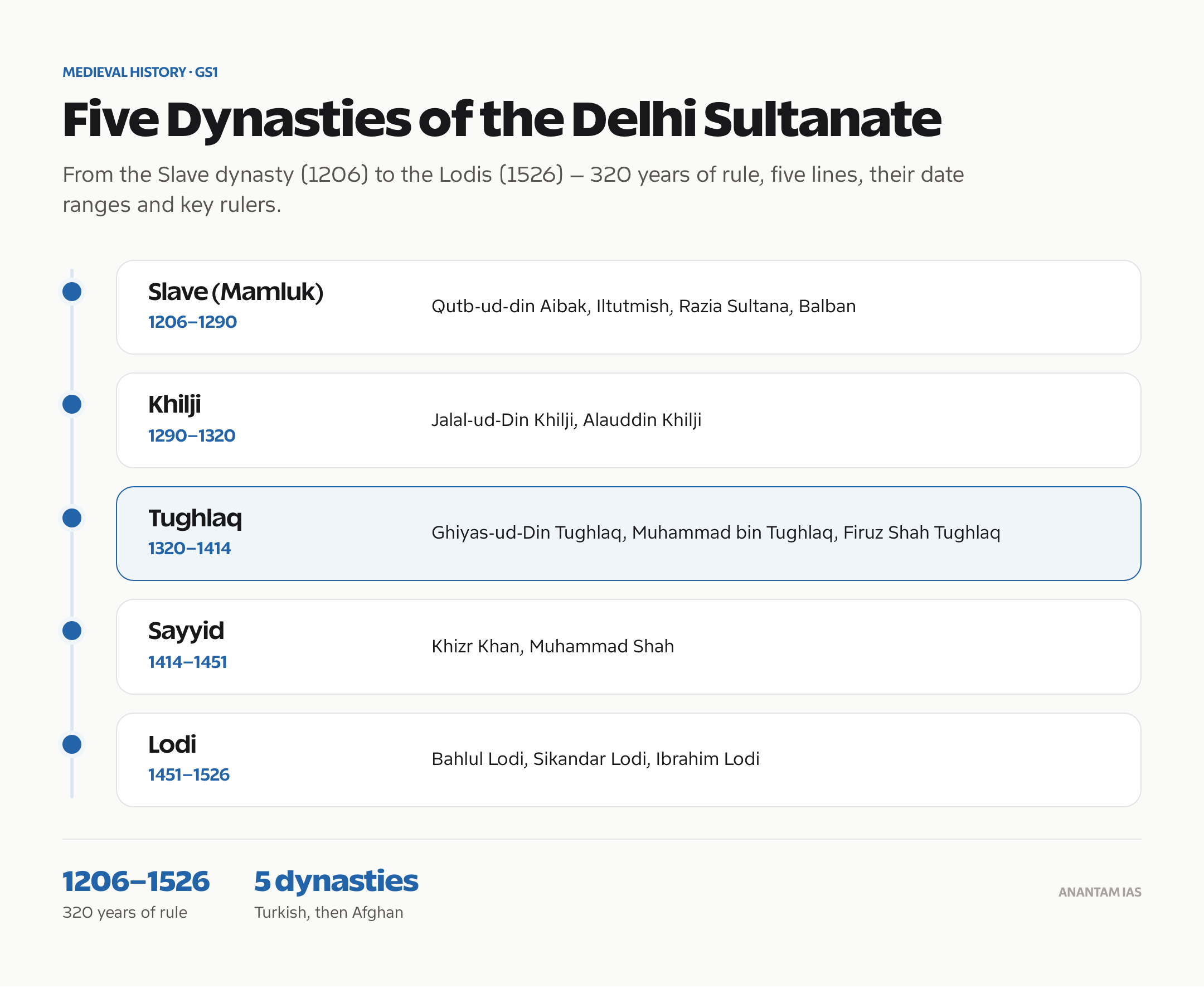
Overview of Five Dynasties
| Dynasty | Period | Key Rulers |
|---|---|---|
| Slave (Mamluk) | 1206–1290 | Qutb-ud-din Aibak, Iltutmish, Razia Sultana, Balban |
| Khilji | 1290–1320 | Jalal-ud-Din Khilji, Alauddin Khilji |
| Tughlaq | 1320–1414 | Ghiyas-ud-Din Tughlaq, Muhammad bin Tughlaq, Firuz Shah Tughlaq |
| Sayyid | 1414–1451 | Khizr Khan, Muhammad Shah |
| Lodi | 1451–1526 | Bahlul Lodi, Sikandar Lodi, Ibrahim Lodi |
Dynasty 1: Slave (Mamluk) Dynasty (1206–1290)
Qutb-ud-din Aibak: Founder (1206–1210)
Qutb-ud-din Aibak was a slave (mamluk) of Muhammad of Ghor, who had conquered large parts of north India. When Muhammad of Ghor died in 1206, Aibak declared independence and established the Delhi Sultanate with his capital at Lahore, later Delhi.
He began construction of the Qutb Minar in Delhi and the Quwwat-ul-Islam Mosque (the first mosque to be built in India after the conquest). He was known as Lakh Baksh (“Giver of Lakhs”) for his generosity. He died in 1210 from a fall from his horse during a polo match.
Iltutmish: The Real Consolidator (1211–1236)
Shams-ud-Din Iltutmish was Aibak’s son-in-law and is genuinely regarded as the effective founder of the Delhi Sultanate — he consolidated what Aibak had begun.
Key achievements:
- Moved the capital to Delhi from Lahore
- Completed the Qutb Minar (Aibak had built only the base)
- Received the Letter of Investiture from the Caliph of Baghdad (1229) — giving the Delhi Sultanate formal legitimacy in the Islamic world
- Repelled the Mongols under Genghis Khan — Iltutmish wisely refused to give refuge to the Khwarezm prince that Genghis Khan was pursuing, avoiding Mongol attack
- Established the iqta system — revenue assignments to nobles in lieu of salary (the predecessor to the Mughal Jagir)
- Currency reform — established the standard silver tanka and copper jital
- Organised the Chalisa (Group of Forty) — a body of 40 Turkish nobles who were the political elite
Razia Sultana (1236–1240)
Razia Sultana was the first and only female ruler of the Delhi Sultanate. Iltutmish specifically nominated her as successor over his sons, recognising her superior capability.
She was competent but faced entrenched opposition from Turkish nobles who resented being ruled by a woman. She dispensed with purdah and held court without a veil, appointed an Abyssinian slave Malik Yakut to a senior position (creating jealousy), and tried to rule independently rather than through the nobles.
She was deposed in 1240 and died shortly after. Her reign lasted only about 3.5 years — cut short by noble factionalism, not incompetence.
Balban: Iron Fist (1266–1287)
Ghiyas-ud-Din Balban is the third major figure of the Slave dynasty. He had been a member of the Chalisa, wielded effective power through various titles during previous reigns, and finally became Sultan in 1266.
His most significant characteristic was his theory of kingship:
- The king is the Shadow of God (zill-i-Ilahi) — a divine institution requiring absolute obedience
- The king must maintain awe and distance (haibat) from subjects — no mixing, no informality
- He abolished the Chalisa — the nobles’ group — precisely because it implied collective power that diluted royal authority
He maintained a strong Persian-influenced court, enforced strict discipline, and suppressed Bengal’s rebellious nobles — his own son’s revolt was put down and the governor of Bengal killed.
His spy network (barid) was extensive. He placed spies in every province to monitor governors.
He repelled Mongol invasions in the northwest — his son Muhammad (the “beloved son” of Balban’s court poets) was killed fighting the Mongols in 1285, which broke Balban. He died in 1287.
Dynasty 2: Khilji Dynasty (1290–1320)
Jalal-ud-Din Khilji (1290–1296)
The Khilji dynasty represented a shift — from Turkish to a mixed Turkish-Afghan power base. Jalal-ud-Din was elderly when he took the throne and relatively mild by the standards of the time. He was murdered by his nephew and son-in-law, Alauddin, in 1296.
Alauddin Khilji: The Market Reformer (1296–1316)
Alauddin Khilji is one of the most remarkable rulers in medieval Indian history — a military genius, an administrative innovator, and a ruthless authoritarian. He expanded the Sultanate to its greatest extent to that point and implemented policy experiments unprecedented in the period.
Military achievements:
- Conquered Gujarat (1299), Rajputana (Chittor 1303, Ranthambore 1301, Mewar 1313)
- Defeated Mongol invasions four times — the most sustained and successful resistance to Mongol attacks in Indian history
- Sent Malik Kafur on campaigns to the Deccan (1307–1313), extracting tribute from Warangal, Hoysala, and Pandya kingdoms
Market Reforms (Reforms of Alauddin):
Alauddin’s market control system is his most discussed administrative experiment. He established three markets in Delhi:
- Grain market (Shahana-i-Mandi) — controlled grain and food prices
- Cloth, cattle, horses market — fixed prices for horses (critical for cavalry), cattle, cloth
- General goods market — miscellaneous commodities
Control mechanisms:
- Fixed prices across markets — no deviation allowed
- Controller of the market (Shahana) in each market, responsible for prices
- Intelligence officers (Munhiyans) who reported secretly on violations
- Severe punishment for violations — hands cut off for merchants who sold at above-fixed prices
- Soldiers’ grain was distributed at fixed prices to maintain an affordable army
Purpose: Alauddin maintained a large, cheap standing army. By fixing grain and commodity prices, he could pay soldiers less in currency and still maintain their purchasing power. It was a fiscal policy as much as an economic one.
Land revenue: He increased land revenue to half of produce, removed all allowances from village headmen (khuts and muqaddams), and personally supervised the revenue administration with unusual attention.
Prohibition: He banned wine and intoxicants in Delhi — unusually strict for the period.
Alauddin’s reforms worked because of his personal control and terror. After his death in 1316, the market system collapsed — no successor had the administrative will or capacity to maintain it.
Dynasty 3: Tughlaq Dynasty (1320–1414)
Ghiyas-ud-Din Tughlaq (1320–1325)
Ghiyas-ud-Din Tughlaq founded the dynasty and is notable for administrative reform — he tried to moderate Alauddin’s harsh land revenue system, making demands more reasonable. He died when a pavilion collapsed during a celebration (suspicious circumstances; his son Muhammad may have arranged it).
Muhammad bin Tughlaq: The Brilliant Eccentric (1325–1351)
Muhammad bin Tughlaq is medieval India’s most intellectually interesting and practically catastrophic ruler. He was educated, curious, personally brave, and possessed of a bureaucratic imagination — but his schemes failed spectacularly, often because he implemented them too quickly or without adequate preparation.
Major experiments:
1. Transfer of the capital to Daulatabad (1327): Muhammad ordered the entire population of Delhi — hundreds of thousands of people — to relocate to Daulatabad (Devagiri) in the Deccan, roughly 1,100 km away. The rationale was geographic centrality — Daulatabad was more centrally located in the Sultanate’s territory than Delhi.
The relocation was botched — inadequate planning for food, water, and shelter along the route caused enormous suffering and deaths. Within a few years, he ordered the capital moved back to Delhi. Both relocations were traumatic for the population.
2. Token Currency (1329): He introduced copper and brass token coins intended to have the same value as silver coins. This was a proto-paper-money experiment — sound in theory if the state maintained the exchange and prevented forgery. In practice, the state could not prevent large-scale counterfeiting, and the token coins flooded the market, causing the silver coins to disappear (Gresham’s Law in action). He eventually withdrew the tokens and repaid them in silver — at enormous cost to the treasury.
3. Taxation in the Doab: He raised taxes in the fertile Doab region (between the Ganges and Yamuna), apparently to fund his expensive schemes. A famine occurred simultaneously. The combination drove cultivators from the land, causing agricultural collapse and exacerbating the treasury’s problems.
4. Khorasan and Qarachil Campaigns: He assembled enormous armies for campaigns in Khorasan (Afghanistan/Persia) and the Qarachil region (Kumaon hills) that failed and cost huge resources.
Ibn Battuta — the Moroccan traveler who spent several years in the Sultanate — wrote extensively about Muhammad’s reign, describing his generosity alongside his cruelty. Muhammad executed freely, often for perceived insults. But he also gave lavishly and promoted scholars and craftsmen.
Firuz Shah Tughlaq (1351–1388)
After Muhammad’s death, Firuz Shah Tughlaq undid many of his predecessor’s reforms — abolishing extra taxes, restoring traditional privileges of nobles and village headmen, and generally governing more conservatively.
He was a builder: he founded Firozabad (now part of Delhi) and built numerous mosques, hospitals, and irrigation canals. He also compiled an early account of archaeological sites and was interested in Indian languages.
His weakness was indulgence of the nobility — he allowed them autonomy that gradually undermined central control. After his death in 1388, the dynasty fragmented.
Timur’s Invasion (1398): Timur (Tamerlane) invaded India in 1398 and sacked Delhi with extraordinary brutality — the city was set on fire, populations massacred. The Tughlaq dynasty was effectively finished. The Sultanate never recovered its pre-Timur strength.
Dynasty 4: Sayyid Dynasty (1414–1451)
The Sayyid dynasty was founded by Khizr Khan, who had served as Timur’s governor of Multan and claimed descent from the Prophet — hence “Sayyid.” But in practice, the Sayyids were vassals of the Timurids and ruled a much-reduced Delhi region, not an empire.
Four rulers in four decades; none achieved significant consolidation. The last Sayyid ruler, Alam Shah, voluntarily surrendered power to Bahlul Lodi in 1451.
Dynasty 5: Lodi Dynasty (1451–1526)
Bahlul Lodi (1451–1489)
Bahlul Lodi was the first Afghan ruler of the Delhi Sultanate — previous dynasties were Turkish. He consolidated the Sultanate by incorporating eastern UP and Bihar, treating Afghan nobles as equals rather than slaves — a different political culture from the Turkish-dominated earlier period.
Sikandar Lodi (1489–1517)
Sikandar Lodi was an able administrator and expanded the Sultanate into Bihar and Bengal. He founded Agra in 1504 (or moved the capital there), which became the Mughal capital later. He was religiously orthodox and ordered destruction of some Hindu temples.
He also systematised the gaz-i-Sikandar — a standard unit of measurement for land.
Ibrahim Lodi (1517–1526): The End
Ibrahim Lodi was arrogant, autocratic, and unable to manage his Afghan nobles. His high-handedness alienated the nobility, including Daulat Khan Lodi (governor of Punjab) and Alam Khan (Ibrahim’s uncle), both of whom invited Babur to invade.
Ibrahim was defeated and killed at the First Battle of Panipat (April 21, 1526), ending the Delhi Sultanate and beginning the Mughal Empire.
Administration of the Delhi Sultanate
Central Administration
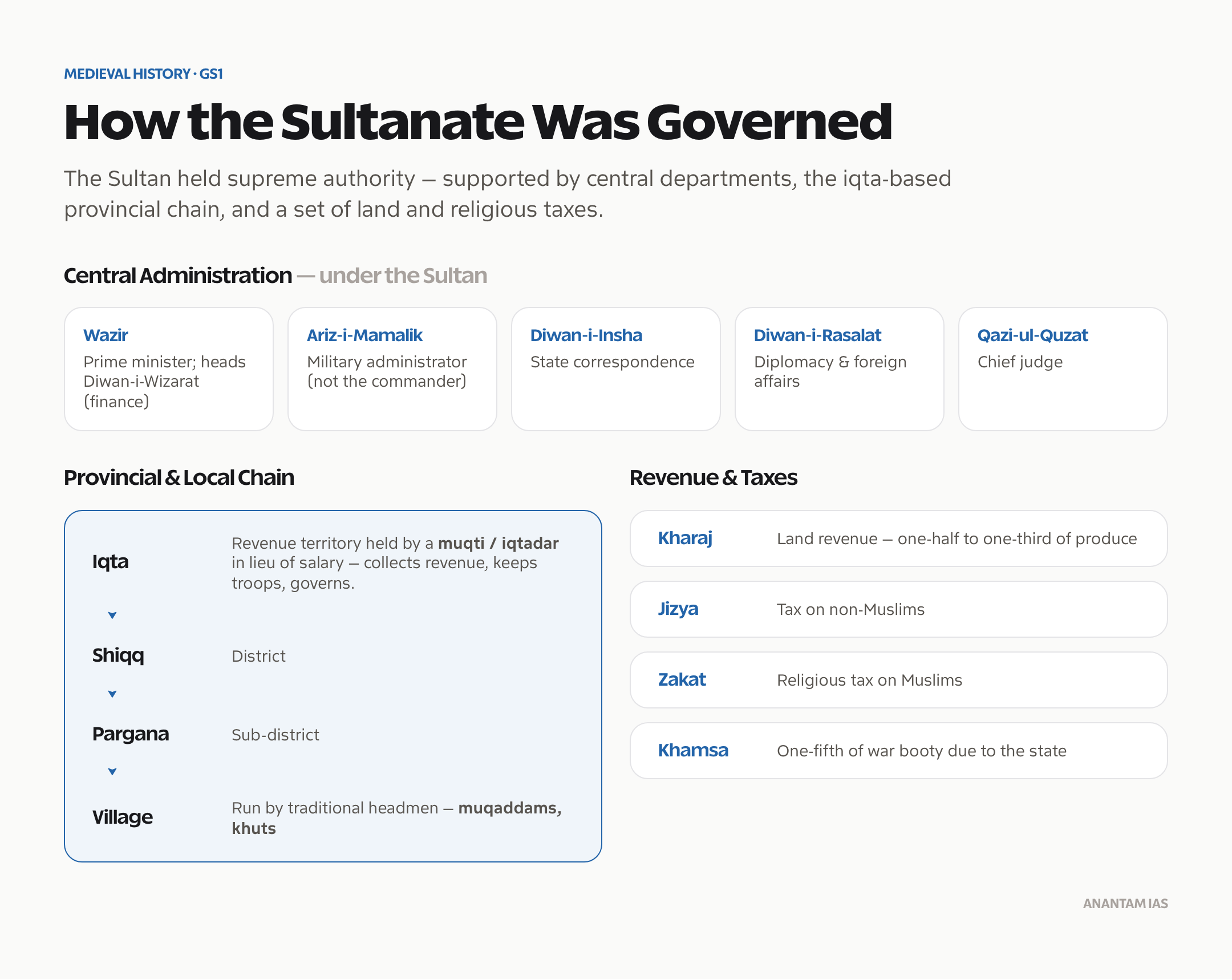
The Sultan was the supreme authority. Below him:
- Wazir — prime minister; head of the Diwan-i-Wizarat (finance department)
- Ariz-i-Mamalik — military department head; not commander but military administrator
- Diwan-i-Insha — correspondence department
- Diwan-i-Rasalat — diplomatic correspondence; foreign affairs
- Qazi-ul-Quzat — chief judge
Provincial and Local Administration
The Sultanate divided into Iqtas — revenue-bearing territories assigned to officials in lieu of salary. The holder (muqti or iqtadar) collected revenue, maintained troops, and governed the territory. This was the Sultanate’s version of the Jagir — and it had similar problems: muqtis tended to become autonomous the longer they held a territory.
Below the Iqta were districts (shiqq), sub-districts (pargana), and villages. Village administration was largely left to traditional headmen (muqaddams, khuts).
Revenue
The primary taxes:
- Kharaj — land revenue; typically one-half to one-third of produce
- Jizya — tax on non-Muslims (though some Sultans, notably Akbar later, abolished it)
- Zakat — religious tax on Muslims
- Khamsa — one-fifth of war booty due to the state
Architecture
The Delhi Sultanate produced some of India’s most significant architecture:
| Monument | Builder | Location | Style |
|---|---|---|---|
| Qutb Minar | Aibak (begun), completed by Iltutmish | Delhi | Indo-Islamic |
| Quwwat-ul-Islam Mosque | Aibak | Delhi | Earliest mosque in India |
| Tomb of Iltutmish | Iltutmish | Delhi | First dome in India |
| Alai Darwaza | Alauddin Khilji | Delhi (Qutb complex) | True arch and dome |
| Tughlaqabad Fort | Ghiyas-ud-Din Tughlaq | Delhi | Military fort |
| Tomb of Ghiyas-ud-Din | Muhammad bin Tughlaq | Delhi | |
| Firoz Shah Kotla | Firuz Shah Tughlaq | Delhi | Fort complex |
The Qutb Minar (72.5 metres) is the tallest brick minaret in the world and a UNESCO World Heritage Site.
Frequently Asked Questions
What are the five dynasties of the Delhi Sultanate?
The five dynasties are: (1) Slave/Mamluk Dynasty (1206–1290) — founded by Qutb-ud-din Aibak; (2) Khilji Dynasty (1290–1320) — most famous for Alauddin Khilji; (3) Tughlaq Dynasty (1320–1414) — includes Muhammad bin Tughlaq; (4) Sayyid Dynasty (1414–1451) — short-lived post-Timur rulers; and (5) Lodi Dynasty (1451–1526) — first Afghan rulers, ended by Babur at First Battle of Panipat.
What were Alauddin Khilji’s market reforms?
Alauddin Khilji established three regulated markets in Delhi for grain, horses and livestock, and general goods. He fixed prices for all commodities, appointed Controllers of the Market (*Shahana*) and secret intelligence officers to ensure compliance, and punished violations severely. The purpose was to maintain a large army affordably by keeping prices low. The system worked during his reign but collapsed after his death.
What were Muhammad bin Tughlaq’s famous experiments?
Muhammad bin Tughlaq’s three most discussed experiments were: (1) Transfer of the capital from Delhi to Daulatabad in the Deccan — poorly planned, causing mass suffering, reversed within years; (2) Introduction of token currency (copper and brass coins at par with silver) — undermined by counterfeiting, causing economic chaos; (3) Heavy taxation of the Doab during a famine, which caused agricultural abandonment.
What was the Iqta system?
The Iqta system was a revenue assignment system where the state assigned the right to collect land revenue from a specific territory to an official (muqti or iqtadar) in lieu of cash salary. The muqti maintained troops from this revenue and was obligated to fight for the Sultan when required. It was the main administrative tool of the Delhi Sultanate, later evolving into the Mughal Jagir system.
How did the Delhi Sultanate end?
The Delhi Sultanate ended at the First Battle of Panipat on April 21, 1526. The last Lodi Sultan, Ibrahim Lodi, was defeated and killed by Babur, who had been invited to invade by disaffected Afghan nobles. Babur established the Mughal Empire, which ruled India for the next three centuries.
Tell Google you want more of this.
Add Anantam IAS as a preferred sourceOne tap, and this site shows up more often in your own Top Stories, AI Overviews and AI Mode. Remove it any time.