Samrat Ashoka (c. 304 BCE – c. 232 BCE), known as Ashoka the Great, was the third ruler of the Maurya dynasty and the most celebrated emperor of ancient India. Grandson of Chandragupta Maurya and son of Bindusara, Ashoka ruled from approximately 268 BCE to 232 BCE over an empire that stretched from present-day Afghanistan in the north-west to Karnataka in the south, and from Bengal in the east to Gujarat in the west — the largest pre-modern Indian empire.
The defining moment of his reign was the Kalinga War (c. 261 BCE) and his subsequent conversion to Buddhism. Abandoning military conquest (Digvijaya) for moral conquest (Dhammavijaya), Ashoka institutionalised a policy of Dhamma that he inscribed across the subcontinent in rock and pillar edicts — India’s earliest decipherable royal writings. His Lion Capital at Sarnath is the State Emblem of India and the Ashoka Chakra features at the centre of the Indian national flag.
For UPSC, Ashoka is a core GS1 (Ancient India) topic — from Mauryan administration and epigraphy to Buddhism's transformation into a world religion.
The Mauryan Dynasty Before Ashoka
| Ruler | Reign | Key Events |
|---|---|---|
| Chandragupta Maurya | c. 322–298 BCE | Founded the Maurya Empire with Chanakya's (Kautilya) counsel |
| Bindusara (Amitraghata) | c. 298–273 BCE | Extended empire southward; father of Ashoka |
| Ashoka (Devanampriya Priyadarsi) | c. 268–232 BCE | Kalinga War; Dhamma; spread of Buddhism |
Early Life and Accession
- Born: c. 304 BCE
- Father: Bindusara
- Mother: Subhadrangi (Dhammaraksita) — Buddhist sources name her variously
- As a young prince, Ashoka served as Viceroy (Kumara) of Ujjain (Avanti) and reportedly suppressed a revolt in Taxila (Takshashila).
- After Bindusara's death (~273 BCE), there was reportedly a four-year succession struggle among the princes.
- Ashoka was formally crowned (abhisheka) around 268 BCE.
The Early "Chandashoka" (Cruel Ashoka)
Buddhist texts (Ashokavadana, Mahavamsa, Divyavadana) portray Ashoka's early years as harsh — even having rival princes and dissenting ministers killed. He was known as Chandashoka ("Ashoka the Fierce") before his transformation into Dhammashoka ("Ashoka the Pious").
The Kalinga War (c. 261 BCE) — The Turning Point
The Campaign
- Kalinga (roughly modern coastal Odisha, from the Mahanadi to the Godavari) was an independent kingdom of considerable wealth.
- Ashoka invaded in the 8th regnal year (c. 261 BCE).
- Decisive Mauryan victory.
The Cost
As recorded in Major Rock Edict XIII — Ashoka's own account:
- 100,000 killed in battle
- 150,000 deported
- Many times that number died from subsequent famine and disease
The Remorse
Major Rock Edict XIII is one of the most remarkable documents in world history — a ruler's public confession of the horrors of his own war. Ashoka declares he felt profound remorse (anusochana) and that any harm to even a tiny fraction of the beings who suffered in Kalinga is a grievous matter to him.
From this moment, he renounced bherighosha (war drums) for dhammaghosha (sound of Dhamma).
The Policy of Dhamma
Ashoka's Dhamma was not Buddhism-as-sect, but a broad ethical and social code applicable across religions.
Core Principles of Dhamma
- Non-violence (ahimsa) — toward humans and animals
- Truthfulness (satya)
- Respect for elders, teachers, Brahmins, and Sramanas
- Kindness to servants and the poor
- Religious tolerance — respect all sects (samaja)
- Restraint in speech and action
- Purity of heart
- Charity and welfare
Administrative Measures
- Dhamma Mahamattas (new class of officers) — appointed in the 13th regnal year to propagate Dhamma.
- Medical care for humans and animals (Rock Edict II) — across the empire and in neighbouring kingdoms including Chola, Pandya, Satiyaputra, Keralaputra, Tamraparni (Sri Lanka).
- Planting of banyan trees and mango groves; digging of wells along roads.
- Ban on animal sacrifice in the capital and restrictions on royal hunt.
- Rest houses (dharmasalas).
- Dhamma yatras (pilgrimage tours) instead of Vihara yatras (pleasure tours).
Ashoka and Buddhism
Personal Conversion
- Converted to Buddhism under the influence of the monk Upagupta (or Moggaliputta Tissa, per Pali sources).
- Became an upasaka (lay follower) about 2.5 years after conversion and then a more committed follower.
Third Buddhist Council (c. 250 BCE)
- Convened at Pataliputra under Ashoka's patronage.
- Presided over by Moggaliputta Tissa.
- Purged heretical tendencies.
- Organised Buddhist missions to nine directions — to Kashmir, Gandhara, Mahisa-mandala, Vanavasi, Aparantaka, Maharattha, Yona (Greek world), Himavant, and Sri Lanka.
Mission of Mahendra and Sanghamitra to Sri Lanka
- Ashoka's son Mahendra (Mahinda) and daughter Sanghamitra led the mission to Sri Lanka.
- Converted King Devanampiya Tissa of Sri Lanka.
- Sanghamitra is said to have carried a sapling of the Bodhi Tree from Bodh Gaya, planted at Anuradhapura.
Ashokan Edicts — The Earliest Royal Writings of India
Ashoka’s edicts are the earliest decipherable inscriptions in Indian history and the primary source for his reign. They are inscribed on rocks and pillars across the empire.
Languages and Scripts
| Region | Language | Script |
|---|---|---|
| Most of the empire | Prakrit | Brahmi |
| North-west (Shahbazgarhi, Mansehra) | Prakrit | Kharosthi |
| Kandahar (Afghanistan) | Aramaic and Greek (bilingual) | Aramaic and Greek scripts |
Decipherment of Brahmi by James Prinsep in 1837 enabled modern scholars to read Ashoka's edicts.
Classification of Edicts
| Type | Number | Examples / Notes |
|---|---|---|
| Major Rock Edicts | 14 | Girnar, Dhauli, Jaugada, Shahbazgarhi, Mansehra, Kalsi, Yerragudi, Sopara |
| Minor Rock Edicts | ~15 sites | Maski, Gujarra, Nittur, Udegolam (names Ashoka explicitly — "Devanampiya Asoka") |
| Major Pillar Edicts | 7 | Delhi-Topra, Delhi-Meerut, Allahabad, Lauriya-Nandangarh, Lauriya-Araraj, Rampurva |
| Minor Pillar Edicts | Several | Sarnath, Sanchi, Allahabad (Queen's Edict) |
| Cave Inscriptions (Barabar Hills, Bihar) | 3 | Donated to the Ajivika sect |
| Kandahar bilingual | 1 | Greek-Aramaic |
Key Themes in Edicts
- Major Rock Edict I: Ban on animal sacrifice in the royal kitchen
- Major Rock Edict II: Medical care for men and animals
- Major Rock Edict XIII: Kalinga War and remorse; names 5 Hellenistic kings (Antiochus II, Ptolemy II, Antigonus II, Magas of Cyrene, Alexander of Epirus) — invaluable for dating
- Schism Edict (Sanchi, Sarnath, Kausambi): Threatens expulsion of monks who cause schism in the Sangha
- Queen's Edict (Allahabad): Donations by Karuvaki, mother of Prince Tivara
The Maski Edict (Discovered 1915)
A Minor Rock Edict from Maski (Karnataka) was the first to explicitly name "Devanampiya Asoka", confirming that the ruler called "Devanampiya Piyadasi" in most inscriptions was indeed Ashoka.
Ashokan Art and Architecture
Pillars
- Highly polished monolithic sandstone pillars (Chunar stone).
- Topped with animal capitals: lion, bull, elephant, horse.
- Famous pillars: Sarnath, Rampurva, Lauriya-Nandangarh, Sankissa, Vaishali, Allahabad-Kosam.
Lion Capital of Sarnath
- Four Asiatic lions standing back-to-back on a circular abacus.
- Abacus bears four animals (lion, elephant, bull, horse) alternating with four Dharmachakras (wheels of law).
- Adopted as the State Emblem of India on 26 January 1950.
- The motto "Satyameva Jayate" ("Truth alone triumphs") — from the Mundaka Upanishad — was added below.
Ashoka Chakra
- The 24-spoked Dharmachakra from the Sarnath capital.
- Placed at the centre of the Indian national flag adopted on 22 July 1947.
Stupas
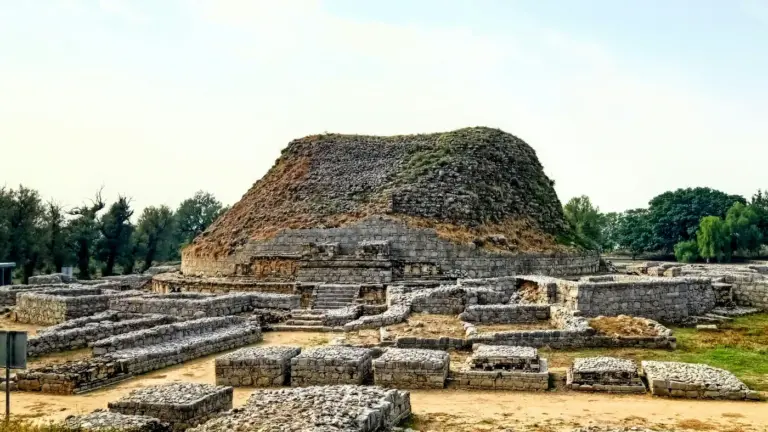
- Ashoka is said to have built 84,000 stupas enshrining Buddha's relics — most famous: Sanchi Stupa (Stupa No. 1).
Empire — Extent and Administration
Extent
- North-west: present-day Afghanistan (Kandahar, Kabul valley)
- West: Gujarat (Junagadh, Girnar)
- East: Kalinga, Bengal
- South: up to Karnataka (Maski, Nittur, Udegolam edicts) — but not Tamilakam (independent Chola, Pandya, Keralaputra, Satiyaputra, Tamraparni)
Administration
- Four main provincial capitals: Taxila (North-West), Ujjain (West), Tosali (East — Kalinga), Suvarnagiri (South).
- Capital at Pataliputra (Patna).
- Governed by Kumaras (princes) and Mahamattas.
- Efficient bureaucracy carried over from Chandragupta-Chanakya era (as described in Kautilya's Arthashastra).
Death and Decline
- Ashoka died c. 232 BCE after a reign of about 36 years.
- Within 50 years of his death, the Maurya Empire disintegrated.
- The last Maurya, Brihadratha, was killed by his general Pushyamitra Shunga (c. 185 BCE) — founding the Shunga dynasty.
Reasons for Decline
- Weakness of Ashoka's successors
- Financial strain from Dhamma welfare expenditure
- Brahminical reaction to pro-Buddhist policies (a contested view — Romila Thapar, H.C. Raychaudhuri)
- Administrative over-centralisation
- Foreign invasions (Bactrian Greeks)
Legacy
- National emblem (Lion Capital) and national flag (Ashoka Chakra) of the Republic of India
- Ashoka Jayanti (Samrat Ashok Jayanti) observed in several Indian states
- H.G. Wells in The Outline of History: "Amidst the tens of thousands of names of monarchs… the name of Asoka shines, and shines almost alone, a star."
- Ashoka transformed Buddhism from a regional Indian faith into a world religion by sending missions beyond India.
UPSC Relevance
GS1 (Ancient Indian History): Mauryan Empire, Ashoka’s edicts, Dhamma, Buddhism, Ashokan art and architecture.
Key Prelims facts:
- Dynasty: Maurya; Grandfather: Chandragupta Maurya; Father: Bindusara
- Reign: c. 268–232 BCE
- Capital: Pataliputra
- Kalinga War: c. 261 BCE (8th regnal year); described in Major Rock Edict XIII
- Titles: Devanampriya Piyadasi ("Beloved of the Gods, of Pleasing Countenance")
- Converted to Buddhism; probable teachers: Upagupta / Moggaliputta Tissa
- Third Buddhist Council: c. 250 BCE, Pataliputra, under Moggaliputta Tissa
- Missions: Mahendra (Mahinda) and Sanghamitra to Sri Lanka; converted King Devanampiya Tissa
- Edicts: 14 Major Rock Edicts, 7 Major Pillar Edicts, numerous Minor Rock Edicts, Minor Pillar Edicts, and cave inscriptions
- Languages/Scripts: Prakrit in Brahmi (most), Kharosthi (north-west), Greek and Aramaic (Kandahar)
- Brahmi script deciphered by James Prinsep in 1837
- Maski Edict (Karnataka, 1915): first to name "Devanampiya Asoka"
- Lion Capital of Sarnath: adopted as State Emblem of India (26 January 1950)
- Ashoka Chakra (24 spokes): centre of Indian national flag
- Motto "Satyameva Jayate": from the Mundaka Upanishad
- Said to have built 84,000 stupas; founded/expanded Sanchi Stupa
- Four provincial capitals: Taxila, Ujjain, Tosali, Suvarnagiri
- Died: c. 232 BCE; last Maurya Brihadratha killed by Pushyamitra Shunga c. 185 BCE
Tell Google you want more of this.
Add Anantam IAS as a preferred sourceOne tap, and this site shows up more often in your own Top Stories, AI Overviews and AI Mode. Remove it any time.