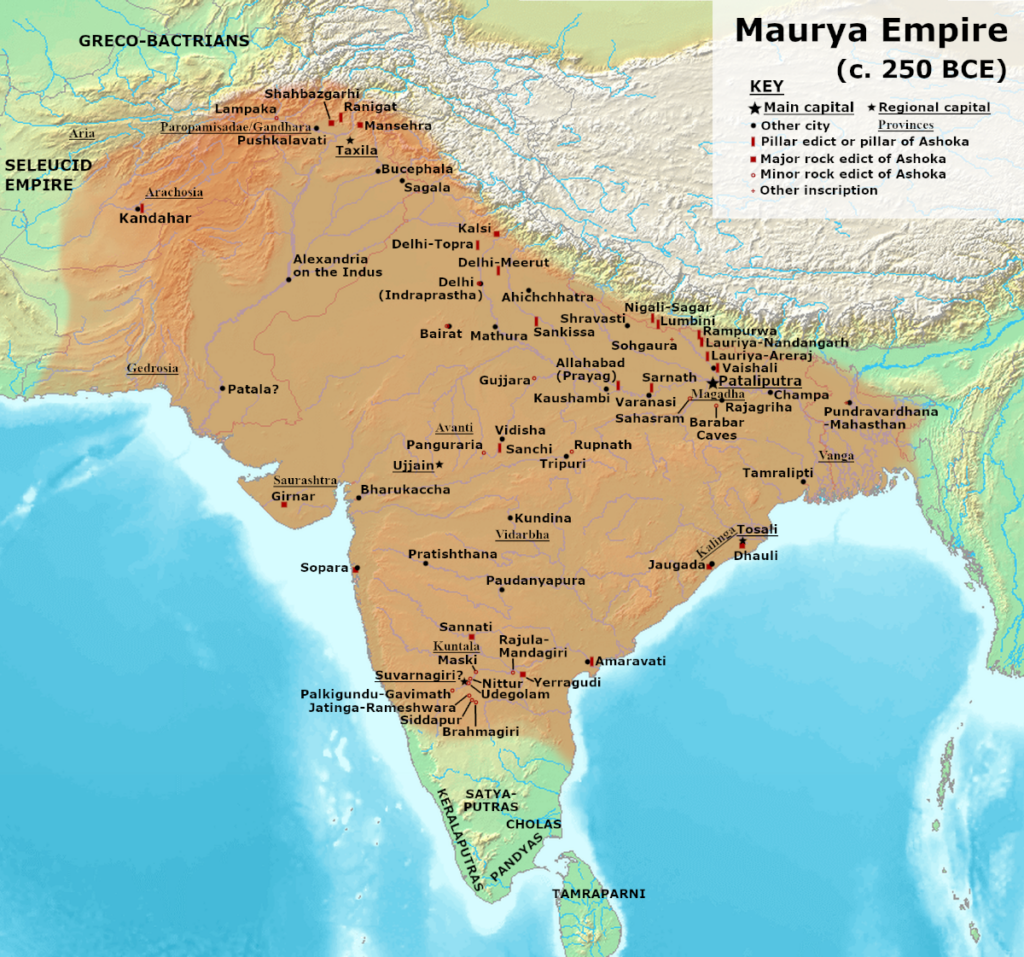
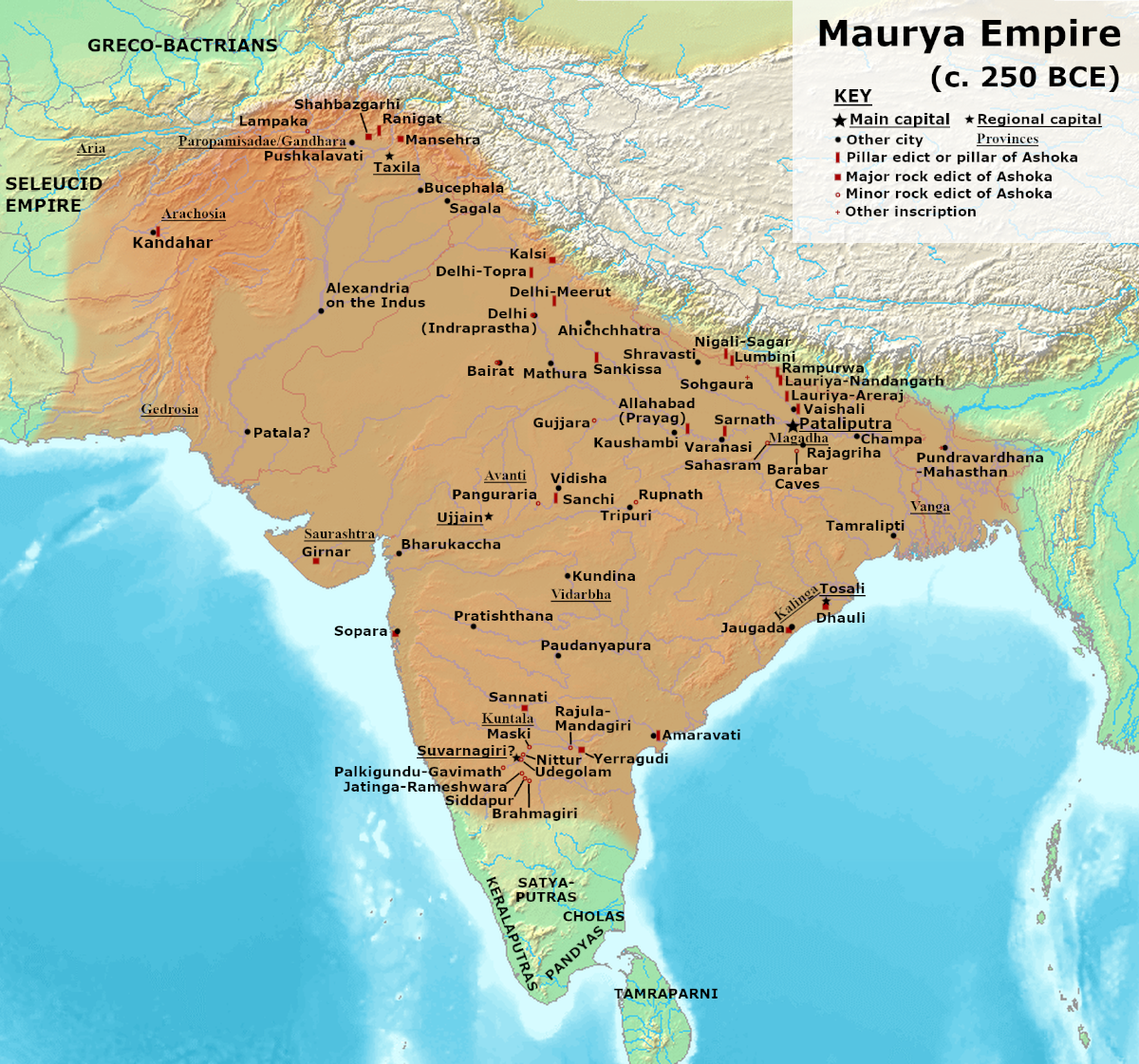
The Mauryan Empire was the first state in Indian history to bring almost the entire subcontinent under a single political authority. Founded by Chandragupta Maurya in 322 BCE after the overthrow of the Nanda dynasty of Magadha, the empire reached its territorial peak under his grandson Ashoka in the mid third century BCE, and finally collapsed in 185 BCE when the last Mauryan king, Brihadratha, was assassinated by his own commander Pushyamitra Shunga. For 137 years the Mauryan Empire ran a centralised bureaucracy, an enormous standing army, an elaborate intelligence network, and a system of imperial inscriptions that still survive on rocks and pillars across South Asia.
This article walks through the founding of the Mauryan Empire, the expansion under Bindusara, the transformation under Ashoka, the administrative system codified in the Arthashastra, the art and architecture of the period, and the reasons for the dynasty’s eventual decline. The Mauryan Empire is one of the most heavily examined topics in UPSC Prelims and Mains under Ancient History and Indian Art and Culture, and it sets the template for how every later Indian empire is understood.
The Mauryan Empire matters in 2026 because it is the reference point for everything ancient India is judged by. Its capital city Pataliputra (modern Patna), its lion capital at Sarnath (now the national emblem), and its chakra on the flag are all live political symbols. The empire’s edicts are the earliest deciphered written records of Indian history in Brahmi script.
Quick Facts About the Mauryan Empire
- Founder: Chandragupta Maurya, 322 BCE
- Capital: Pataliputra (modern Patna, Bihar)
- Major Rulers: Chandragupta Maurya (322 to 297 BCE), Bindusara (297 to 273 BCE), Ashoka (268 to 232 BCE)
- Last Ruler: Brihadratha, assassinated 185 BCE by Pushyamitra Shunga
- Greatest Extent: From present-day Afghanistan to Bangladesh, and from the Himalayas to Karnataka, under Ashoka
- Population at Peak: Estimated 50 to 60 million, around a third of the world’s population at the time
- Religion: Royal patronage shifted from Ajivika and Jain leanings under early rulers to Buddhism under Ashoka
- Key Text: Arthashastra of Kautilya (Chanakya), the founding manual of Mauryan administration
- Foreign Account: Indica of Megasthenes, Greek ambassador at the court of Chandragupta
Founding of the Mauryan Empire by Chandragupta
The Mauryan Empire begins with a single political fact. In 322 BCE Chandragupta Maurya, guided by his Brahmin teacher and minister Kautilya (also called Chanakya or Vishnugupta), overthrew the unpopular Nanda dynasty of Magadha and made himself master of the Gangetic plain.
The exact origin of Chandragupta is disputed. Buddhist tradition makes him the son of a tribal chief of the Moriya clan from Pippalivana. Jain and Brahmanical sources say he was raised in obscurity, possibly the son of a peacock-tamer (mayura), which is where the dynasty name “Maurya” supposedly comes from. The Greek sources call him Sandrokottos and place his meeting with Alexander the Great around 326 BCE.
What is certain is that by 322 BCE Chandragupta and Kautilya had organised an army, recruited disaffected nobles, and taken the Nanda capital. Within ten years they had pushed further. By 305 BCE Chandragupta fought Seleucus Nicator, one of Alexander’s generals who had inherited the eastern part of the empire. The war ended with Seleucus ceding the satrapies of Arachosia, Gedrosia and Paropamisadae (roughly modern Afghanistan and Balochistan) in exchange for 500 war elephants. A marriage alliance sealed the deal. The Mauryan Empire now ran from the Hindu Kush to Bengal.
Chandragupta is also remembered for his religious choice at the end of life. Around 297 BCE he abdicated in favour of his son Bindusara, became a Jain monk under the teacher Bhadrabahu, migrated south to Shravanabelagola in modern Karnataka, and fasted to death (sallekhana) on the rock now called Chandragiri hill. For a deeper look at his life, read our pillar on Chandragupta Maurya.
Role of Kautilya in the Founding
Kautilya is the second name that defines the early Mauryan Empire. As Chandragupta’s chief minister he organised the state, ran the intelligence network, and wrote the Arthashastra, a manual on statecraft, taxation, espionage and war. The Arthashastra survives in a Sanskrit recension recovered in 1904 from a south Indian library and decoded by R. Shamasastry. It treats politics as a science of self-interest, not morality. For more on the man, read Kautilya.
Reign of Bindusara
Bindusara, son of Chandragupta, ruled from about 297 to 273 BCE. Greek sources call him Amitrochates (“slayer of foes”). He extended Mauryan power south of the Vindhyas, probably as far as Karnataka, though sources are thin. He retained Chanakya as minister at first and later replaced him with Subandhu. The Ajivika sect, an austere ascetic order, received royal patronage during his reign. Bindusara died in 273 BCE, and after a brief succession struggle his son Ashoka took the throne, formally consecrated in 268 BCE.
Ashoka the Great and the Kalinga War
The Mauryan Empire reaches its high noon under Ashoka. He is the only Indian king before modern times whose own words survive in his own voice, carved on rocks and pillars across the empire in Brahmi and Kharosthi script, with copies in Greek and Aramaic at the western edges.
Eight years into his reign, in 261 BCE, Ashoka invaded Kalinga, a prosperous coastal kingdom in modern Odisha. The campaign was bloody. The 13th Major Rock Edict, in Ashoka’s own words, records that 150,000 people were deported, 100,000 were killed, and many times that number died of starvation and disease. After the victory Ashoka renounced military expansion. He converted to Buddhism, took the title Devanampiya Piyadasi (“Beloved of the Gods, He who looks on with affection”), and replaced bherighosha (the drum of war) with dhammaghosha (the proclamation of dhamma).
The Dhamma policy was not Buddhism in the narrow sectarian sense. It was a public moral code: respect for elders, non-violence towards animals and humans, religious tolerance, truthfulness, generosity, and care for slaves and servants. Ashoka appointed Dhamma Mahamatras (officers of dhamma) to spread the message, and sent missions abroad to Sri Lanka (led by his son Mahinda and daughter Sanghamitra), to the Hellenistic kingdoms of West Asia, to Egypt, and possibly to Greece itself. For the full story, read Ashoka the Great.
Edicts of Ashoka
Ashoka’s edicts are the earliest deciphered Indian inscriptions. They fall into four groups: 14 Major Rock Edicts, Minor Rock Edicts, 7 Pillar Edicts, and Cave Inscriptions. They appear from Mansehra and Shahbazgarhi in the north-west (in Kharosthi) to Brahmagiri in Karnataka (in Brahmi), and from Girnar in Gujarat to Dhauli and Jaugada in Odisha. They were deciphered by James Prinsep in 1837, opening the door to the modern study of Indian antiquity.
Mauryan Administration: The Sapta Anga System
The Mauryan Empire ran on a theory of seven limbs (sapta anga) of the state, described in the Arthashastra: the king (swami), the minister (amatya), the territory and people (janapada), the fortified capital (durga), the treasury (kosha), the army (danda) and the ally (mitra). All seven had to be strong for the state to be strong.
In practice the empire was a centralised monarchy with provincial decentralisation. The king ruled from Pataliputra. Below him were four to five provinces (Uttarapatha at Taxila, Avantirashtra at Ujjain, Dakshinapatha at Suvarnagiri, Kalinga at Tosali, and the home province at Pataliputra). Each was governed by a Kumara (often a prince of royal blood). Below the provinces were districts under Pradeshikas, and villages under Gramikas.
Two features stand out. First, the espionage network. The Arthashastra prescribes spies of every kind: wandering ascetics, students, householders, courtesans, and so on, reporting directly to the king. Second, the standing army. Megasthenes reports an army of 600,000 infantry, 30,000 cavalry, 9,000 war elephants and 8,000 chariots, run by a war office of 30 members in six committees of five.
The empire also ran public works at a scale unmatched until much later. Roads were maintained with milestones and rest houses. The Junagadh Rock Inscription of Rudradaman, dated to the 2nd century CE, records that the Sudarshana Lake at Girnar was originally constructed by Pushyagupta, Chandragupta’s governor, and later improved under Ashoka.
Taxation Under the Mauryas
Land revenue (bhaga) was the main source of income, typically one-sixth of the produce, although the Arthashastra allows higher rates under emergency. Other taxes included bali (tribute), kara (occasional tax), vivita (pasturage tax), and tolls on trade. The state ran its own mines, forests, shipbuilding yards and liquor stores as direct enterprises. Royal monopolies on salt, mining and the manufacture of weapons brought additional revenue.
Mauryan Art and Architecture
Mauryan art is the first phase of monumental Indian art. It is largely royal art, produced for and on behalf of the imperial court at Pataliputra and Ashoka’s pillars. The defining material is polished Chunar sandstone, sourced from quarries near Varanasi, given a distinctive mirror-like Mauryan polish.
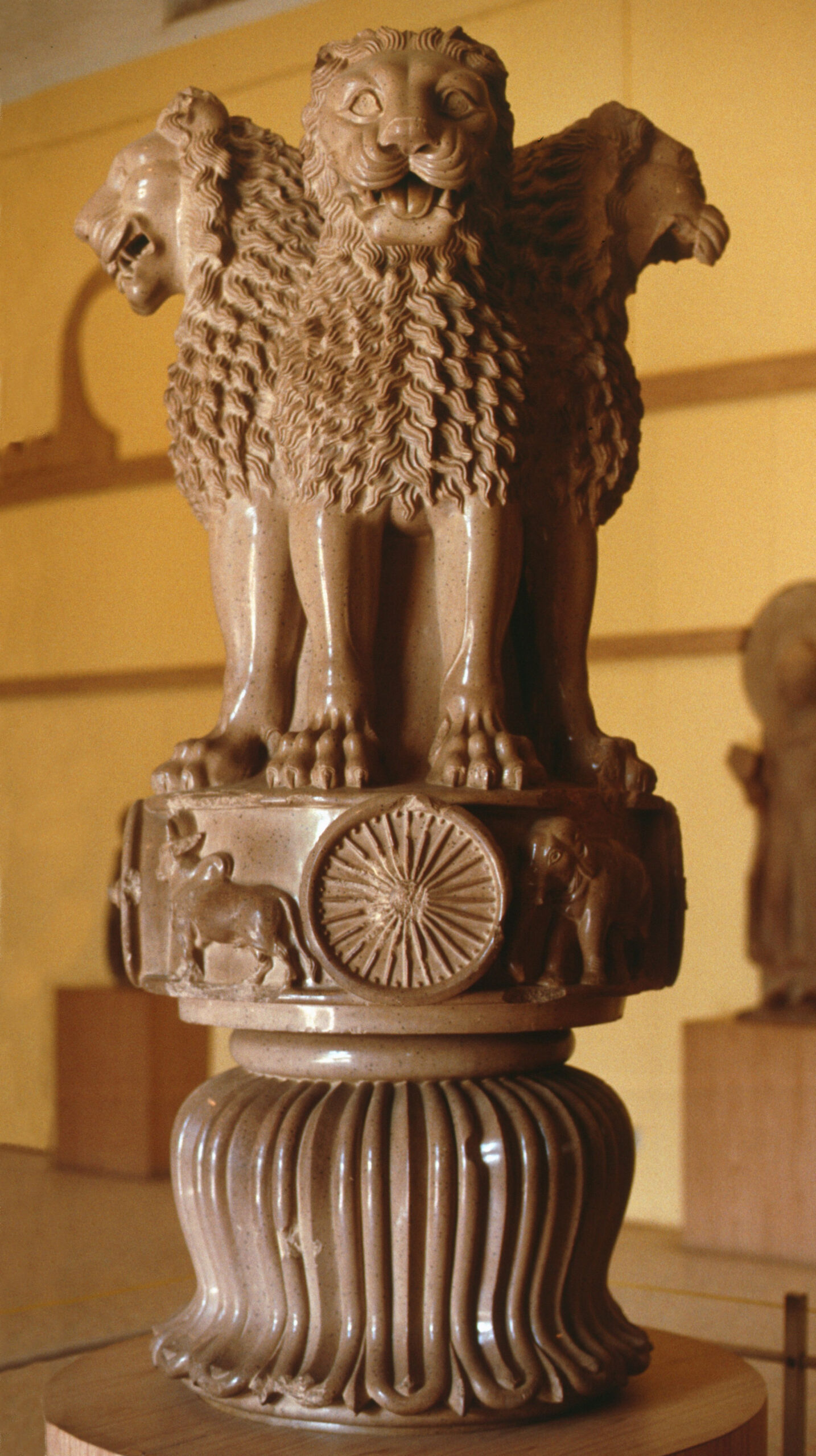
The most famous Mauryan monument is the Lion Capital at Sarnath, erected by Ashoka around 250 BCE to mark the site of the Buddha’s First Sermon. Four lions stand back to back, atop a circular abacus carved with four animals (lion, elephant, horse, bull) and four chakras, set on an inverted lotus bell. The lions, the bell capital, and the chakra together became the State Emblem of India in 1950.
Other examples include the Lauria Nandangarh Pillar in Bihar (a single lion), the Vaishali Pillar (also a single lion, polished, with no edict), the Sankissa Pillar (an elephant), the Rampurva Pillar (a bull), and the polished cave sanctuaries at Barabar Hills near Gaya, the earliest rock-cut caves in India, donated by Ashoka to the Ajivika sect.
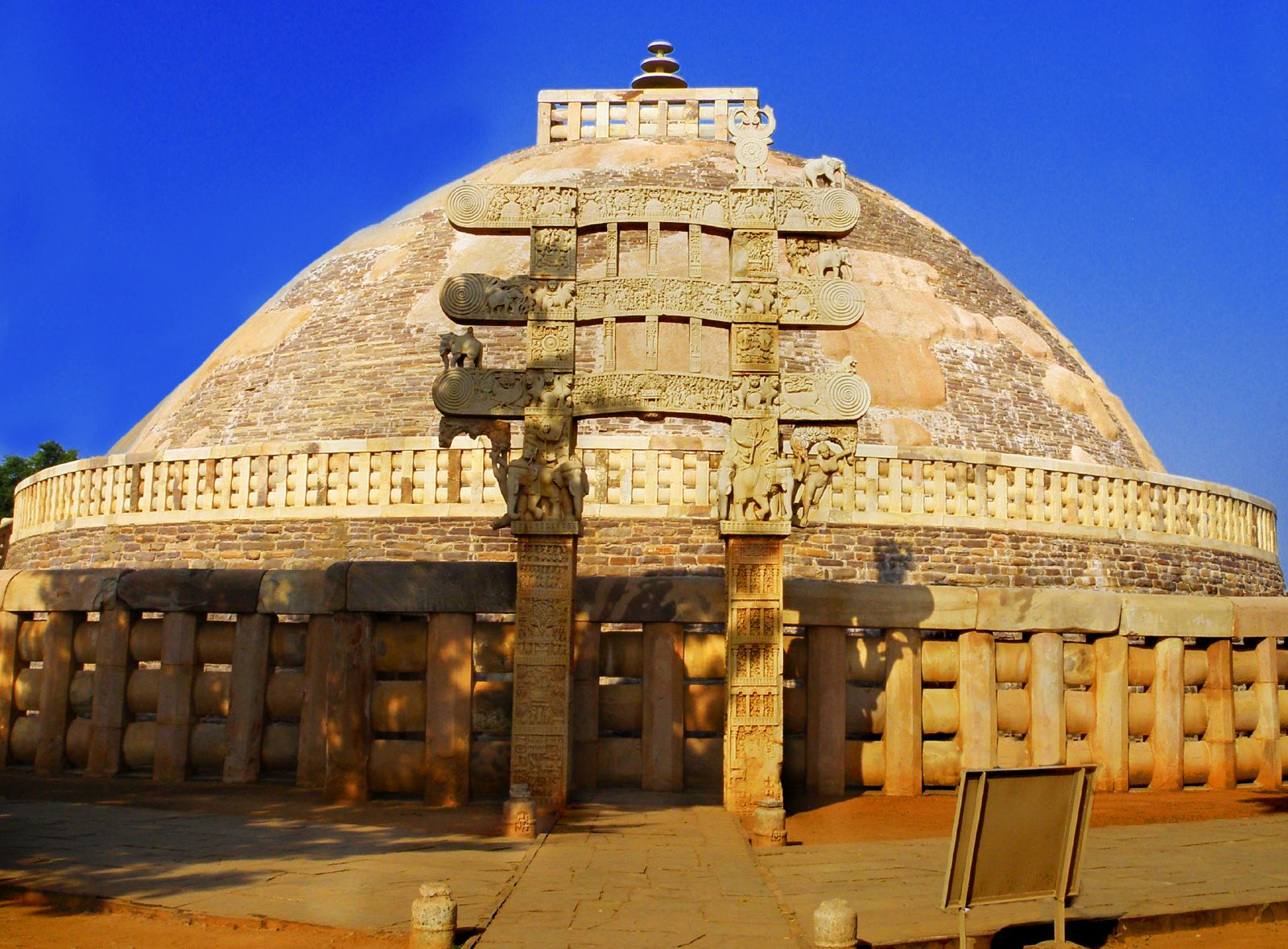
The first generation of Buddhist stupas also belong to this period. The original brick core of the Great Stupa at Sanchi was raised by Ashoka, although the surrounding stone railings (vedika) and gateways (toranas) are later Sunga and Satavahana work. Eight original stupas were said to enshrine relics of the Buddha; Ashoka redistributed these relics to 84,000 stupas across the empire, according to Buddhist tradition.
Pataliputra: The Imperial Capital
Pataliputra was described by Megasthenes as a city nine miles long and one and a half wide, surrounded by a wooden palisade with 64 gates and 570 towers, and a moat 200 metres broad. Archaeology at Kumhrar and Bulandi Bagh in modern Patna has uncovered the remains of an 80-pillared hall on a wooden platform, modelled on Achaemenid Persian halls at Persepolis. This is the most likely candidate for the Mauryan throne room.
Decline of the Mauryan Empire
The Mauryan Empire declined rapidly after Ashoka’s death in 232 BCE. Within fifty years it had collapsed entirely. Historians have offered several overlapping explanations.
The first is dynastic weakness. Ashoka was succeeded by a string of short-reigned kings (Dasharatha, Samprati, Salisuka, Devavarman, Satadhanvan, and Brihadratha). None had Ashoka’s stature, and the practice of dividing the empire among heirs may have weakened central authority.
The second is fiscal exhaustion. Maintaining a standing army of nearly 650,000 men plus an enormous bureaucracy was expensive. Some scholars (notably D.D. Kosambi) argue that the empire ran into a silver shortage and started debasing the punch-marked coinage.
The third, advanced by H.C. Raychaudhuri, is that Ashoka’s Dhamma policy and patronage of Buddhism alienated the Brahmin aristocracy, on whom the state depended for administration and legitimacy. The Mauryan commander Pushyamitra Shunga, who killed Brihadratha in 185 BCE and founded the Shunga dynasty, was himself a Brahmin who is said to have revived Vedic ritual including the Ashvamedha horse sacrifice.
The fourth is external pressure. Hellenistic Bactrian kings, beginning with Demetrius around 200 BCE, were already pushing into the north-west. The empire was simply too large to be defended from a single centre once its grip weakened.
Legacy of the Mauryan Empire
Three things from the Mauryan Empire have outlasted every dynasty since.
First, the idea of pan-Indian rule. Every later Indian empire (Gupta, Harsha, Delhi Sultanate, Mughal, British Raj, Republic of India) has measured itself against the Mauryan template of a single state running from the Hindu Kush to Tamil Nadu.
Second, the inscriptional habit. Ashoka invented Indian epigraphy. Every later king who left a stone inscription was working in his tradition.
Third, the national symbols. The Lion Capital is on the national emblem. The Dharma Chakra is on the national flag. The Brahmi script is the ancestor of every modern Indian script except Urdu and the Perso-Arabic scripts.
The Mauryan Empire also shaped the comparative history of empire itself. It was contemporary with the Hellenistic kingdoms in the west, the Qin and early Han in China, and the Roman Republic in the Mediterranean, and it is often grouped with them as one of the four great states of antiquity.
For related history reading on later Indian empires and battles, see our coverage of the Battles of Panipat, and on later temple architecture see Brihadeeswara Temple at Thanjavur.
Frequently Asked Questions
Who founded the Mauryan Empire?
The Mauryan Empire was founded by Chandragupta Maurya in 322 BCE after he overthrew the Nanda dynasty of Magadha with the help of his minister Kautilya (Chanakya). The dynasty takes its name either from the Moriya clan or from his mother’s peacock-tamer family (mayura).
What was the extent of the Mauryan Empire at its peak?
Under Ashoka in the mid third century BCE, the Mauryan Empire extended from the Hindu Kush mountains in modern Afghanistan in the north-west to the Brahmaputra in the east, and from the Himalayan foothills in the north to Karnataka in the south. The Tamil regions of Cholas, Cheras and Pandyas remained independent allies, and Kalinga was conquered separately in 261 BCE.
What is the Arthashastra and who wrote it?
The Arthashastra is a Sanskrit manual on statecraft, taxation, war and espionage attributed to Kautilya (also called Chanakya or Vishnugupta), the minister of Chandragupta Maurya. It was rediscovered in 1904 and edited by R. Shamasastry in 1909. The Arthashastra treats politics as a science of practical self-interest and describes the seven-limbed (sapta anga) theory of the state.
What was the Kalinga War and why was it important?
The Kalinga War was fought by Ashoka in 261 BCE against the kingdom of Kalinga in modern Odisha. According to the 13th Major Rock Edict, 100,000 people were killed and 150,000 deported. The carnage caused Ashoka deep remorse. He renounced military conquest, embraced Buddhism, and adopted the policy of Dhamma. The Kalinga War is the turning point of Ashoka’s reign and of the moral history of the Mauryan Empire.
What are the edicts of Ashoka?
The edicts of Ashoka are inscriptions in Brahmi, Kharosthi, Greek and Aramaic carved on rocks, pillars and cave walls across the Mauryan Empire. They include 14 Major Rock Edicts, several Minor Rock Edicts, 7 Pillar Edicts, and cave inscriptions at Barabar. They were deciphered by James Prinsep in 1837 and are the earliest deciphered written records of Indian history.
Why did the Mauryan Empire decline?
The Mauryan Empire declined because of a combination of weak successors after Ashoka, fiscal strain from maintaining a vast army and bureaucracy, alienation of the Brahmin aristocracy from Ashoka’s Buddhist Dhamma policy, and external pressure from Hellenistic Bactrian kings. The last Mauryan ruler Brihadratha was assassinated in 185 BCE by his Brahmin commander Pushyamitra Shunga, who founded the Shunga dynasty.
What was Mauryan administration based on?
Mauryan administration was based on the sapta anga (seven limbs) theory of the state described in the Arthashastra: king, minister, territory and people, fortified capital, treasury, army and ally. The empire was a centralised monarchy with five provinces under princes (Kumaras), districts under Pradeshikas, and villages under Gramikas, backed by an elaborate espionage network and a standing army of over 600,000.
What is the legacy of the Mauryan Empire?
The Mauryan Empire bequeathed three lasting things to India. First, the idea of pan-Indian political unity, the template every later empire has measured itself against. Second, the inscriptional habit of recording royal acts on stone, beginning with Ashoka’s edicts. Third, the national symbols: the Lion Capital at Sarnath is the State Emblem of India, the Dharma Chakra is on the national flag, and the Brahmi script is the ancestor of almost every modern Indian script.
Tell Google you want more of this.
Add Anantam IAS as a preferred sourceOne tap, and this site shows up more often in your own Top Stories, AI Overviews and AI Mode. Remove it any time.