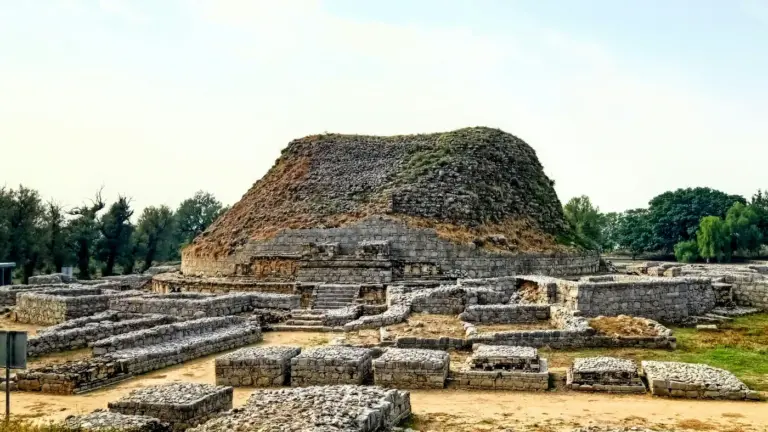
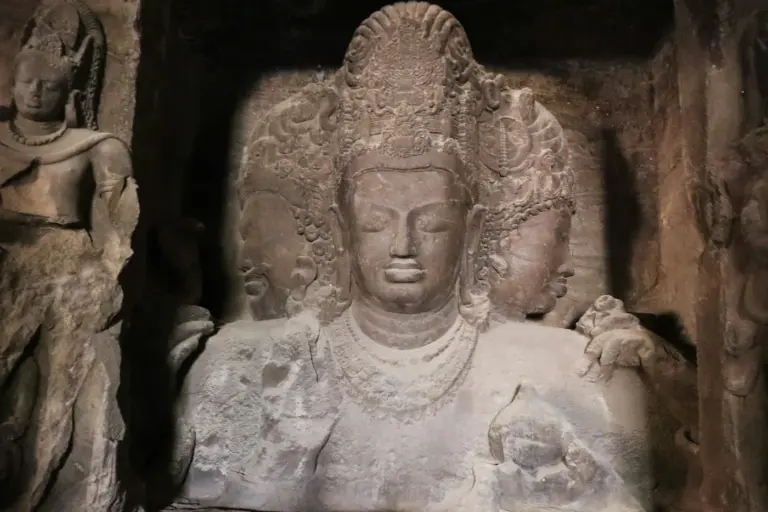
The Kalinga War was fought around 261 BCE between Samrat Ashoka, the third ruler of the Mauryan Empire, and the independent state of Kalinga on the eastern coast of India. It is the only major war Ashoka personally waged and the only one we know of in ancient Indian history where the victor publicly recorded his remorse and renounced war as a policy. The battle, its human cost and Ashoka’s ensuing spiritual and political transformation are recorded in his own words in Rock Edict XIII, one of the most remarkable documents of the ancient world.
Background: Ashoka and the Mauryan Empire
By 261 BCE, the Mauryan Empire, founded by Chandragupta Maurya in 322 BCE and consolidated by Bindusara, stretched from the Hindu Kush to Bengal and from the Himalaya to Karnataka. Ashoka ascended the throne around 268 BCE. Most of the subcontinent lay under Mauryan control except for the deep south (Chola, Chera, Pandya, Satiyaputra kingdoms) and one crucial coastal state – Kalinga.
Kalinga: Location and Strategic Value
Kalinga occupied most of modern Odisha and parts of northern Andhra Pradesh, coastal Chhattisgarh and West Bengal up to the Mahanadi-Godavari belt.
| Aspect | Details |
|---|---|
| Territory | Mahanadi to Godavari, between Bay of Bengal and Eastern Ghats |
| Capital | Traditionally identified with Tosali (near Dhauli) |
| Coastline | Vast maritime frontage on the Bay of Bengal |
| Ports | Palur, Pithunda, Kalingapatnam |
| Economy | Trade with Southeast Asia, precious stones, textiles, rice, elephants |
Kalinga controlled sea routes to Sri Lanka, Burma, Indonesia and China, and dominated inland trade routes between North and South India. It had earlier been under Nanda control but had regained independence and posed both an economic and political challenge to Magadha's supremacy.
Causes of the Kalinga War
| Cause | Explanation |
|---|---|
| Imperial ambition | Ashoka wanted to complete the Mauryan unification of the subcontinent |
| Strategic geography | Kalinga lay astride crucial land and sea trade routes |
| Economic interests | Control of Bay of Bengal trade and elephants for Mauryan army |
| Historic rivalry | Earlier Nanda emperors had fought Kalinga; the wound lingered |
| Political independence | An unsubdued Kalinga symbolised incomplete Mauryan sovereignty |
The War: Scale and Casualties
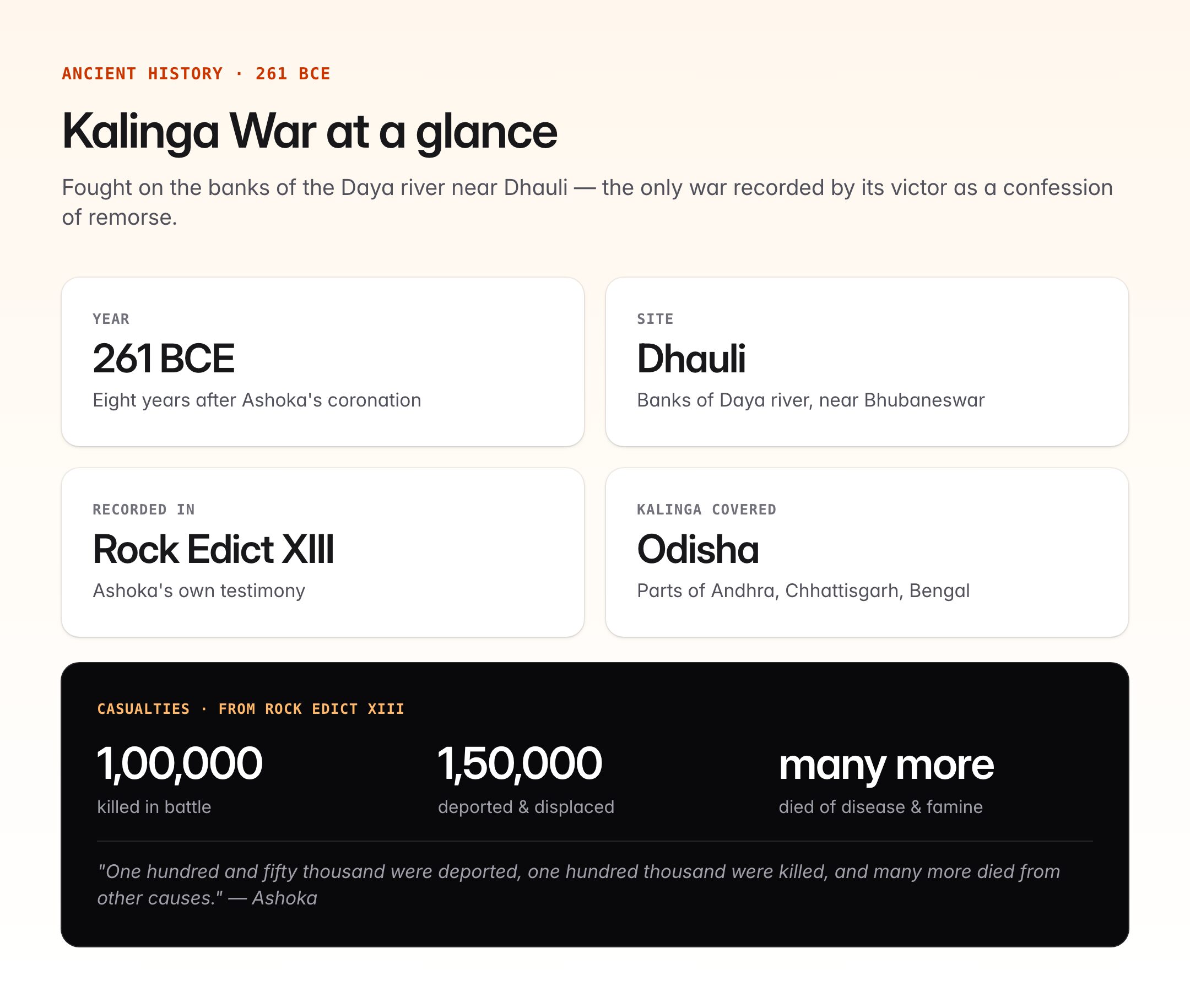
The war was fought in and around Dhauli Hills, near modern Bhubaneswar, on the banks of the Daya River. While military details are sparse, Ashoka's own edict gives us the scale.
From Major Rock Edict XIII:
"One hundred and fifty thousand were deported, one hundred thousand were killed, and many more died from other causes."
| Category | Figure |
|---|---|
| Deported (enslaved or displaced) | 1,50,000 |
| Killed in battle | 1,00,000 |
| Died of other causes (disease, famine, wounds) | "Many more" |
Tradition says the Daya River ran red with blood. Even by the standards of ancient warfare the casualties are immense, and the figures are given by the winning monarch himself, lending them credibility.
Ashoka's Transformation
Unlike other ancient kings who commissioned panegyrics after victories, Ashoka confessed sorrow. In Rock Edict XIII he explicitly states:
"The Beloved of the Gods, King Piyadasi, conquered the Kalingas eight years after his coronation… After that, now that the Kalingas have been conquered, the Beloved of the Gods is devoted to the intense study of Dhamma, to the love of Dhamma, and to the inculcation of Dhamma."
This is the pivot of Ashokan history. Remorse transformed the conqueror into a philosopher-king and sent him towards the path already blazed by the Buddha and Mahavira.
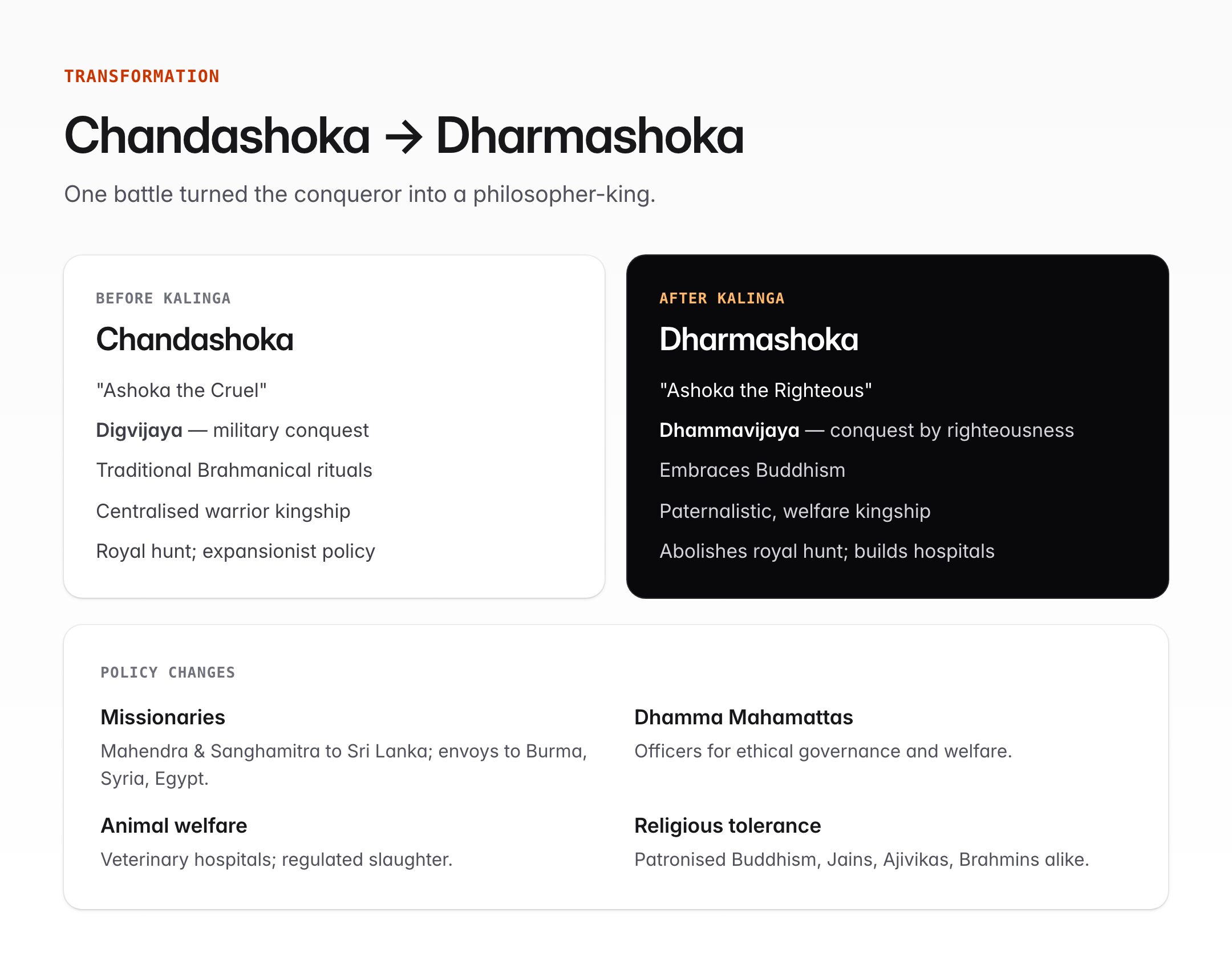
| Before Kalinga | After Kalinga |
|---|---|
| "Chandashoka" (Ashoka the Cruel) | "Dharmashoka" (Ashoka the Righteous) |
| Policy of Digvijaya (military conquest) | Policy of Dhammavijaya (conquest through righteousness) |
| Traditional Brahmanical rituals | Embrace of Buddhism |
| Centralised warrior kingship | Paternalistic, welfare kingship |
Ashoka's Conversion to Buddhism
Although Buddhist texts like the Divyavadana and the Mahavamsa (Sri Lankan chronicle) claim Ashoka was introduced to Buddhism by the monk Upagupta (or Nigrodha), most modern historians accept that the Kalinga War was the decisive event that drove him to formally embrace Buddhism. Within a few years he became a lay follower (upasaka) and later described himself as a committed devotee (bahuka). His adoption of Buddhism had a long-term civilisational consequence: what had been a regional Indian sect became a world religion.
Policy Changes after Kalinga
| Domain | Change |
|---|---|
| Foreign policy | Abandoned territorial expansion; dispatched peace missions |
| Dhamma | Propagated Ashokan Dhamma – ethical code of tolerance, non-violence, respect for elders, honesty |
| Animal welfare | Abolished royal hunt, regulated slaughter, built veterinary hospitals |
| Religious tolerance | Patronised Buddhism but supported Ajivikas, Jains and Brahmins |
| Missionaries | Sent Buddhist missions to Sri Lanka (son Mahendra, daughter Sanghamitra), Burma, Central Asia, Syria, Egypt, Macedonia |
| Administration | Created Dhamma Mahamattas – officers for ethical governance and welfare |
| Public works | Roads, shade trees, rest houses, wells, hospitals for humans and animals |
| Law | Mild penal code, appeals for clemency, emphasis on reform over retribution |
Dhauli Rock Edicts
The site of the war – Dhauli Hills, 8 km south of Bhubaneswar – carries one of Ashoka's most important inscriptions, a set of Separate Rock Edicts (also called the Kalinga Edicts). These are inscribed in Brahmi script in Prakrit language.
| Feature | Detail |
|---|---|
| Location | Dhauli Hills, banks of Daya River, near Bhubaneswar |
| Script | Brahmi |
| Language | Magadhi Prakrit |
| Above the edicts | A rock-carved elephant (symbol of the Buddha) – one of the earliest rock sculptures in India |
| Content | Welfare of conquered Kalingans, instructions to officers to treat subjects as their children |
A second set of Separate Kalinga Edicts is at Jaugada in Ganjam district. Notably, Major Rock Edict XIII (the war confession) was omitted from the Kalinga editions – out of sensitivity to the defeated people. This suggests a ruler who cared about how his subjects received his words.
Long-Term Impact
- End of territorial expansion – Ashoka became the first known emperor to renounce conquest despite possessing the means to continue.
- Spread of Buddhism – Kalinga War catalysed the global spread of the Buddha's teaching through royal patronage.
- Ideology of non-violence – Ashokan Dhamma embedded ahimsa, tolerance and welfare as state objectives. Gandhi would invoke the same principles 2,200 years later.
- Ironic twist – After Ashoka's death (232 BCE), Kalinga regained independence under the Mahameghavahana dynasty, and its later king Kharavela (1st century BCE) left the Hathigumpha inscription at Udayagiri – which, interestingly, still complains about Magadhan aggression.
- Civilisational reference point – The Lion Capital of Sarnath and Ashokan symbols became the emblems of independent India. The Ashoka Chakra on the national flag carries a direct lineage to the moral revolution born of Kalinga.
Sources of Information
| Source | Type |
|---|---|
| Major Rock Edict XIII | Ashoka's own testimony |
| Separate Kalinga Edicts (Dhauli and Jaugada) | Administrative guidance |
| Divyavadana | Buddhist Sanskrit text |
| Mahavamsa and Dipavamsa | Sri Lankan Pali chronicles |
| Hathigumpha inscription of Kharavela | Later Kalingan perspective |
| Arthashastra and Indica of Megasthenes | Indirect Mauryan context |
UPSC Relevance
Prelims: Direct factual questions on the year (261 BCE, eight years after coronation), the site (Dhauli on the Daya River), the casualties (one lakh killed, 1.5 lakh deported), the edict that describes the war (Rock Edict XIII), the location of the Dhauli elephant sculpture, and the missionary dispatches (Mahendra and Sanghamitra to Sri Lanka) are frequent.
Mains GS-1 (Ancient History and Culture): Candidates must explore Ashoka's transformation from Chandashoka to Dharmashoka, Dhammavijaya vs Digvijaya, the content and spread of Ashokan Dhamma, and the propagation of Buddhism across Asia. The war fits cleanly into questions on Mauryan administration, edicts and inscriptions as historical sources, and the role of ideology in statecraft.
Mains GS-4 (Ethics): The Kalinga War is a template case study on moral transformation through remorse, leadership and conscience, ethical governance and non-violence as a policy. Ashoka's admission – "even one hundredth part of the suffering of Kalinga now weighs on the mind of the Beloved of the Gods" – is one of the most quoted lines in ethics answers.
Essay: The war offers rich material for essays on power and responsibility, peace vs conquest, the moral limits of statecraft, and why ideas outlast empires.
Candidates should memorise the date (261 BCE), the casualty figures, the key edict (XIII), the sites (Dhauli and Jaugada), and the twin transformation – religious (to Buddhism) and political (Dhammavijaya) – to cover every common angle of this turning-point war in Indian history.
Tell Google you want more of this.
Add Anantam IAS as a preferred sourceOne tap, and this site shows up more often in your own Top Stories, AI Overviews and AI Mode. Remove it any time.