

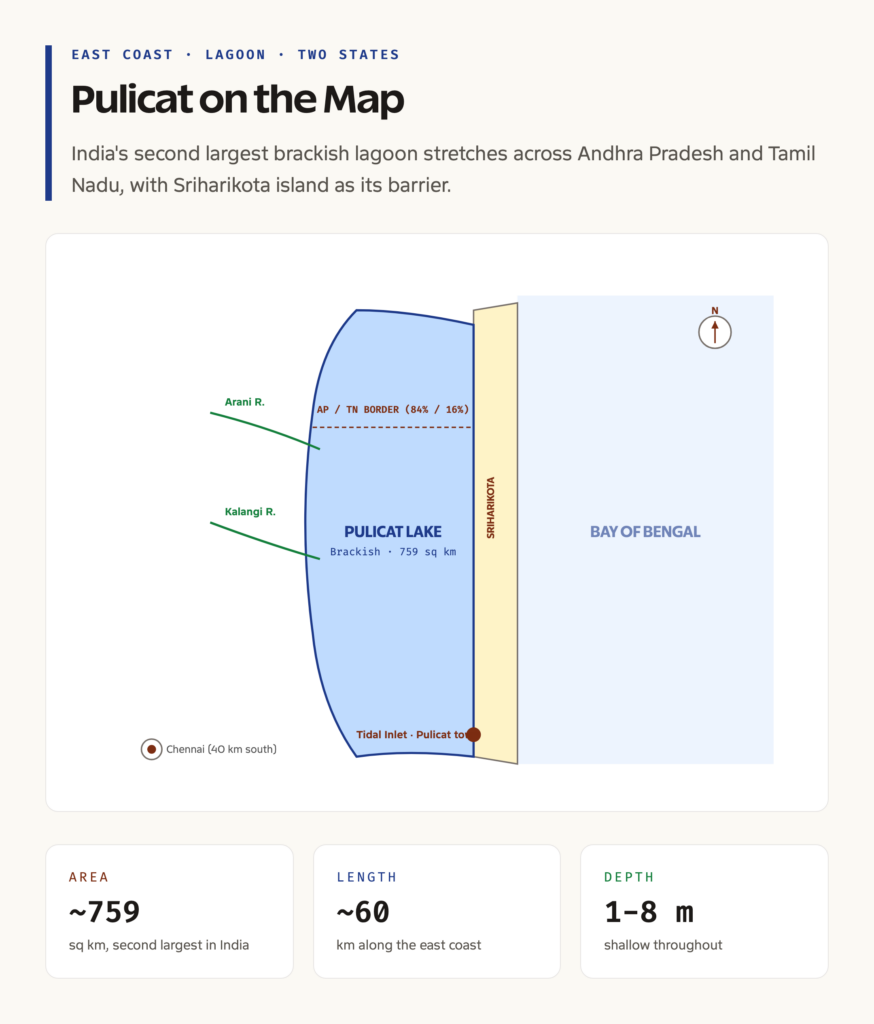
A long, slender stretch of brackish water curls along India’s east coast just north of Chennai, separated from the Bay of Bengal by a low sandbar. This is Pulicat Lake, a lagoon that runs across the border between Andhra Pradesh and Tamil Nadu, fed by two small rivers from the Eastern Ghats and connected to the sea through a narrow inlet. It is the second largest brackish water lagoon in India after Chilika, and it sits at one of the most curious ecological intersections on the subcontinent: a Ramsar-pending bird sanctuary on one shore, a rocket launch complex on a barrier island, and a fishing community whose padu rotation system has worked for centuries.
For UPSC, Pulicat is a high-yield topic. It is geographically distinctive, ecologically significant, administratively split between two states, and home to ISRO’s Satish Dhawan Space Centre on Sriharikota island. Prelims questions on Pulicat appear in cycles, mains questions on coastal lagoons or migratory bird habitats can pull Pulicat in as a case study, and the annual Flamingo Festival adds a timely current-affairs hook.
This guide explains where Pulicat is, what it contains, why it matters, and how it fits into prelims and mains preparation.
Quick Facts
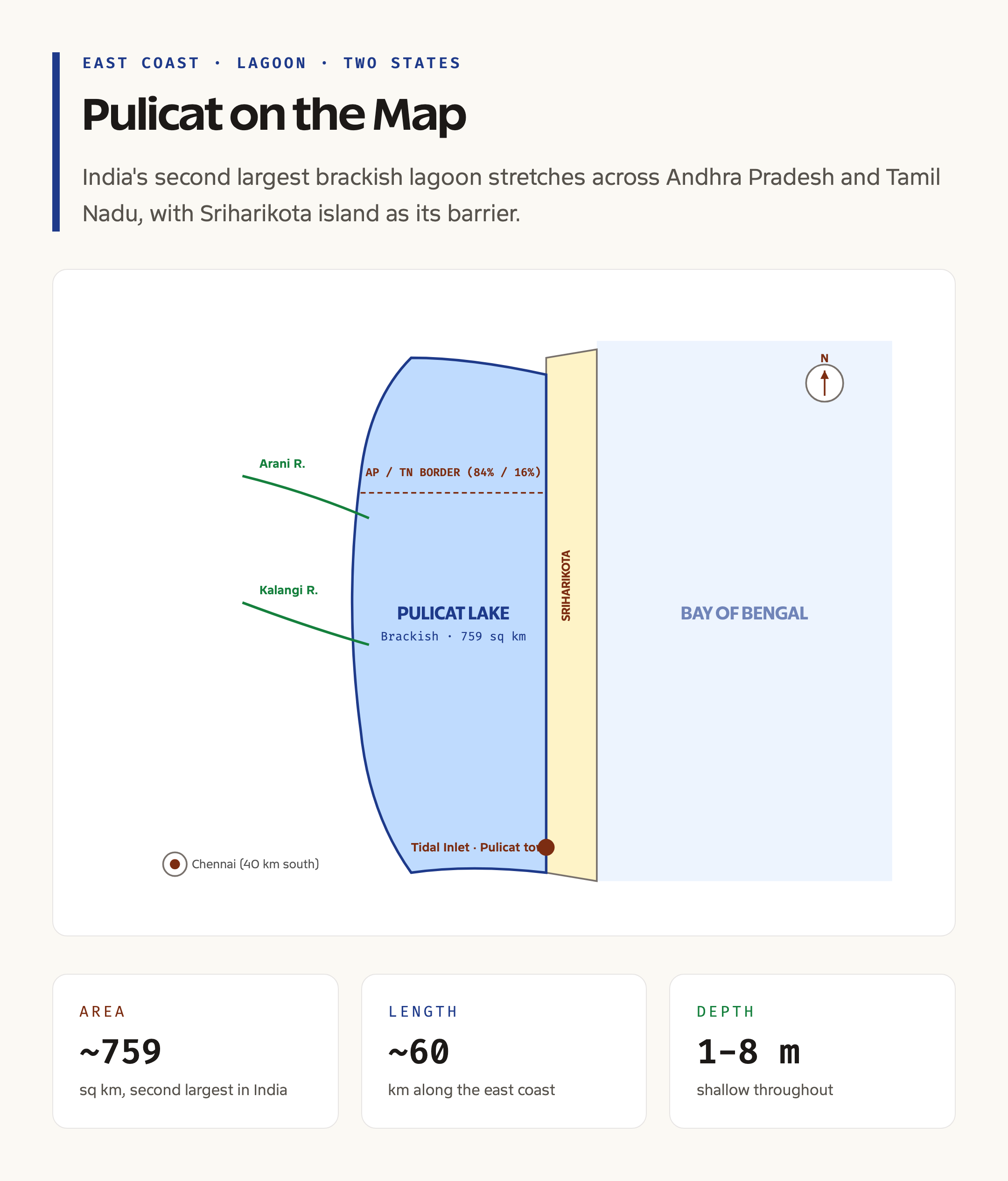
- Type: Brackish water lagoon
- Rank in India: Second largest brackish water lagoon after Chilika (Odisha)
- Location: East coast of India, north of Chennai
- States: Andhra Pradesh (84 per cent) and Tamil Nadu (16 per cent)
- Length: Around 60 kilometres along the coast
- Maximum width: Around 15 kilometres
- Area: Roughly 759 square kilometres at high water
- Average depth: 1 to 2 metres; maximum around 8 metres
- Fed by: Arani river and Kalangi river, with seasonal contributions
- Barrier island: Sriharikota, separating the lagoon from the Bay of Bengal
- Notable installation: ISRO’s Satish Dhawan Space Centre on Sriharikota
- Bird sanctuary: Pulicat Lake Bird Sanctuary, 1976, around 759 sq km
- Annual event: Flamingo Festival, held at Pulicat each winter
Geography of Pulicat Lake
Pulicat sits between latitudes 13° 24′ and 13° 47′ north on India’s eastern seaboard. The lagoon is long and shallow, oriented north to south, and runs parallel to the coast for some 60 kilometres. The barrier island of Sriharikota separates it from the Bay of Bengal along most of its length, with a single tidal inlet near Pulicat town in Tamil Nadu providing the sea connection. Two minor rivers, the Arani and the Kalangi, drain the eastern slopes of the local hill chains and bring fresh water in during the monsoon.
The lagoon straddles the inter-state border. The bulk of the lake area, around 84 per cent, lies in the Tirupati and Nellore districts of Andhra Pradesh. The remaining 16 per cent, including the southern outflow at Pulicat town, falls in Tiruvallur district of Tamil Nadu. This split has long created administrative complications for fisheries, conservation, and tourism management, since two state governments have to coordinate on water quality, dredging, and bird protection.
The salinity varies sharply across seasons. During the southwest and northeast monsoons, freshwater inflow lowers salinity to brackish levels of around 5 to 15 parts per thousand. In the dry season, evaporation pushes salinity up to near-marine levels of 30 to 35 parts per thousand. This salinity oscillation is what makes the lagoon so productive: it supports a mix of freshwater, brackish, and marine species, with peak biodiversity in the transitional months.
Hydrology and Connection to the Sea
The single tidal inlet at the southern end is critical to the lagoon’s health. Tides flush the lagoon with seawater and let migratory fish and prawn species enter and leave. When the inlet narrows or silts up, salinity rises, oxygen falls, fisheries collapse, and bird populations suffer. Through history, the inlet has periodically silted shut and been re-opened by storms or by manual dredging.
The Bird Sanctuary
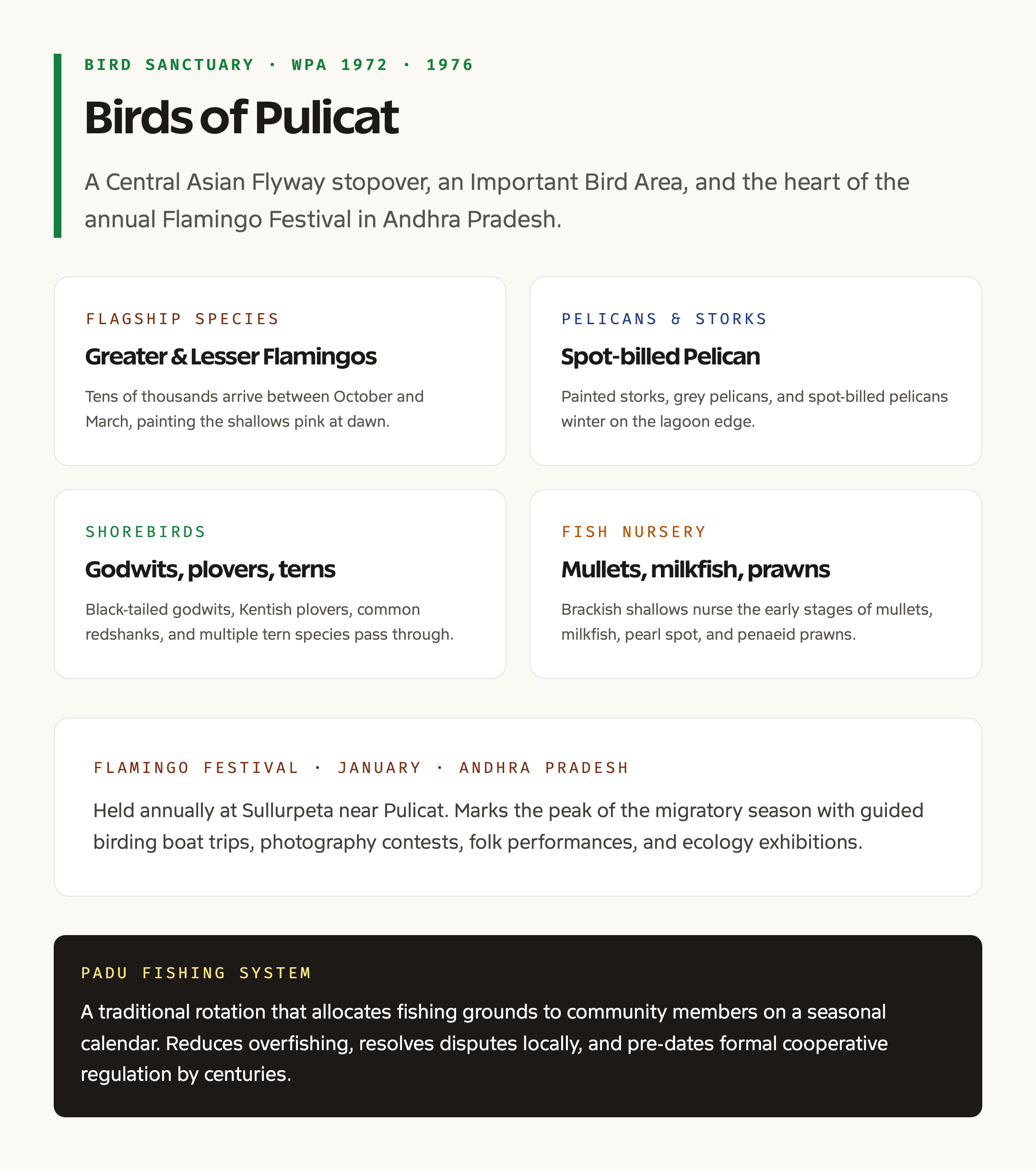
The Pulicat Lake Bird Sanctuary was notified in 1976 and covers most of the lagoon area, around 759 square kilometres, making it one of the larger bird sanctuaries in southern India. The sanctuary is best known for its winter populations of greater and lesser flamingos, which arrive in October and stay until March. At peak season, the lagoon hosts tens of thousands of flamingos, painting the shallows pink at dawn.
Beyond flamingos, Pulicat is a site of international importance for shorebirds. Painted storks, spot-billed pelicans, grey pelicans, black-tailed godwits, common redshanks, marsh sandpipers, kentish plovers, lesser sand plovers, and many tern species use the lagoon during migration. The Central Asian Flyway passes overhead, and Pulicat acts as a major stopover and wintering site. BirdLife International has flagged Pulicat as an Important Bird and Biodiversity Area.
The lagoon is also a fish nursery. Mullets, milkfish, pearl spot, and several penaeid prawns spawn or develop in the brackish shallows. The fisheries are managed under the traditional padu system, in which fishing rights are rotated among community members on a seasonal calendar that reduces over-extraction and resolves disputes without formal courts.
Sriharikota and the Space Centre
Sriharikota is the long, narrow barrier island that separates Pulicat from the sea. It is roughly 50 kilometres long, 8 kilometres wide at the widest, and rises only a few metres above sea level. The island has been the launch site for the Indian Space Research Organisation since 1971. The Satish Dhawan Space Centre, named for the former ISRO chairman, hosts the launch pads for the PSLV, the GSLV, the LVM3, and the new SSLV. Chandrayaan, Mangalyaan, Aditya-L1, and the Gaganyaan abort tests have all flown from here.
The space centre’s location on Pulicat creates an unusual mix. On one side of the island, rocket launches lift satellites toward orbit; on the other side, flamingos wade through brackish shallows. Launch days bring temporary noise and exclusion zones over a section of the lagoon, but the long-term coexistence has been managed without major ecological disruption. ISRO also operates a forest department coordination cell to align launch windows with bird breeding seasons where possible.
The Flamingo Festival
The Flamingo Festival is held every January in Andhra Pradesh, centred on the village of Sullurpeta near Pulicat. The festival is run by the state tourism department in partnership with the forest department and local communities. It marks the peak of the migratory season, when the lagoon is at its most spectacular. Activities include guided birding boat trips, photography contests, traditional dance and folk music, school engagement programmes, and exhibitions on coastal ecology.
The festival has helped raise local revenue, give the conservation effort a public face, and bring tourist traffic in winter months. It complements similar festivals at other Indian wetlands such as Chilika, Mangalajodi, and Nelapattu.
Threats and Conservation Concerns
Pulicat faces a familiar set of pressures. Reduced freshwater inflow from the Arani and Kalangi catchments, due to upstream irrigation and rainfall variability, has lowered the lagoon’s average freshwater pulse. The tidal inlet has narrowed in recent decades, partly because of natural sand transport and partly because of port and harbour works in the wider region.
Pollution is a second concern. Urban runoff from settlements along the lagoon, untreated sewage from Pulicat town, and aquaculture effluent from prawn farms in the catchment have raised nutrient loads. Eutrophication shows up as occasional fish kills and as algal blooms during low-flushing periods.
Encroachment, illegal sand mining, and mangrove loss along the lagoon edge are also documented. Cyclones, increasingly frequent on the east coast, can reshape the inlet, breach the barrier island, and stress the avian populations during sensitive windows.
| Aspect | Pulicat | Chilika |
|---|---|---|
| Type | Brackish water lagoon | Brackish water lagoon |
| Area | ~759 sq km | ~1,100 sq km at high water |
| States | Andhra Pradesh, Tamil Nadu | Odisha |
| Ramsar status | Not yet designated | Designated, 1981 |
| Iconic species | Greater flamingo, painted stork | Irrawaddy dolphin, flamingo |
| Annual festival | Flamingo Festival | Chilika Bird Festival |
| Major fishing system | Padu rotation | Cooperative leases |
Conservation Initiatives
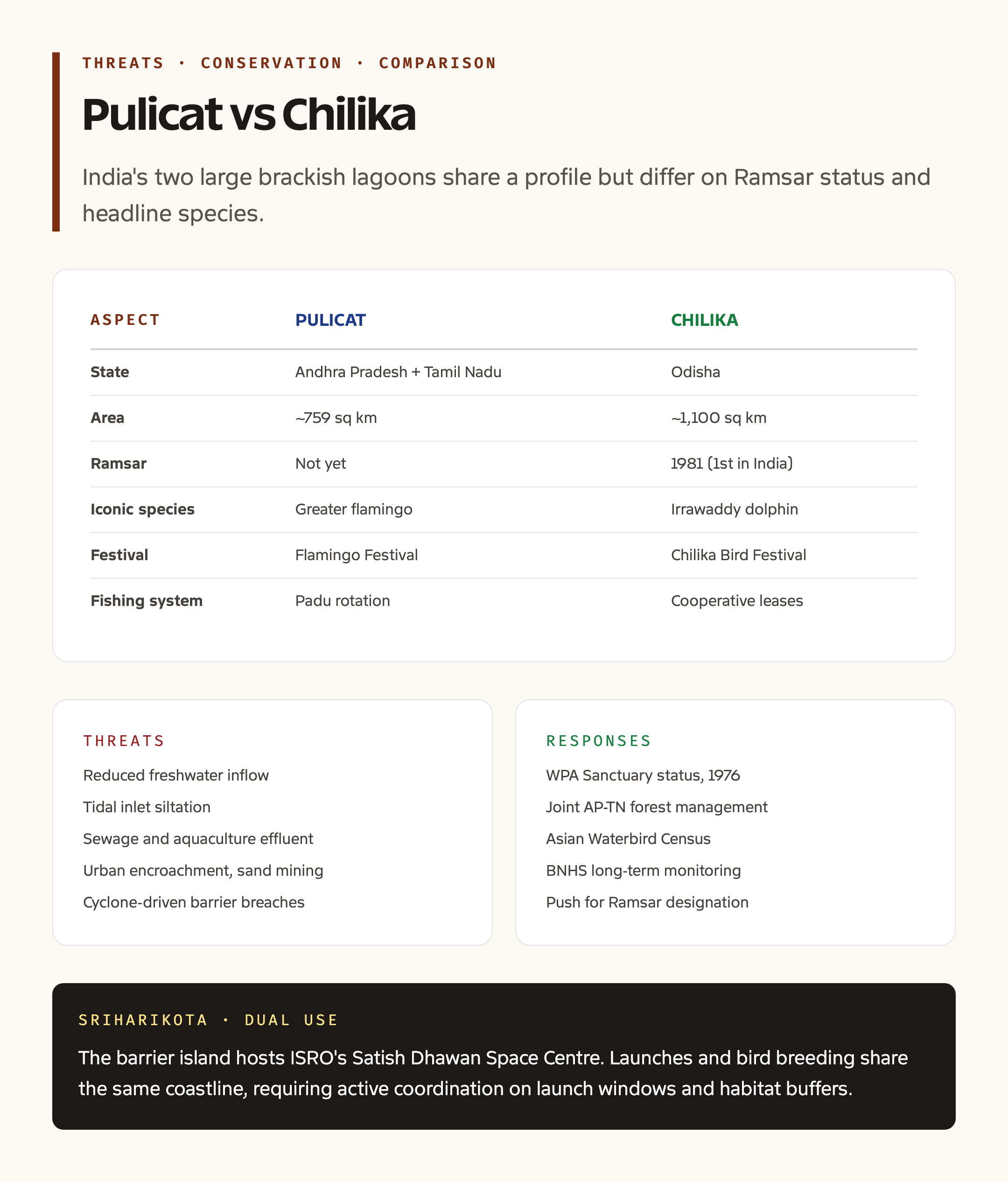
Pulicat is protected as a wildlife sanctuary, which gives it Wildlife Protection Act, 1972 status. The Andhra Pradesh forest department and the Tamil Nadu wildlife wing run patrolling and monitoring jointly with local panchayats. Bird counts are organised every winter under the Asian Waterbird Census, and the data feeds into BirdLife International’s regional analyses.
Civil society contributions have been substantial. The Bombay Natural History Society and BirdLife affiliates run long-term monitoring at Pulicat. Local cooperatives administer the padu fishing system and act as informal sentinels against poaching and habitat damage. Educational institutions in Chennai and Tirupati run field programmes on the lagoon’s ecology.
A push for Ramsar designation has been on the conservation agenda for years. Chilika became a Ramsar site as early as 1981, and the case for Pulicat is similar. Ramsar status would not change the day-to-day management much but would unlock international visibility, technical support, and reporting requirements that improve baseline data.
Linkages and Multi-Topic Connections
Pulicat ties into multiple UPSC threads. It connects to coastal regulation through the Coastal Regulation Zone notifications, which apply to lagoon shorelines. It connects to the Central Asian Flyway and the Convention on Migratory Species. It connects to the broader category of major lakes in India and to the Greater Flamingo species note. It connects to space policy through Sriharikota.
For prelims, expect direct factual questions on Pulicat’s location, its rank as the second largest brackish lagoon, its rivers, its bird sanctuary, and the Sriharikota link. For mains, Pulicat fits into questions on coastal ecosystem management, inter-state coordination on natural resources, migratory bird conservation, and the trade-offs between strategic infrastructure and environmental sites.
Way Forward
The agenda for Pulicat is straightforward but requires sustained effort. The tidal inlet needs periodic dredging to maintain marine connection. The Arani and Kalangi catchments need integrated management to keep freshwater inflow viable. Pollution from sewage and aquaculture needs treatment before discharge. Ramsar designation would lock in international monitoring. The Flamingo Festival should be expanded sensitively to support local livelihoods without disturbing the birds. And the inter-state mechanism between Andhra Pradesh and Tamil Nadu needs to be strengthened so that one state’s actions on water or pollution do not undo the other’s conservation work.
UPSC Relevance
For prelims, remember: Pulicat is the second largest brackish lagoon in India after Chilika; it is on the east coast across Andhra Pradesh and Tamil Nadu; the Arani and Kalangi rivers feed it; Sriharikota island lies between it and the Bay of Bengal; the Pulicat Lake Bird Sanctuary covers around 759 sq km; the Flamingo Festival is an Andhra Pradesh winter event.
For mains, Pulicat is a useful case for coastal ecosystem governance, the padu system as community resource management, and the integration of strategic infrastructure with sensitive habitats. Companion topics for cross-references include latest added Ramsar sites, wetlands of India, and olive ridley turtle for east-coast wildlife framing.
Frequently Asked Questions
Where is Pulicat Lake located?
Pulicat Lake lies on the east coast of India, north of Chennai. It straddles the border between Andhra Pradesh and Tamil Nadu, with about 84 per cent of its area in Andhra Pradesh and 16 per cent in Tamil Nadu. The lagoon is separated from the Bay of Bengal by Sriharikota island.
Is Pulicat a freshwater lake?
No, Pulicat is a brackish water lagoon. Its salinity oscillates between 5 to 15 parts per thousand in the wet season and 30 to 35 parts per thousand in the dry season. This mix supports freshwater, brackish, and marine species.
What is the rank of Pulicat among Indian lagoons?
Pulicat is the second largest brackish water lagoon in India after Chilika Lake in Odisha. Chilika is roughly 1,100 square kilometres, Pulicat around 759 square kilometres at high water.
Which rivers feed Pulicat Lake?
The Arani river and the Kalangi river feed Pulicat Lake, with seasonal contributions from a few smaller streams. Both rivers drain the eastern slopes of the local Eastern Ghats.
Why is Sriharikota associated with Pulicat?
Sriharikota is the barrier island that separates Pulicat from the Bay of Bengal. It hosts ISRO’s Satish Dhawan Space Centre, India’s primary satellite launch facility. Chandrayaan, Mangalyaan, and most other major Indian missions have flown from here.
When is the Flamingo Festival held at Pulicat?
The Flamingo Festival is held every January in Andhra Pradesh, centred on Sullurpeta near Pulicat. It celebrates the peak of the winter migratory bird season, when greater and lesser flamingos arrive in large numbers along with painted storks, pelicans, and shorebirds.
Is Pulicat a Ramsar site?
Pulicat is not yet a Ramsar site, though there is a long-running push for designation. It is protected under the Wildlife Protection Act, 1972 as the Pulicat Lake Bird Sanctuary, and recognised by BirdLife International as an Important Bird and Biodiversity Area.
Tell Google you want more of this.
Add Anantam IAS as a preferred sourceOne tap, and this site shows up more often in your own Top Stories, AI Overviews and AI Mode. Remove it any time.






