
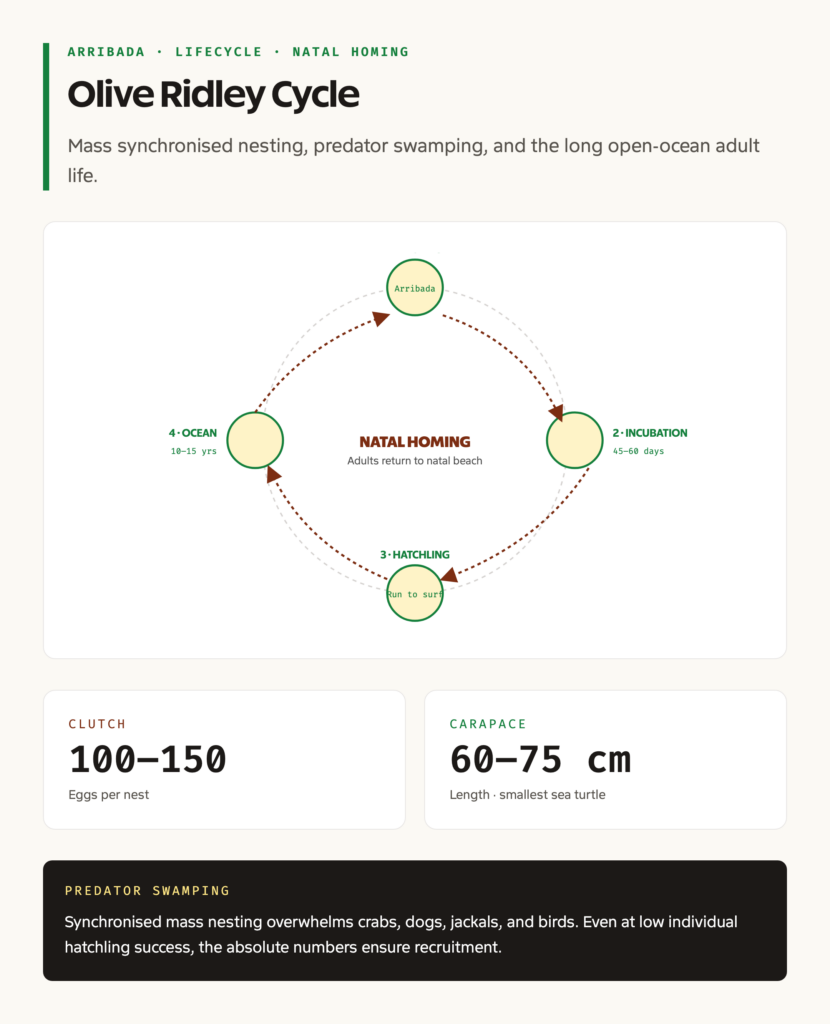
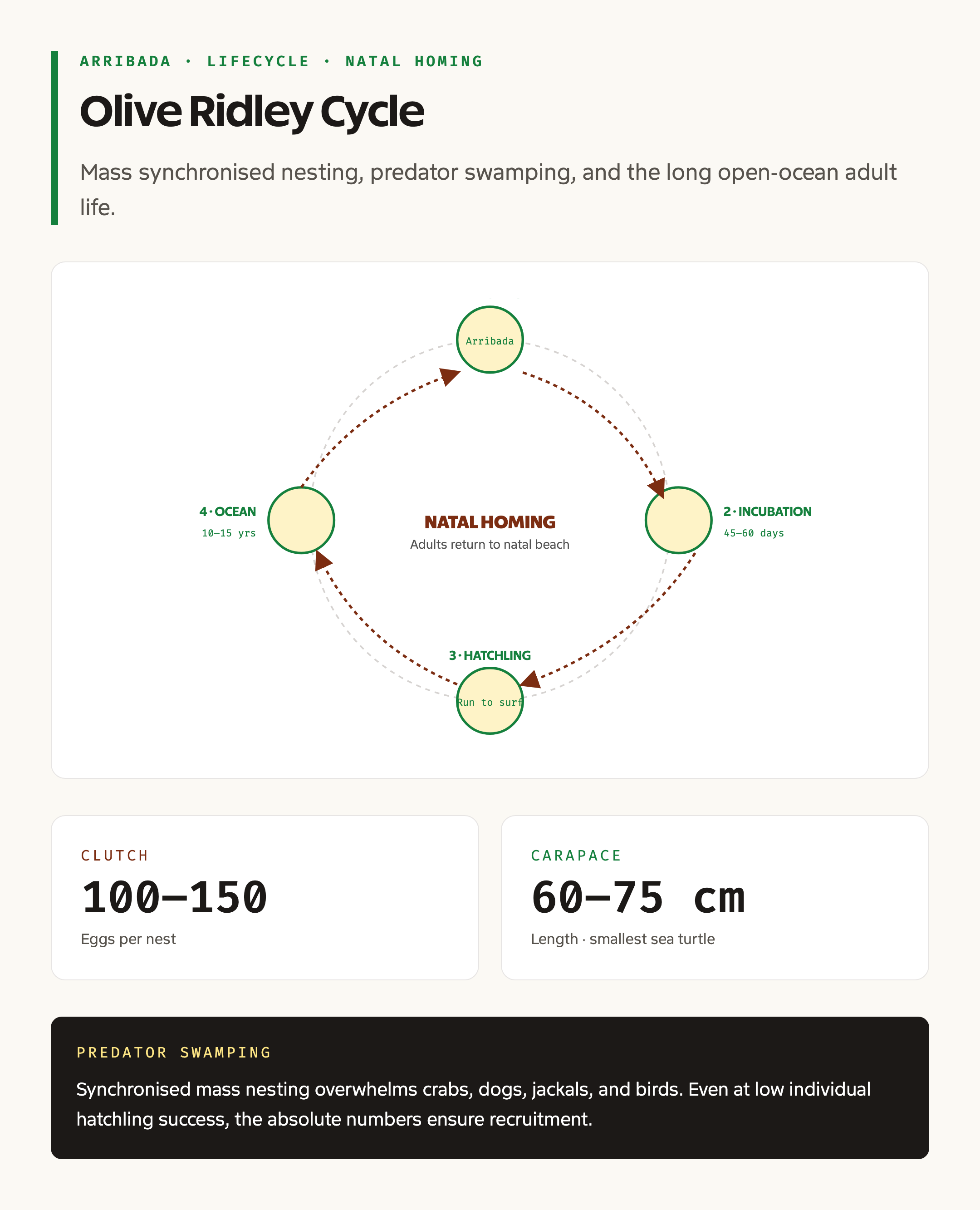
For roughly two weeks in late winter or early spring, the beaches at Gahirmatha and Rushikulya in Odisha host one of the most dramatic biological events on the Indian coast. Hundreds of thousands of olive ridley turtles, each a little larger than a dinner plate, swim in from the offshore congregation areas, haul themselves up the tideline at night, dig flask-shaped nests with their hind flippers, lay around 100 to 150 eggs each, cover the nests with sand, and return to the sea before sunrise. The phenomenon is called arribada, the Spanish word for arrival, and Gahirmatha is the largest known arribada beach in the world. Two months later, hatchlings the size of a fifty-rupee coin emerge in waves, scuttle to the surf, and disappear into the Bay of Bengal.
The olive ridley is the smallest of the seven sea turtle species, named for the olive-green tint of its carapace. It is widely distributed across the warm waters of the Pacific, Indian, and Atlantic oceans, but the synchronous mass nesting that defines it is restricted to a handful of beaches worldwide. India’s eastern coast, particularly the Odisha shoreline between the Mahanadi and Rushikulya river mouths, holds three of those beaches, making the country a globally critical site for the species’ continued survival. The Gahirmatha rookery alone has hosted single-season arribadas of over 600,000 nesting females in years of exceptional turnout.
Recent years have brought sharp concern over olive ridley deaths along the Odisha coast, driven mainly by mechanised trawlers operating in restricted nesting waters. The Indian Coast Guard’s Operation Olivia, run since the late 1990s, is the central instrument of state response. For UPSC, the olive ridley is a recurring prelims topic and a consistent mains entry into themes of marine protected areas, fisheries conflict, and biodiversity governance.
Quick Facts
- Scientific name: Lepidochelys olivacea
- Common name: Olive ridley sea turtle
- Size: Carapace 60 to 75 centimetres; weight 35 to 50 kilograms
- Distinguishing feature: Smallest of all sea turtles; olive-coloured carapace; numerous coastal scutes
- Diet: Omnivorous; feeds on jellyfish, algae, lobsters, crabs, and shrimp
- Distribution: Tropical and subtropical Pacific, Indian, and Atlantic oceans
- Mass nesting term: Arribada (Spanish for “arrival”)
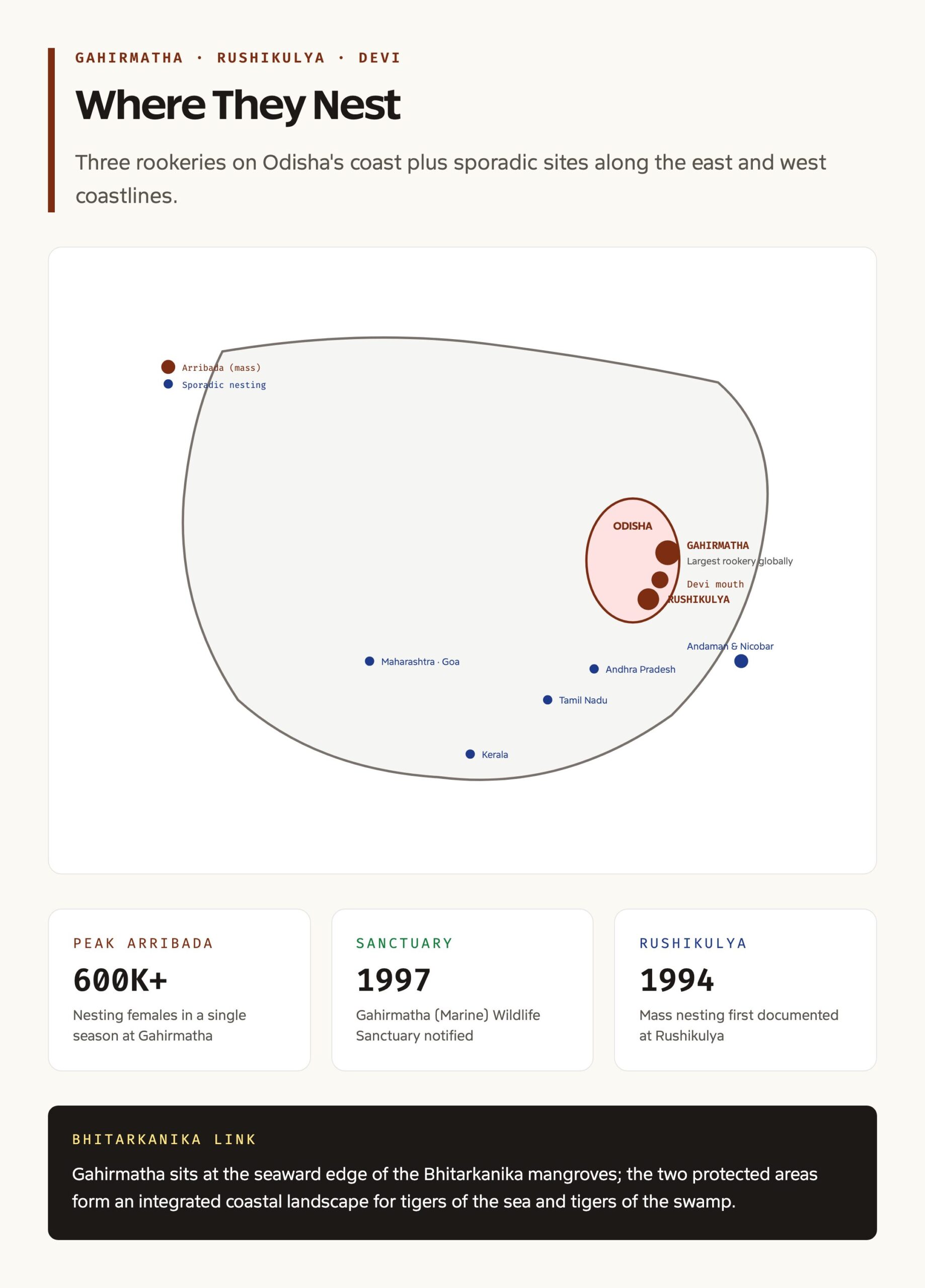
- Indian arribada beaches: Gahirmatha, Rushikulya, Devi river mouth (all Odisha)
- Other Indian nesting sites: Andaman and Nicobar Islands, Tamil Nadu, Andhra Pradesh, Maharashtra, Goa, Kerala
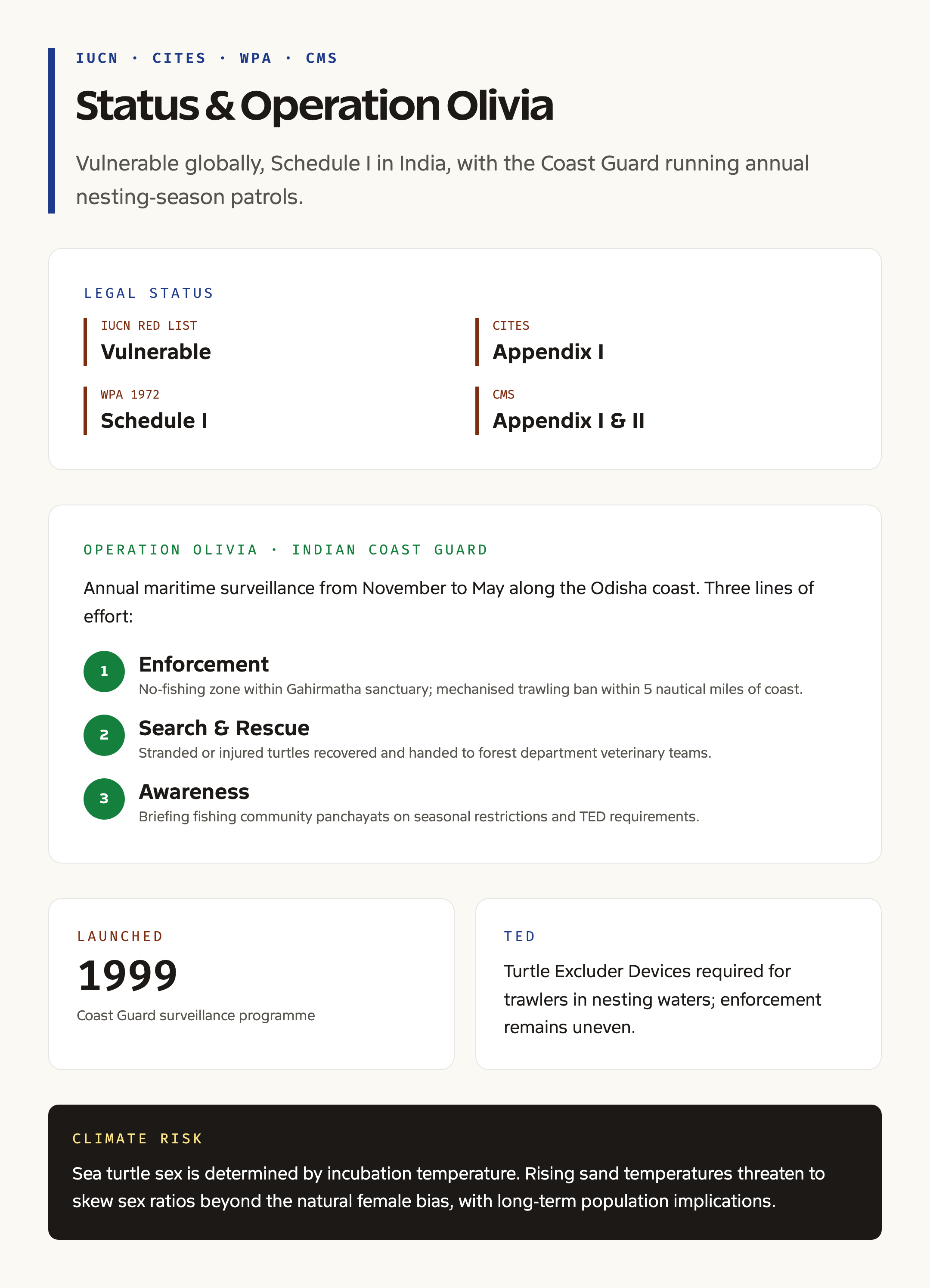
- IUCN Red List status: Vulnerable
- Wildlife (Protection) Act, 1972: Schedule I (highest protection)
- CITES status: Appendix I (international trade prohibited)
- CMS status: Appendix I and II (Convention on Migratory Species)
- State response: Operation Olivia, Indian Coast Guard, since 1999
- Natal homing: Females return to nest at the beach where they were born
- Hatchling emergence: 45 to 60 days after egg laying
What Is the Olive Ridley Turtle
The olive ridley is a marine reptile and one of seven extant sea turtle species, the others being the leatherback, green, hawksbill, loggerhead, flatback, and Kemp’s ridley. The genus Lepidochelys has only two species, the olive ridley and the closely related Kemp’s ridley, distinguished primarily by colour, range, and nesting beaches. Olive ridleys are characterised by a heart-shaped carapace, six to eight pairs of coastal scutes (more than any other sea turtle), and a robust, parrot-like beak adapted for an omnivorous diet.
Olive ridleys spend most of their adult lives in the open ocean, foraging in the upper water column and occasionally diving to several hundred metres. Sub-adult turtles often associate with floating vegetation rafts and ocean fronts, where prey concentrations are high. Adults are largely solitary except during the mating season and the nesting aggregations.
The species’ defining biological feature is the arribada. While individual nesting (called sporadic nesting) happens routinely, mass synchronised nesting is restricted to a few beaches in the eastern Pacific (Costa Rica’s Ostional and Nancite, Mexico’s La Escobilla), the eastern Atlantic (parts of West Africa), and the Indian Ocean (Odisha’s three rookeries). The cue for the mass arrival is not fully understood. Lunar cycle, tidal range, offshore current patterns, wind direction, and beach temperature have all been proposed as triggers, with the general consensus that the synchronisation evolved as a predator-swamping strategy. By laying so many eggs in a short window, the turtles overwhelm the capacity of crabs, dogs, jackals, and birds to predate hatchlings.
Background and Historical Context
Sea turtles have been part of coastal Indian culture and subsistence for centuries, with references in Sangam-era Tamil literature, in Odia coastal folklore, and in fishing community taboos along the Konkan and Malabar coasts. Systematic scientific attention to the olive ridley nesting in Odisha, however, began only in 1974, when biologist Bivash Pandav and colleagues at the Wildlife Institute of India and the Bombay Natural History Society documented the Gahirmatha arribada and pushed for formal protection.
The Three Major Rookeries
Gahirmatha sits at the mouth of the Brahmani-Baitarani delta in the Kendrapara district of Odisha. The beach is a barrier strip in front of the Bhitarkanika mangroves and faces the Bay of Bengal. It was notified as the Gahirmatha (Marine) Wildlife Sanctuary in 1997, the only marine wildlife sanctuary in India dedicated specifically to olive ridley protection. In peak years, single-season arribadas have crossed 600,000 nesting females, making this beach the largest known olive ridley rookery in the world.
Rushikulya is a smaller but biologically significant rookery near the mouth of the Rushikulya river in the Ganjam district. Mass nesting was first documented at Rushikulya in 1994, well after Gahirmatha was already on the conservation map. Annual nesting numbers vary widely, from less than 50,000 in lean years to over 500,000 in the best years.
Devi river mouth, in the Puri district, is the third arribada beach. Numbers here have declined relative to historical estimates, attributed to delta dynamics, sand mining, and mechanised fishing pressure. The site continues to host significant sporadic nesting.
Beyond these three, sporadic nesting is reported from the Andaman and Nicobar Islands (where leatherbacks also nest), Tamil Nadu (Chennai to the Cauvery delta), Andhra Pradesh (Visakhapatnam to Krishna delta), Maharashtra (Velas, Anjarle), Goa, and Kerala (Kolavipalam).
Why It Matters
The olive ridley occupies a specific niche in the marine food web. Adults feed on jellyfish, crustaceans, and small molluscs, controlling jellyfish populations that otherwise compete with commercial fisheries. The hatchlings serve as prey for a long list of marine predators and feed pelagic food chains during their early years. The mass arribada itself transfers nutrients from the ocean to the beach in the form of unhatched eggs, deceased adults, and hatchling biomass that does not survive the run to the sea, fertilising the dune and back-beach ecosystem.
The species is a flagship for marine conservation in India. Public concern for olive ridleys has been the political driver behind much of the marine protected area policy on the east coast, including Gahirmatha sanctuary, the seasonal trawling ban (November to May along the Odisha coast), and the requirement that mechanised fishing vessels operating in the area carry Turtle Excluder Devices (TEDs).
The cultural value is substantial in Odisha. Local communities at Rushikulya and Bhitarkanika have organised hatchling-protection volunteer networks. Schoolchildren at Gokharkuda and Purunabandha villages adopt nests during peak season, and the annual arribada has become a sustainable tourism draw, carefully regulated to avoid disturbance.
Detailed Analysis: Threats and Conservation
Trawler bycatch is the largest single threat. Mechanised trawlers operate in offshore waters where olive ridleys congregate before nesting. Adult turtles caught in trawl nets typically drown within 30 to 90 minutes if the net is left submerged. Hundreds of dead turtles wash ashore at Gahirmatha and Rushikulya each season, with peaks correlating to violations of the seasonal ban or fishing inside the sanctuary boundary. The Indian Coast Guard’s Operation Olivia is the principal enforcement mechanism.
Marine debris and plastic ingestion is a growing concern. Olive ridleys eat jellyfish and easily mistake floating plastic bags for prey. Necropsies on stranded turtles have repeatedly shown plastic in the digestive tract.
Coastal development affects nesting beaches. Sand mining, dune flattening, beach hotels, and bright artificial lights disorient hatchlings, which use the natural horizon brightness over the sea to find their way to the water. Light pollution near Rushikulya and Visakhapatnam has been documented to reduce hatchling success.
Climate change presents a structural risk. Sea turtle sex is determined by incubation temperature: warmer sand produces females, cooler sand produces males. Rising sand temperatures at Indian rookeries threaten to skew sex ratios beyond the female-biased norm, with long-term implications for population viability. Sea-level rise and increased cyclone intensity also erode nesting beaches and inundate buried clutches.
Predation by feral dogs, jackals, monitor lizards, and crows takes a steady toll on eggs and hatchlings. Volunteer hatcheries at Rushikulya and Velas relocate threatened clutches to fenced enclosures, raising hatch success.
Operation Olivia
Operation Olivia is the Indian Coast Guard’s annual maritime surveillance operation for the protection of olive ridley turtles. Launched in 1999 and run as a sustained programme since, it deploys offshore patrol vessels, fast interceptor craft, Dornier maritime patrol aircraft, and helicopters across the Odisha coast from November to May, the period covering offshore congregation, mating, mass nesting, and hatchling emergence.
The operation works on three lines of effort. The first is enforcement of the no-fishing zone within the Gahirmatha sanctuary and the broader prohibition on mechanised trawling within five nautical miles of the coast. Vessels operating in violation are detained, their gear confiscated, and operators prosecuted under the Wildlife Protection Act and the Maritime Zones of India Act. The second is search and rescue: stranded or injured turtles are recovered and handed to forest department veterinary teams. The third is awareness and outreach: the Coast Guard works with the Forest Department, fisheries department, and local NGOs to brief fishing community panchayats on the seasonal restrictions.
Operation Olivia has materially reduced trawler-induced mortality but has not eliminated it. Continued mortality reports during recent nesting seasons reflect the gap between patrol coverage and the sheer scale of the fishing fleet.
Comparative Frame
| Sea Turtle Species | Carapace Length | Distribution | Indian Nesting | IUCN Status |
|---|---|---|---|---|
| Olive Ridley | 60 to 75 cm | Pan-tropical | Odisha (mass), east and west coasts | Vulnerable |
| Leatherback | 130 to 180 cm | Global, including subpolar | Andaman and Nicobar Islands | Vulnerable |
| Green | 80 to 120 cm | Tropical worldwide | Lakshadweep, Andamans, Gujarat | Endangered |
| Hawksbill | 60 to 95 cm | Tropical reefs | Lakshadweep, Andamans | Critically Endangered |
| Loggerhead | 80 to 100 cm | Temperate to tropical | Sporadic on east coast | Vulnerable |
| Kemp’s Ridley | 55 to 75 cm | Gulf of Mexico, Atlantic | None in India | Critically Endangered |
| Flatback | 75 to 95 cm | Northern Australia | None in India | Data Deficient |
The olive ridley is the most numerous sea turtle in India and the only one with arribada-scale nesting on the mainland.
Challenges
Beyond direct mortality, the olive ridley faces structural pressures. Fisheries policy is a continuous tension. The fishing community has legitimate livelihood claims and has resisted seasonal bans and TED requirements. The Forest Department, Coast Guard, and Fisheries Department occasionally pull in different directions. The marine sanctuary has limited carrying capacity for tourism, and excessive crowding during arribada can disturb nesting. Plastic pollution requires upstream waste management investment, not just beach cleaning. The data picture, while better than for many marine species, still has gaps in juvenile and sub-adult survival, which constrain population modelling.
Prelims Pointers
- Scientific name: Lepidochelys olivacea; smallest sea turtle
- Mass synchronous nesting is called arribada (Spanish, “arrival”)
- Three major Indian rookeries: Gahirmatha, Rushikulya, Devi river mouth (all Odisha)
- Gahirmatha is the largest olive ridley rookery in the world
- Notified as Gahirmatha (Marine) Wildlife Sanctuary in 1997, India’s only marine wildlife sanctuary specifically for olive ridleys
- IUCN: Vulnerable; Wildlife (Protection) Act, 1972: Schedule I; CITES: Appendix I
- Operation Olivia: Indian Coast Guard initiative since 1999
- Females practise natal homing, returning to the beach of their birth
- Sex is determined by nest temperature (warmer = female)
- Bhitarkanika mangroves lie immediately inland of Gahirmatha
Mains Practice Questions
- Mass nesting of olive ridley turtles at Odisha’s beaches is a globally significant biological event. Discuss the ecological and conservation significance, and assess India’s institutional response through Operation Olivia and the Gahirmatha (Marine) Wildlife Sanctuary.
- Examine the conflict between mechanised fisheries and marine protected areas on India’s east coast, with particular reference to the olive ridley nesting season. What policy mix would balance conservation and livelihood concerns?
- Climate change introduces structural risks for sea turtles, including the olive ridley. Identify these risks and suggest a long-term conservation strategy that incorporates climate adaptation.
Way Forward
A robust olive ridley strategy needs to operate at three scales. At the beach scale, hatchery management, light pollution control, dune restoration, and community volunteer networks need sustained funding through the Forest Department’s marine wing and the Compensatory Afforestation Fund. At the offshore scale, Operation Olivia patrol coverage, satellite-tracked vessel monitoring, and stronger TED enforcement remain central. At the regional scale, India’s role under the Indian Ocean and South-East Asian Memorandum of Understanding on Marine Turtles offers a framework for coordination across nesting and migration ranges, including with Sri Lanka, Bangladesh, Myanmar, and the Maldives.
The species is, on the face of it, abundant globally. It is also tied to a tiny number of beaches for reproduction, which makes it structurally fragile. India holds three of those beaches. The conservation outcome therefore depends as much on Indian state action as on any other country in the species’ range.
Frequently Asked Questions
What is an arribada?
An arribada is the synchronised mass nesting of olive ridley or Kemp’s ridley sea turtles, in which tens of thousands of females come ashore over a few nights at a single beach to lay eggs. The Spanish word means u0022arrival.u0022
Why do olive ridleys nest in Odisha specifically?
The Odisha coast offers a combination of suitable sand grain size, beach slope, offshore current pattern, and a delta-fed nutrient supply that supports a large offshore congregation of females. Gahirmatha, Rushikulya, and Devi river mouth all sit at or near major river mouths.
What is Gahirmatha (Marine) Wildlife Sanctuary?
Gahirmatha is India’s only marine wildlife sanctuary specifically dedicated to olive ridley turtle protection, notified in 1997. It covers the offshore congregation and nesting waters off the Bhitarkanika coast in Odisha’s Kendrapara district.
What is Operation Olivia?
Operation Olivia is the Indian Coast Guard’s annual maritime surveillance operation for olive ridley protection, run from November to May each year. It enforces fishing restrictions, conducts search and rescue, and supports awareness work in coastal villages.
What is the IUCN status of the olive ridley?
The olive ridley is classified as Vulnerable on the IUCN Red List, listed on Schedule I of the Wildlife (Protection) Act, 1972 in India, and on Appendix I of CITES, which prohibits international trade.
Are olive ridley turtles endangered?
The species is classified as Vulnerable rather than Endangered, but it faces structural threats including trawler bycatch, plastic ingestion, climate-driven sex ratio skew, and habitat loss at nesting beaches. The status reflects relative abundance globally rather than the absence of threat.
What is natal homing?
Natal homing is the behaviour of female sea turtles returning to nest at the same beach where they were born, often after decades at sea. The mechanism is believed to involve geomagnetic imprinting, supplemented by chemical and visual cues near the beach.
How are olive ridley hatchlings protected at Rushikulya?
Local volunteers, in partnership with the Forest Department and NGOs like the Olive Ridley Project and Action for Protection of Wild Animals, run nest protection enclosures, monitor emergence, reduce light pollution, and chaperone hatchlings to the surf during peak emergence nights.
What is a Turtle Excluder Device?
A Turtle Excluder Device is a metal grid fitted into a trawl net that allows large bycatch like sea turtles to escape through an opening while retaining smaller commercial fish. India requires TEDs for trawlers operating in olive ridley nesting waters, though enforcement has been uneven.
What is the difference between olive ridley and Kemp’s ridley turtles?
Both belong to the genus Lepidochelys. Kemp’s ridley is restricted mainly to the Gulf of Mexico and the Atlantic coast of North America, has a slightly more rounded carapace, and is critically endangered. Olive ridleys are pan-tropical and classified as vulnerable, with a wider distribution and larger global population.
Tell Google you want more of this.
Add Anantam IAS as a preferred sourceOne tap, and this site shows up more often in your own Top Stories, AI Overviews and AI Mode. Remove it any time.





