Panchayati Raj System in India: 73rd Amendment
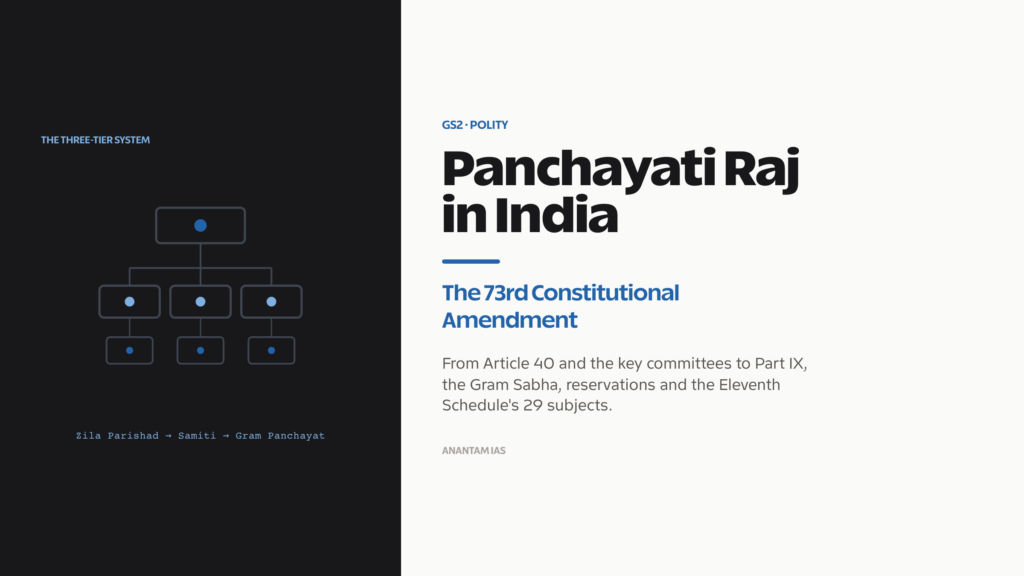
The Panchayati Raj system is India’s constitutionally mandated framework for grassroots democracy, established through the 73rd Constitutional Amendment Act of 1992. It creates a three-tier structure of local self-governance — Gram Panchayat, Panchayat Samiti, and Zila Parishad — bringing democratic decision-making to rural India’s 6 lakh+ villages. For UPSC aspirants, this topic carries significant weight in both Prelims and Mains under Indian Polity and Governance.
Historical Evolution of Panchayati Raj
The concept of village self-governance isn’t new to India. Ancient texts reference sabhas and samitis as village assemblies. But the modern journey began with specific constitutional and committee recommendations.
Pre-Independence Roots
The British colonial administration introduced limited local governance through the Royal Commission on Decentralization (1907) and the Government of India Act, 1919, which transferred local self-government to Indian ministers under dyarchy. The Government of India Act, 1935 further expanded provincial autonomy but didn’t create a structured village-level governance system.
Mahatma Gandhi championed the idea of Gram Swaraj — village self-rule — as the foundation of Indian democracy. His vision placed the village republic at the centre of governance, a principle that influenced the Constituent Assembly debates.
Constituent Assembly and Article 40
During the framing of the Constitution, Panchayati Raj found place not in the enforceable Fundamental Rights but in the Directive Principles of State Policy. Article 40 directs the State to organise village panchayats and endow them with powers necessary for functioning as units of self-government. This positioning made Panchayati Raj a policy aspiration rather than a justiciable right — a gap the 73rd Amendment later addressed.
Key Committees That Shaped the System
| Committee | Year | Key Recommendation |
|---|---|---|
| Balwant Rai Mehta Committee | 1957 | Three-tier Panchayati Raj structure; democratic decentralisation |
| Ashok Mehta Committee | 1978 | Two-tier system; direct elections; constitutional status |
| G.V.K. Rao Committee | 1985 | Regular elections; planning at district level |
| L.M. Singhvi Committee | 1986 | Constitutional recognition; Gram Sabha empowerment |
The Balwant Rai Mehta Committee’s recommendation led Rajasthan to become the first state to establish Panchayati Raj institutions in 1959, followed by Andhra Pradesh. However, without constitutional backing, these institutions remained weak and dependent on state governments.
The 73rd Constitutional Amendment Act, 1992
The 73rd Amendment, which came into effect on 24 April 1993 (celebrated as National Panchayati Raj Day), added Part IX to the Constitution. It transformed Panchayati Raj from a policy directive into a constitutional mandate.
Key Provisions
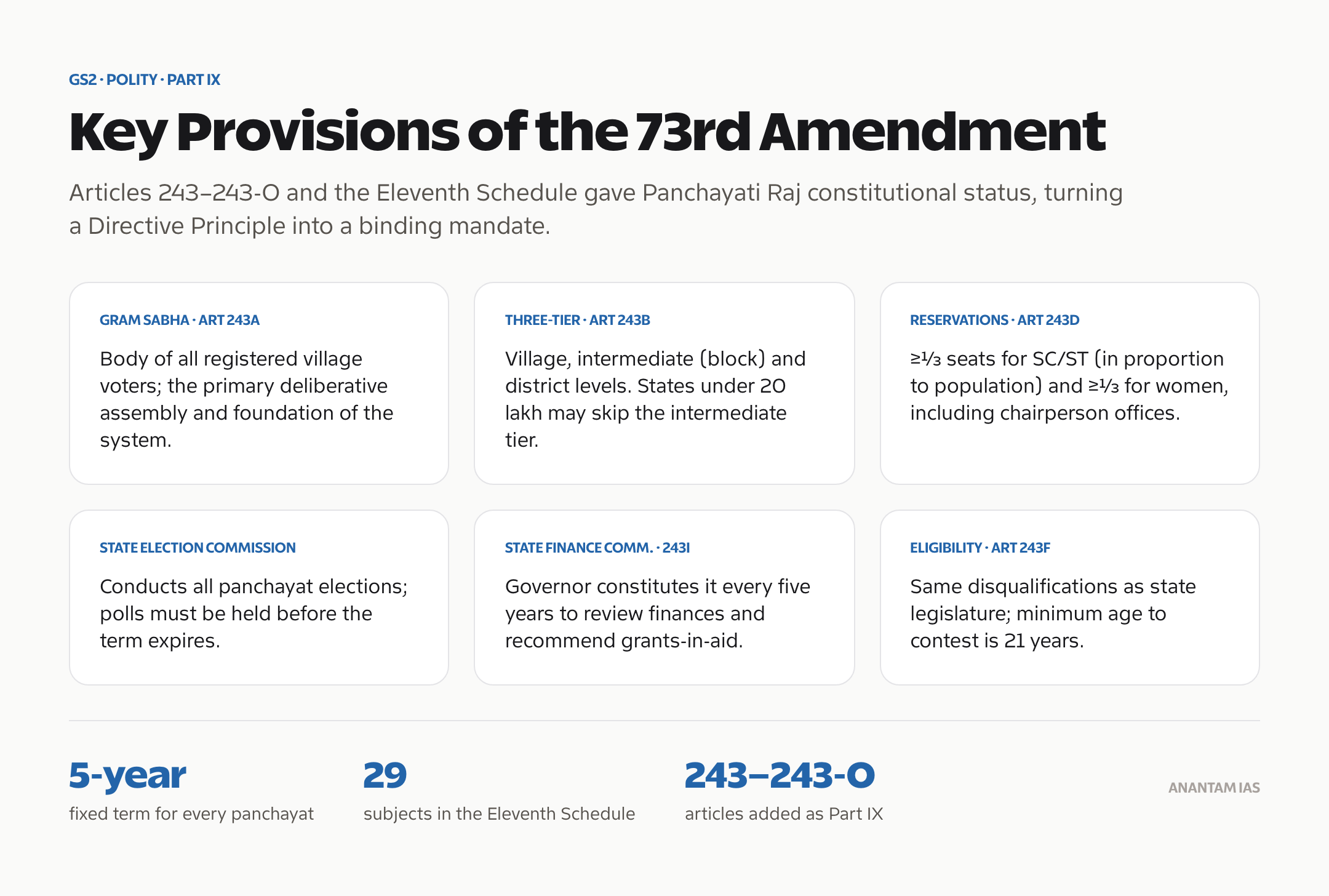
The Amendment inserted Articles 243 to 243-O and added the Eleventh Schedule listing 29 subjects for panchayat governance. Here are the core provisions:
Gram Sabha (Article 243A): The foundation of the system. Every village gets a Gram Sabha — a body of all registered voters — that functions as the primary deliberative assembly. State legislatures determine its powers and functions.
Three-Tier Structure (Article 243B): Panchayats at three levels — village, intermediate (block), and district. States with populations below 20 lakh may skip the intermediate tier.
Composition and Elections (Articles 243C-243K):
- Direct elections for all seats at every level
- Indirect election of chairpersons at intermediate and district levels (state option)
- Five-year term for all panchayats
- State Election Commission to conduct elections
- Elections must be held before the expiry of the five-year term
Reservation Provisions (Articles 243D):
- Not less than one-third seats reserved for Scheduled Castes and Scheduled Tribes in proportion to their population
- Not less than one-third of total seats reserved for women (including SC/ST women)
- Reservation of offices of chairpersons for SCs, STs, and women
- States may provide reservation for Other Backward Classes
State Finance Commission (Article 243I): The Governor constitutes a Finance Commission every five years to review the financial position of panchayats and recommend grants-in-aid from the Consolidated Fund of the State.
Disqualifications (Article 243F): A person shall be disqualified if disqualified under any law for elections to the state legislature. No person shall be disqualified on the ground that they’re less than 25 years of age if they’ve attained 21 years.
Subjects Under the Eleventh Schedule
The Eleventh Schedule lists 29 subjects over which panchayats may exercise authority. These include:
- Agriculture and extension
- Land improvement and soil conservation
- Minor irrigation and water management
- Animal husbandry, dairying, and poultry
- Fisheries
- Social forestry and farm forestry
- Minor forest produce
- Small-scale industries
- Khadi, village, and cottage industries
- Rural housing
- Drinking water
- Fuel and fodder
- Roads, culverts, bridges, ferries, and waterways
- Rural electrification
- Non-conventional energy sources
- Poverty alleviation programmes
- Education (primary and secondary)
- Technical training and vocational education
- Adult and non-formal education
- Libraries
- Cultural activities
- Markets and fairs
- Health and sanitation (hospitals, PHCs, dispensaries)
- Family welfare
- Women and child development
- Social welfare (handicapped and mentally retarded)
- Welfare of weaker sections (SC/ST)
- Public distribution system
- Maintenance of community assets
Three-Tier Structure Explained
Gram Panchayat (Village Level)
The Gram Panchayat is the basic unit of democratic governance. Members called Panches are directly elected by the Gram Sabha. The Sarpanch (chairperson) is either directly elected or chosen from among the Panches, depending on state law.
The Gram Sabha meets at least twice a year to approve the budget, review audit reports, and identify beneficiaries for development schemes. The 73rd Amendment makes the Gram Sabha the cornerstone of participatory democracy.
Key functions include maintenance of village roads, sanitation, street lighting, drinking water supply, and implementation of government schemes like MGNREGA.
Panchayat Samiti (Block/Intermediate Level)
The Panchayat Samiti operates at the block or taluka level. It coordinates planning and development across multiple Gram Panchayats. Members include elected representatives from constituent Gram Panchayats, MLAs and MPs from the area (without voting rights in some states), and co-opted members.
The Block Development Officer (BDO) serves as the executive officer. The Panchayat Samiti primarily handles agriculture extension, primary health centres, rural water supply schemes, and education at the block level.
Zila Parishad (District Level)
The Zila Parishad sits at the apex of the three-tier system. The chairperson is elected from among the elected members. The District Collector or Chief Executive Officer provides administrative support.
Functions include preparation of district development plans, coordination between Panchayat Samitis, distribution of funds among lower tiers, and supervision of block-level activities. The Zila Parishad also links Panchayati Raj institutions with the state government.
Comparison: 73rd vs 74th Amendment
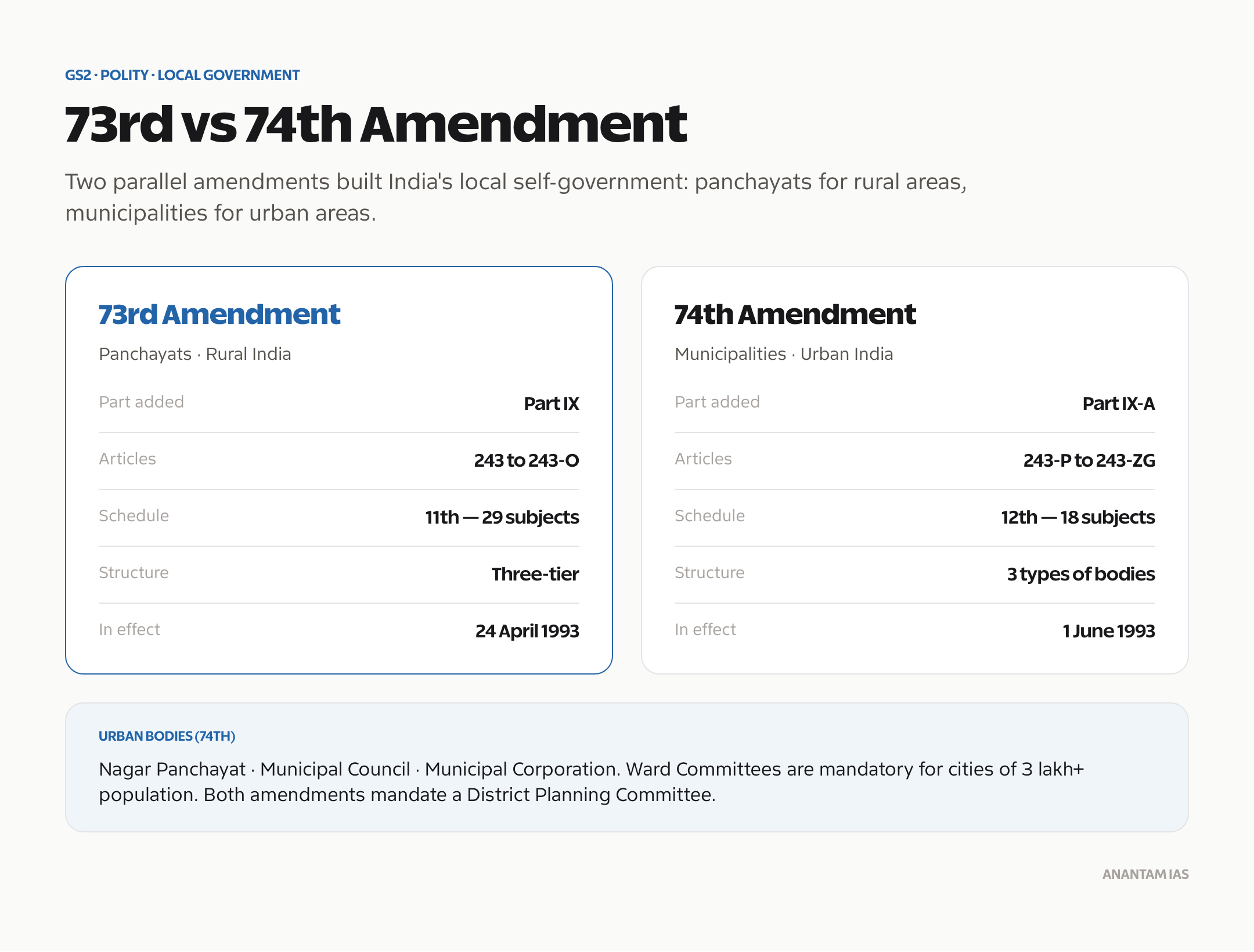
| Feature | 73rd Amendment (Panchayats) | 74th Amendment (Municipalities) |
|---|---|---|
| Part Added | Part IX | Part IX-A |
| Articles | 243 to 243-O | 243-P to 243-ZG |
| Schedule | Eleventh Schedule (29 subjects) | Twelfth Schedule (18 subjects) |
| Area | Rural | Urban |
| Structure | Three-tier | Three types: Nagar Panchayat, Municipal Council, Municipal Corporation |
| Date of Effect | 24 April 1993 | 1 June 1993 |
| Ward Committees | Not applicable | Mandatory for 3 lakh+ population |
| District Planning | District Planning Committee | District Planning Committee |
PESA Act, 1996: Extension to Scheduled Areas
The Provisions of the Panchayats (Extension to Scheduled Areas) Act, 1996 extends Part IX to the Fifth Schedule areas with modifications. PESA recognises the rights of tribal communities to self-governance and their traditional practices.
Key features of PESA:
- Gram Sabha is competent to safeguard and preserve traditions, customs, and cultural identity
- Gram Sabha must approve plans and programmes for social and economic development
- Gram Sabha has ownership of minor forest produce
- Recommendations of Gram Sabha or Panchayat are mandatory before granting prospecting licences or mining leases
- Prior consultation with Gram Sabha required before land acquisition
Ten states have Fifth Schedule areas: Andhra Pradesh, Telangana, Chhattisgarh, Gujarat, Himachal Pradesh, Jharkhand, Madhya Pradesh, Maharashtra, Odisha, and Rajasthan.
Challenges Facing Panchayati Raj
Inadequate Devolution of Powers
Despite the constitutional mandate, many states haven’t fully devolved functions, funds, and functionaries — the “3Fs” — to panchayats. The Second Administrative Reforms Commission noted that activity mapping (clearly defining which level handles which function) remains incomplete in most states.
Financial Weakness
Panchayats generate minimal own revenue. They depend heavily on grants from state and central governments. The State Finance Commissions, meant to strengthen panchayat finances, often lack teeth and their recommendations aren’t binding on state governments.
Proxy Representation
The “Sarpanch Pati” phenomenon — where male family members exercise power on behalf of elected women representatives — undermines the spirit of reservation. Capacity building and political empowerment of women remain significant challenges.
Bureaucratic Control
District administration often retains actual control over planning and implementation, reducing panchayats to mere implementing agencies rather than self-governing bodies. The parallel bodies like District Rural Development Agencies (DRDAs) sometimes bypass panchayat structures.
Irregularity of Elections
Some states have delayed panchayat elections despite the constitutional mandate. The Supreme Court in Kishan Singh Tomar v. Municipal Corporation of Ahmedabad (2006) emphasised that regular elections are essential for democratic decentralisation.
Recent Developments and Reforms
The Rashtriya Gram Swaraj Abhiyan (RGSA) launched in 2018 focuses on capacity building of elected panchayat representatives. The scheme aims to strengthen governance capabilities at the grassroots level with a budget of Rs 7,255 crore.
The Localised Sustainable Development Goals (SDGs) initiative maps the 17 SDGs to the 29 subjects of the Eleventh Schedule. This “sabka saath, sabka vikas” approach gives panchayats a framework for comprehensive local development planning.
The e-Gram Swaraj portal and app provide a digital platform for decentralised planning, accounting, and monitoring of Panchayati Raj institutions across India.
Directive Principles of State Policy Constitutional Amendment Process in India Election Commission of India
Frequently Asked Questions
What is the Panchayati Raj system in India?
The Panchayati Raj system is a three-tier local self-governance structure for rural India — Gram Panchayat (village), Panchayat Samiti (block), and Zila Parishad (district). Constitutionalised through the 73rd Amendment in 1992, it empowers elected local bodies to handle 29 subjects listed in the Eleventh Schedule, bringing democratic governance to the grassroots.
Which committee recommended the three-tier Panchayati Raj structure?
The Balwant Rai Mehta Committee (1957) recommended the three-tier Panchayati Raj structure comprising village, block, and district levels. Following this recommendation, Rajasthan became the first state to establish Panchayati Raj institutions in 1959, with Nagaur district being the first to implement the system.
What is the role of the Gram Sabha in Panchayati Raj?
The Gram Sabha — comprising all registered voters of a village — is the foundation of the Panchayati Raj system. It approves annual budgets, reviews audit reports, selects beneficiaries for government schemes, and holds Gram Panchayat members accountable. Under PESA, tribal Gram Sabhas also control minor forest produce and must approve land acquisition proposals.
How does the 73rd Amendment ensure women’s participation?
The 73rd Amendment mandates reservation of not less than one-third of all seats and offices of chairpersons for women at all three tiers of Panchayati Raj. Many states like Bihar, Uttarakhand, and Rajasthan have increased this to 50%. This has brought over 14 lakh elected women representatives into local governance across India.
What is the difference between Panchayati Raj and Municipal governance?
Panchayati Raj (73rd Amendment) governs rural areas through a three-tier system handling 29 subjects under the Eleventh Schedule. Municipal governance (74th Amendment) covers urban areas through Nagar Panchayats, Municipal Councils, and Municipal Corporations handling 18 subjects under the Twelfth Schedule. Both share the goal of democratic decentralisation.
Tell Google you want more of this.
Add Anantam IAS as a preferred sourceOne tap, and this site shows up more often in your own Top Stories, AI Overviews and AI Mode. Remove it any time.