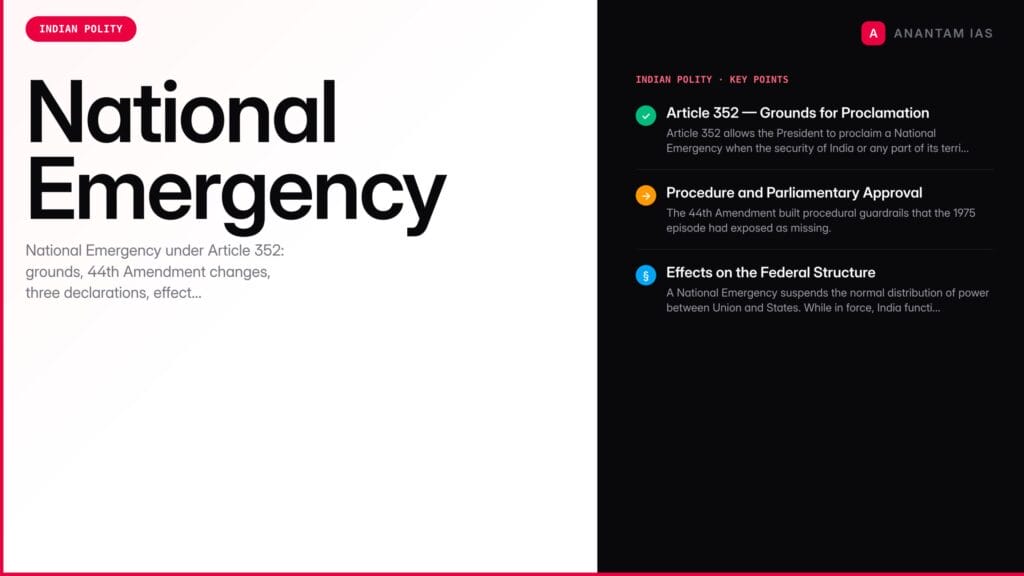
A National Emergency is the gravest of the three emergency provisions in the Indian Constitution. When proclaimed, it converts the federal structure into a near-unitary one, empowers Parliament to legislate on State subjects, and permits the suspension of most Fundamental Rights. The provision sits in Part XVIII (Articles 352–360) and has been invoked only three times since 1950. Each invocation reshaped the law — and the 44th Constitutional Amendment (1978) rewrote the rules to make misuse far harder.
Article 352 — Grounds for Proclamation
Article 352 allows the President to proclaim a National Emergency when the security of India or any part of its territory is threatened. The original Constitution listed three grounds. The 44th Amendment substituted one term to raise the threshold.
| Ground | Original (1950) | Post-44th Amendment (1978) |
|---|---|---|
| External threat | War | War |
| Foreign aggression | External aggression | External aggression |
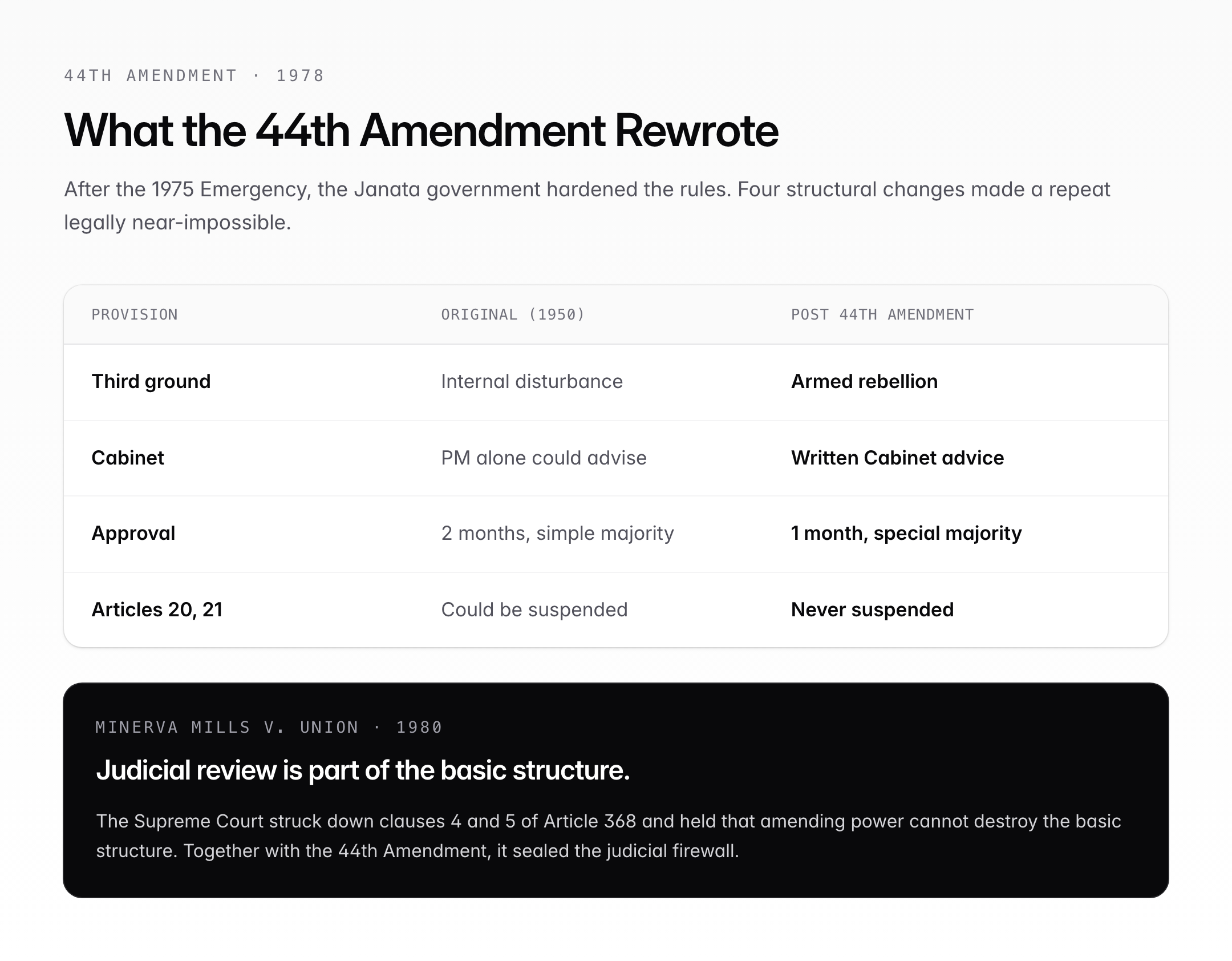
| Domestic upheaval | Internal disturbance | Armed rebellion |
The shift from "internal disturbance" to armed rebellion closed the loophole that Indira Gandhi exploited in 1975. Political protest, strikes, or civil unrest no longer qualify — the disturbance must rise to organised, violent insurrection.
Emergency can be declared even before actual war or aggression occurs, so long as the President is satisfied that an imminent danger exists. It can cover the whole of India or any specified part.
Procedure and Parliamentary Approval
The 44th Amendment built procedural guardrails that the 1975 episode had exposed as missing.
| Stage | Rule |
|---|---|
| Cabinet recommendation | Proclamation requires written recommendation of the Union Cabinet (not just the PM) |
| Initial validity | One month from the date of proclamation |
| Parliamentary approval | Both Houses must approve by special majority within one month |
| Extension | Every six months with fresh parliamentary approval |
| Maximum duration | Indefinite, if renewed every six months |
| Revocation | By subsequent presidential proclamation; Lok Sabha can force revocation by simple majority |
The special majority required for approval is a majority of the total membership of each House plus a two-thirds majority of members present and voting — the same standard used for constitutional amendments.
Effects on the Federal Structure
A National Emergency suspends the normal distribution of power between Union and States. While in force, India functions almost as a unitary state.
- Parliament acquires the power to legislate on subjects in the State List (Article 250)
- The Union can issue executive directions to any State on any matter (Article 353)
- The President can modify financial relations between Union and States (Article 354)
- The life of the Lok Sabha can be extended by one year at a time
- State Legislative Assemblies can have their terms extended similarly
Laws made by Parliament on State subjects cease to operate six months after the emergency ends.
Effect on Fundamental Rights — Articles 358 and 359
This is the area where the 44th Amendment made the sharpest corrections.
Article 358 — Automatic Suspension of Article 19
- When emergency is declared on grounds of war or external aggression, the six freedoms under Article 19 are automatically suspended
- Post-44th Amendment: this does not apply if emergency is declared only on grounds of armed rebellion
- Only laws made in connection with the emergency can override Article 19
Article 359 — Suspension of Enforcement of Other Rights
- The President may issue an order suspending the right to move courts for enforcement of specified Fundamental Rights
- Post-44th Amendment: Articles 20 and 21 (protection against conviction, right to life and personal liberty) cannot be suspended under any circumstances
- This was a direct response to the ADM Jabalpur v. Shivkant Shukla (1976) case, where the Supreme Court had controversially held that Article 21 could be suspended
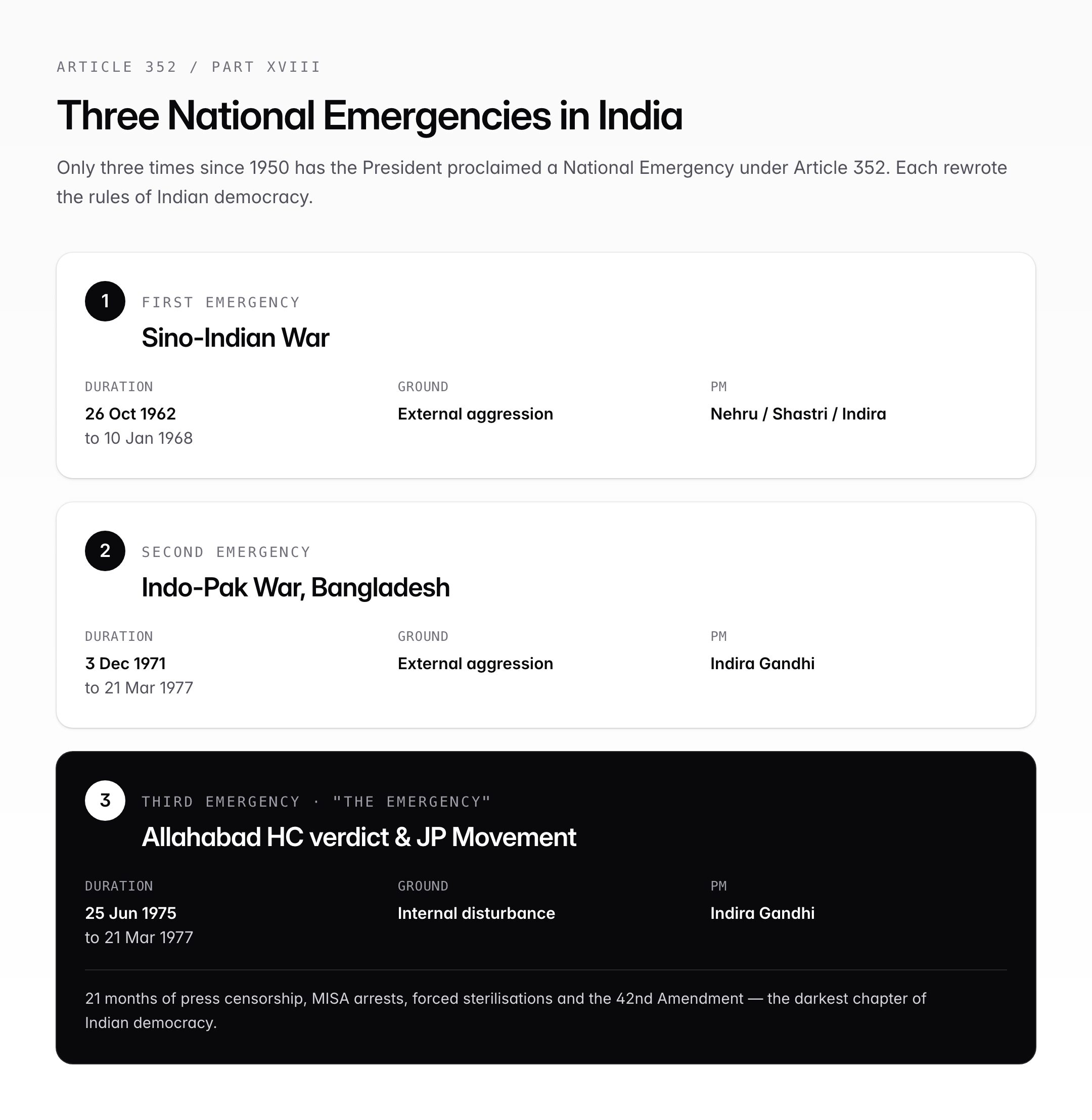
The Three National Emergencies in India
Three emergencies have been declared since 1950. Each had a distinct character.
| Emergency | Duration | PM | Ground | Trigger |
|---|---|---|---|---|
| First | 26 Oct 1962 – 10 Jan 1968 | Nehru, Shastri, Indira Gandhi | External aggression | Sino-Indian War |
| Second | 3 Dec 1971 – 21 Mar 1977 | Indira Gandhi | External aggression | Indo-Pak War, Bangladesh Liberation |
| Third | 25 Jun 1975 – 21 Mar 1977 | Indira Gandhi | Internal disturbance | Allahabad HC verdict against Indira Gandhi; JP Movement |
The third — commonly called the Emergency — ran concurrently with the second for 21 months and is considered the darkest chapter of Indian democracy. Press censorship, mass arrests under MISA, forced sterilisations, and the 42nd Amendment all belong to this period.
The 1975 Emergency and Its Aftermath
On 12 June 1975, the Allahabad High Court found Indira Gandhi guilty of electoral malpractice and disqualified her. Thirteen days later, on 25 June 1975, President Fakhruddin Ali Ahmed proclaimed emergency on the ground of internal disturbance. Key features:
- Opposition leaders jailed under MISA (Jayaprakash Narayan, Morarji Desai, Atal Bihari Vajpayee, L.K. Advani)
- Press censorship through pre-censorship orders
- The 42nd Amendment (1976) curtailed judicial review and extended Lok Sabha's term
- Elections postponed; fundamental rights under Articles 14, 21, 22 suspended
After the March 1977 elections, the Janata government passed the 44th Amendment (1978), which reversed most of the 42nd Amendment's damage and hardened the emergency provisions.
Minerva Mills Case (1980) — The Judicial Firewall
Minerva Mills Ltd. v. Union of India (1980) remains the landmark judgment on emergency provisions.
| Issue | Holding |
|---|---|
| Clauses 4 and 5 of Article 368 (42nd Amendment) | Struck down as unconstitutional |
| Scope of judicial review | Part of the basic structure — cannot be removed |
| Balance between FRs and DPSPs | Neither is superior; harmony is part of basic structure |
| Power to amend | Limited, not unlimited — cannot destroy basic structure |
The Supreme Court held that the amending power under Article 368 is itself subject to the basic structure doctrine (first articulated in Kesavananda Bharati, 1973). Emergency cannot be used to dismantle judicial review or alter core constitutional principles.
Together with the 44th Amendment, Minerva Mills has made a repeat of 1975 legally near-impossible.
Types of Emergency in the Constitution
National Emergency is one of three emergency provisions. The others have different grounds and effects.
| Type | Article | Ground | Effect |
|---|---|---|---|
| National Emergency | 352 | War, external aggression, armed rebellion | Centralisation of power; suspension of FRs |
| State Emergency / President's Rule | 356 | Failure of constitutional machinery in a State | Dismissal of State government |
| Financial Emergency | 360 | Threat to financial stability of India | Union control over State finances (never invoked) |
UPSC Relevance
National Emergency under Article 352 is a Polity core topic and appears regularly in Prelims and Mains.
- Prelims: Grounds for proclamation (war, external aggression, armed rebellion), procedural requirements, 44th Amendment changes, Articles 358 and 359 distinctions
- Mains GS Paper II: Centre-State relations during emergency, effect on federalism, judicial review during emergency, comparison with other emergency provisions
- Essay: "Emergency provisions — safeguard or threat to democracy?" and similar themes
- Landmark cases: ADM Jabalpur (1976), Minerva Mills (1980), Kesavananda Bharati (1973), S.R. Bommai (1994)
- Committees: Sarkaria Commission, Punchhi Commission on Centre-State relations
Candidates should memorise the three emergencies with exact dates, understand the before-and-after impact of the 44th Amendment, and be able to evaluate the balance between national security and civil liberties that Article 352 attempts to strike.
Tell Google you want more of this.
Add Anantam IAS as a preferred sourceOne tap, and this site shows up more often in your own Top Stories, AI Overviews and AI Mode. Remove it any time.