The Mughal Empire ruled most of the Indian subcontinent from 1526 to 1857 — though its effective power collapsed long before the formal end. At its peak under Aurangzeb, it governed roughly 150 million people and generated about a quarter of global GDP. It produced some of the most sophisticated administrative systems, the most celebrated architecture, and the most contested historical legacy of any Indian dynasty.
For UPSC Medieval History, the Mughals are central — expect questions on individual rulers, the Mansabdari system, revenue policy, architecture, and the causes of decline.
The Six Great Mughals: Ruler by Ruler
Babur (1526–1530): Founder
Zahir-ud-Din Muhammad Babur descended from Timur on his father's side and Genghis Khan on his mother's. He lost Fergana (his home kingdom in Central Asia) at age 12 and spent years fighting to hold territory. He captured Kabul in 1504.
His conquest of India came through a specific invitation. Ibrahim Lodi, the last Lodi Sultan of Delhi, was deeply unpopular with his Afghan nobles, including Daulat Khan Lodi (governor of Punjab) and Rana Sanga of Mewar. They invited Babur to invade.
First Battle of Panipat (April 21, 1526): Babur defeated Ibrahim Lodi’s numerically superior force using a combination of:
- Tulughma (flanking cavalry tactics from Central Asia)
- Matchlock firearms — artillery and muskets that Ibrahim's forces had no effective counter to
- Field fortifications with carts (araba)
Ibrahim Lodi died in battle. Babur occupied Delhi and Agra.
He then defeated Rana Sanga at the Battle of Khanwa (1527) and the Afghan chiefs at the Battle of Ghaghra (1529), consolidating control. He died in 1530, reportedly transferring his own life force to his dying son Humayun in a Sufi ritual — an account in his own memoirs, the Baburnama.
The Baburnama is one of the earliest autobiographies in Islamic literature — candid, observant, and remarkably honest. Babur also wrote poetry and is considered a founder of the Chagatai literary tradition.
Humayun (1530–1540, 1555–1556): The Interrupted Reign
Nasir-ud-Din Muhammad Humayun inherited the empire but struggled to hold it. He divided territory among his brothers (a mistake), faced the powerful Afghan chief Sher Shah Suri, and was defeated at the Battle of Chausa (1539) and then decisively at the Battle of Kanauj/Bilgram (1540).
He spent 15 years in exile — first in Sindh, then in Safavid Persia, where Shah Tahmasp gave him military support in exchange for his nominal conversion to Shia Islam. He reconquered Kabul in 1545 and Delhi in 1555, defeating Sikandar Shah Suri (son of Sher Shah).
He died in January 1556 — falling down the stairs of his library in Delhi (Purana Qila) while responding to the call to prayer. His reign is significant partly for the 15-year interregnum under Sher Shah Suri (1540–1545), who introduced administrative reforms that Akbar later built on, including the Grand Trunk Road, revenue measurement, and a standardised currency.
Akbar (1556–1605): The Architect
Jalal-ud-Din Muhammad Akbar is the most studied Mughal ruler. He came to the throne at 13 after Humayun's death, with Bairam Khan as regent. His long reign transformed a fragile conquest into a durable empire.
Military expansion: Akbar systematically defeated or absorbed every significant power in the subcontinent.
| Conquest | Year | Significance |
|---|---|---|
| Second Battle of Panipat | 1556 | Defeated Hemu (Vikramaditya), secured Delhi |
| Malwa | 1561 | Central India secured |
| Gondwana | 1564 | Rani Durgavati defeated |
| Chittorgarh | 1568 | Mewar's capital captured |
| Ranthambore | 1569 | Rajputana subjugated |
| Bengal | 1576 | East India incorporated |
| Kabul and Kashmir | 1585–86 | Northwest secured |
| Deccan | 1590s | Initial campaigns; incomplete |
Rajput policy: Akbar's most politically significant innovation was bringing Rajput chiefs into the Mughal system as partners rather than simply subjects. He married Rajput princesses (including Jodha Bai, daughter of the Amber king), appointed Rajput chiefs to high Mansabdar positions, and exempted them from some religious impositions. This created a broad coalition of ruling groups that stabilised the empire for over a century.
Din-i-Ilahi: Akbar's religious syncretism is famous and controversial. He held the Ibadat Khana (House of Worship) at Fatehpur Sikri from 1575, initially for Muslim scholars, then opened to Hindus, Jains, Zoroastrians, and eventually Portuguese Jesuits. He formulated the Din-i-Ilahi ("Divine Faith") — a personal spiritual code blending elements from multiple religions, focused on the divine light concept. It had very few adherents and died with him.
Sulh-i-Kul ("peace with all") was his broader political philosophy — a policy of religious non-discrimination in governance.
Cultural contributions: Akbar built Fatehpur Sikri (1571–1585) as his capital — a planned city combining Hindu and Islamic architectural forms. He patronised the Navaratnas (Nine Gems) — nine scholars including Birbal, Tansen (musician), Abul Fazl (historian, author of Ain-i-Akbari and Akbarnama), and Todar Mal (revenue minister).
Jahangir (1605–1627): The Aesthete
Nur-ud-Din Muhammad Jahangir ("World Conqueror") was Akbar's son. His reign is marked by:
- Nur Jahan's influence — his wife Nur Jahan (born Mehr-un-Nissa) effectively co-ruled with him for much of his reign, issuing farmans and coins in her own name alongside his. She was extraordinarily competent but created a court faction that alienated his son Shah Jahan.
- Prince Khurram's (Shah Jahan's) rebellion — conflict with his own son foreshadowed later Mughal succession crises
- British East India Company — Captain William Hawkins arrived in 1608, Thomas Roe in 1615; Roe negotiated the first British trading permissions with Jahangir at Ajmer
- Mughal painting reached its highest level under Jahangir — he had a trained eye and extraordinary artistic sensibility; his reign produced the most naturalistic and observational paintings in the Mughal tradition
- The Tuzuk-i-Jahangiri (Jahangirnama) — his autobiography, frank and self-aware
Shah Jahan (1628–1658): The Builder
Shahab-ud-Din Muhammad Shah Jahan ("King of the World") ruled during the height of Mughal architectural achievement.
Key constructions:
| Monument | Location | Completed |
|---|---|---|
| Taj Mahal | Agra | 1643 |
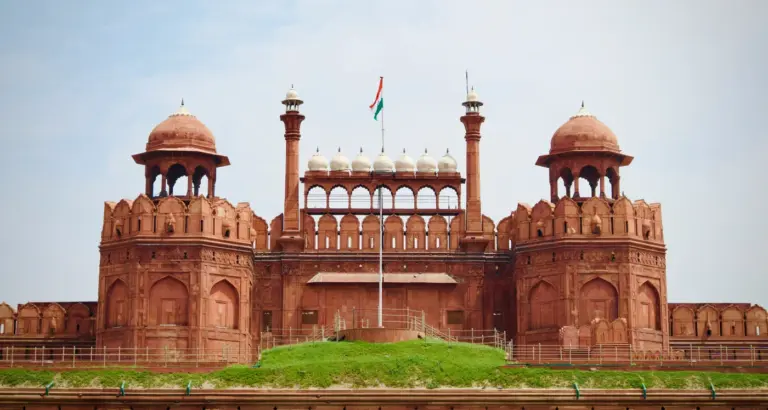
| Red Fort (Lal Qila) | Delhi | 1648 |
| Jama Masjid | Delhi | 1656 |
| Moti Masjid | Agra Fort | 1653 |
| Shalimar Gardens | Lahore | 1641 |
The Taj Mahal, built as a mausoleum for his wife Mumtaz Mahal (died 1631 in childbirth), is the most recognised monument in India. It took an estimated 22 years and 20,000 workers to build.
Shah Jahan's reign also saw costly, largely unsuccessful Deccan campaigns and the famine of 1630–32 in which millions died. He moved the capital from Agra to his new city of Shahjahanabad (Old Delhi) in 1648.
In 1658, his four sons fought a war of succession. His son Aurangzeb defeated and imprisoned him in Agra Fort, where he remained until his death in 1666, reportedly dying gazing at the Taj Mahal from his window.
Aurangzeb (1658–1707): The Controversial Last Great Mughal
Muhi-ud-Din Muhammad Aurangzeb was the sixth and last of the "Great Mughals." His reign was the empire's largest territorial extent — and the beginning of its unravelling.
Military conquests: Aurangzeb spent the last 26 years of his reign in the Deccan, trying to subdue the Marathas under Shivaji (and after his death in 1680, Maratha confederacy forces). He conquered the Deccan Sultanates — Bijapur (1686) and Golconda (1687) — but the Marathas remained unconquerable. Guerrilla warfare exhausted his treasury and army.
Religious policy: Aurangzeb reversed Akbar's syncretism. He:
- Reimposed the jizya (tax on non-Muslims) in 1679, abolished by Akbar in 1564
- Destroyed many Hindu temples, including Kashi Vishwanath in Varanasi and Mathura's Keshava Deva temple
- Prohibited music at court
- Banned the celebration of Hindu festivals in public
Historians debate whether his religious policies were primarily driven by personal piety, political calculation (appeasing orthodox Muslim nobles), or responses to specific rebellions. The Rajput alliances began to fracture, the Jat and Sikh revolts intensified, and the Marathas hardened their resistance.
He died in 1707 at around 88 years old, having spent the last 26 years continuously campaigning. The empire he left was ungovernable.
Mughal Administration
The Mansabdari System
The Mansabdari system was Akbar's most important administrative innovation and the backbone of Mughal governance.
A Mansab ("rank" or "office") was a numerical rank that determined a noble's salary, military obligations, and status. Every noble (amir), military officer, and senior civil official held a Mansab.
The rank had two components:
- Zat — personal rank, determines salary
- Sawar — number of horsemen the holder must maintain
A Mansabdar of 5000 was a high noble; 10,000+ Mansabdars were usually princes. The system had several critical features:
- Ranks were not hereditary — each person received a rank by royal appointment
- This prevented the formation of hereditary noble families with autonomous power
- Salaries were initially paid in cash, later through Jagir assignments
- The king could demote, transfer, or abolish a Mansab
The Jagirdari System
A Jagir was a revenue assignment — the right to collect land revenue from a specific territory in lieu of cash salary. The Jagirdar was not a landowner but a temporary revenue collector.
This distinction matters enormously. Because Jagirs were not permanent or hereditary, Jagirdars had no incentive to invest in long-term agricultural improvement — only to extract as much revenue as possible during their assignment. This created a structural problem: as the empire expanded, Jagirs were redistributed among an ever-larger Mansabdari class. When territorial expansion slowed under Aurangzeb, there were more Mansabdars than available Jagirs — the Jagirdari crisis that partly explains administrative collapse in the 18th century.
Revenue System: Todar Mal's Ain-i-Dahsala
Akbar's revenue minister Raja Todar Mal introduced the Zabt system (also called Ain-i-Dahsala — ten-year settlement) around 1580.
Key features:
- Land was measured and classified by quality
- Average yield per unit area was calculated over ten years (dasala)
- Revenue was fixed as a fraction of average yield (typically one-third)
- Demand was stated in cash terms, not kind
- Local price schedules (ray) were maintained for conversion calculations
This was a sophisticated system but required accurate land surveys. Its implementation was uneven — strongest in the empire's core territories, weaker in the periphery.
Other revenue types:
- Kankut — rough estimate system used where surveys were impractical
- Batai/Ghalla bakshi — crop-sharing system; government took a fixed portion of actual produce
- Nasaq — a customary assessment based on past payments
Administrative Divisions
| Unit | Head | Notes |
|---|---|---|
| Province (Subah) | Subedar (Governor) | 15 provinces under Akbar, expanded later |
| District (Sarkar) | Faujdar (military) + Amalguzar (revenue) | — |
| Sub-district (Pargana) | Shiqdar + Amil | Local administration |
| Village | Muqaddam/Patel (headman) + Patwari (record keeper) | — |
Key Officials
- Wazir/Diwan — chief minister for revenue and finance
- Mir Bakshi — head of military administration and Mansabdari records
- Sadr-us-Sudur — chief religious and judicial officer
- Mir Saman — head of the royal household and workshops (karkhanas)
- Qazi — judicial officer; Qazi-ul-Quzat was the chief judge
Mughal Architecture
Mughal architecture synthesised Persian, Central Asian, and Indian traditions into a distinctive style.
Characteristics:
- Use of red sandstone and later white marble
- Charbagh (four-garden) layout — geometric gardens divided by water channels
- Pietra dura — inlay work with precious stones in marble
- Bulbous domes on tall drums
- Iwans (arched portals) of Persian origin
- Chattris (small pavilions) of Rajput origin
- Integration of calligraphy as decorative element
Evolution across rulers:
- Babur — introduced Charbagh; Ram Bagh in Agra
- Humayun — his tomb in Delhi (completed by Akbar) is the prototype for the Taj Mahal
- Akbar — Fatehpur Sikri, Agra Fort; predominantly red sandstone, robust and massive
- Jahangir — Itmad-ud-Daulah's tomb (first all-marble Mughal building); refinement and naturalism
- Shah Jahan — Taj Mahal, Red Fort; perfection of white marble with pietra dura
- Aurangzeb — Bibi ka Maqbara in Aurangabad (called "poor man's Taj"); austere personal style
Cultural Contributions
Literature and language: Akbar patronised Persian literature but also Hindi poetry (Tulsidas wrote the Ramcharitmanas during his reign, though without direct royal patronage). The Mughal court language was Persian but Urdu emerged as a court vernacular during this period, mixing Persian vocabulary with Hindi grammar.
Music: Tansen, one of Akbar's Navaratnas, is considered the most important figure in Hindustani classical music. He is credited with founding several ragas.
Painting: Mughal painting combined Persian miniature technique with Indian naturalism. The imperial karkhanas (workshops) employed painters, calligraphers, and craftsmen. Each emperor's personal interest shaped the style — Jahangir's reign is especially significant for portraiture and natural history.
Decline of the Mughal Empire
The Mughal Empire’s decline was gradual and multi-causal — beginning visibly after Aurangzeb’s death in 1707 and completing with the formal deposition of the last emperor, Bahadur Shah Zafar II, after the Revolt of 1857.
Main causes:
- Weak successors: After Aurangzeb, twelve emperors ruled in 75 years (1707–1782). Most were figureheads controlled by nobles or regional powers.
- Jagirdari crisis: More Mansabdars than available Jagirs; fierce competition for assignments; revenue extraction intensified.
- Maratha challenge: The Marathas under the Peshwas extended their power across the subcontinent; by the 1750s they were the dominant power in India.
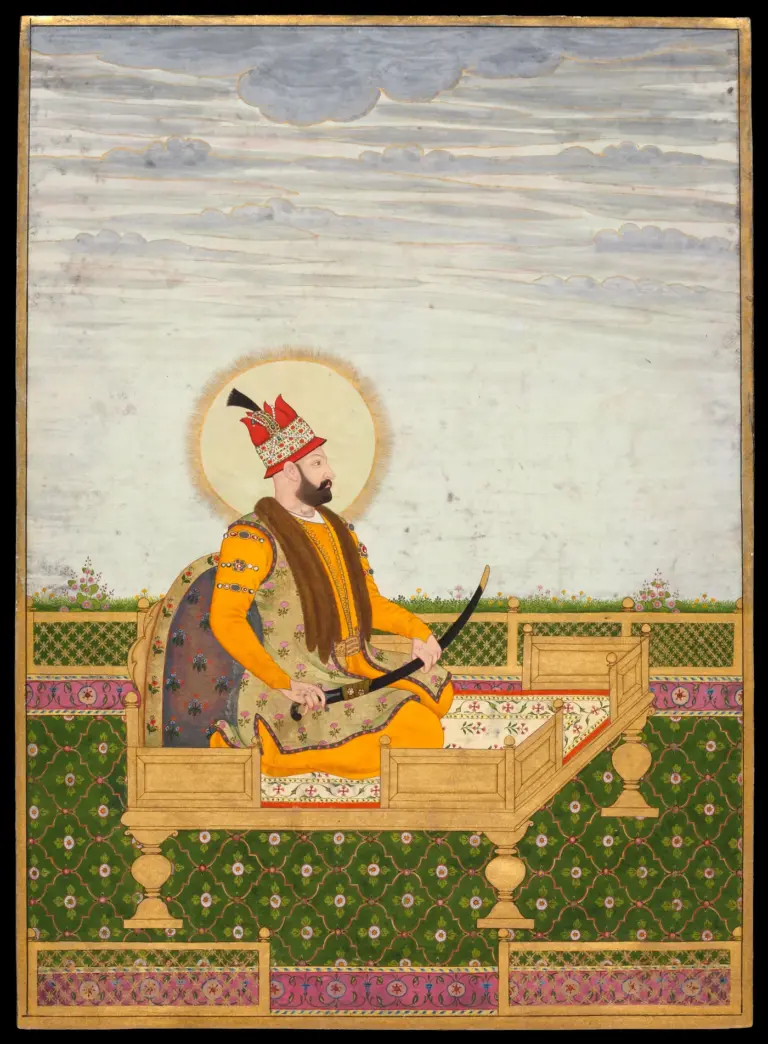
- Nadir Shah's invasion (1739): Nadir Shah sacked Delhi, massacred thousands, and carried off the Peacock Throne and the Koh-i-Noor diamond — the symbolic and material wealth of the empire.
- Ahmad Shah Durrani's invasions: Multiple invasions in the 1750s; the Third Battle of Panipat (1761) saw the Marathas defeated, but the Mughals gained nothing.
- Rise of regional powers: Hyderabad, Awadh, Bengal — all nominally Mughal but effectively independent.
- British expansion: The British East India Company progressively subordinated regional powers and ultimately the Mughal emperor himself, making Bahadur Shah Zafar a pensioner in Delhi.
Frequently Asked Questions About the Mughal Empire
Who founded the Mughal Empire and in which battle?
Babur founded the Mughal Empire after winning the First Battle of Panipat on April 21, 1526, defeating Ibrahim Lodi, the last Lodi Sultan of Delhi. Babur's use of artillery and superior cavalry tactics overcame Ibrahim Lodi's numerically larger force.
What was the Mansabdari system?
The Mansabdari system, introduced by Akbar, was a numerical ranking system for all imperial nobles and officials. Each person held a Mansab with two components: Zat (personal rank, determining salary) and Sawar (number of horsemen to be maintained). Ranks were not hereditary — the emperor could grant, raise, lower, or abolish them. This kept nobles dependent on royal favour rather than independent hereditary power.
What is the difference between Mansabdari and Jagirdari?
Mansabdari is the ranking system — it determines a noble's status and obligations. Jagirdari is the revenue system — a Jagir is an assignment of the right to collect land revenue from a specific area, given instead of cash salary to Mansabdars. A Mansabdar could be paid in cash (called a naqdi) or in Jagir. The Jagir was not permanent or hereditary.
Why is Aurangzeb controversial?
Aurangzeb is controversial because he reversed Akbar's policy of religious accommodation. He reimposed the jizya tax on non-Muslims, destroyed significant Hindu temples, and banned music at court. His long Deccan campaigns exhausted the empire's resources and treasury. Historians debate whether his religious policies were primary causes of the empire's decline or whether structural administrative and military factors were more important.
What caused the decline of the Mughal Empire?
The Mughal decline had multiple causes: weak successors after Aurangzeb, the Jagirdari crisis (too many claimants for too few revenue assignments), the Maratha military challenge, Nadir Shah's devastating 1739 invasion, the rise of independent regional powers (Hyderabad, Awadh, Bengal), and the steady expansion of British power through the East India Company.
Tell Google you want more of this.
Add Anantam IAS as a preferred sourceOne tap, and this site shows up more often in your own Top Stories, AI Overviews and AI Mode. Remove it any time.