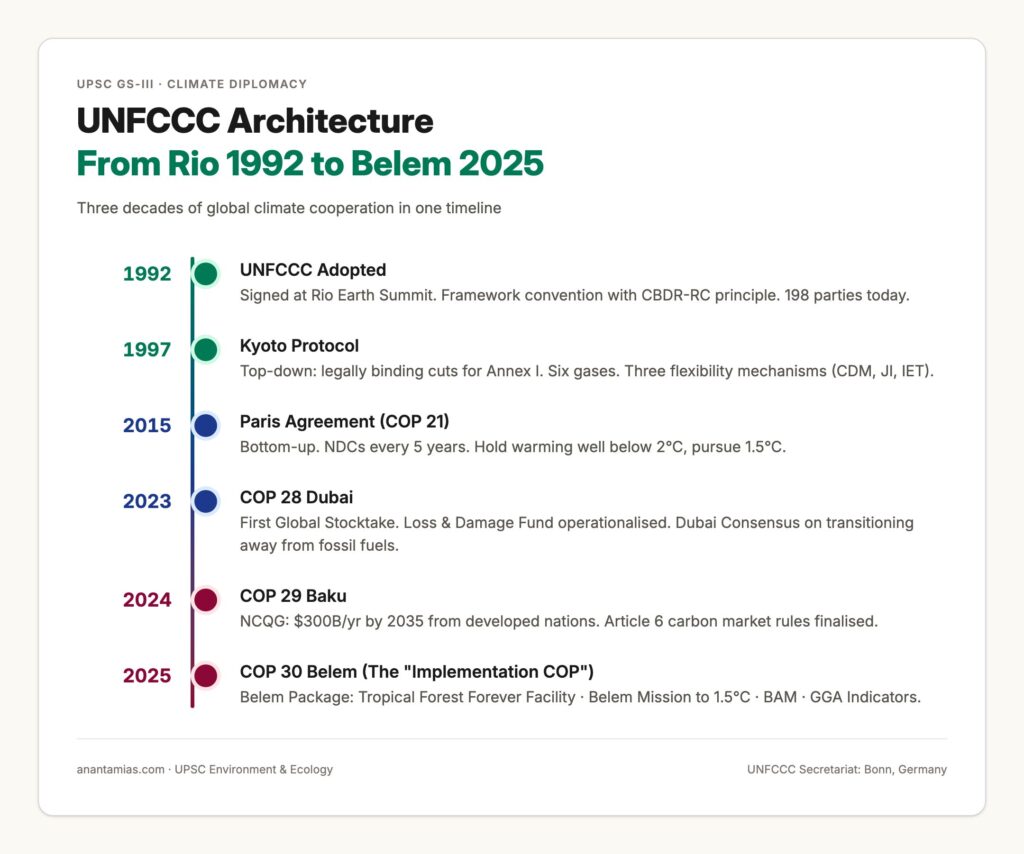
The United Nations Framework Convention on Climate Change, signed at the Rio Earth Summit in 1992, is the constitutional document of global climate diplomacy. Every modern climate instrument, from the Kyoto Protocol to the Paris Agreement to the Loss and Damage Fund operationalised at Dubai, traces its legal authority back to this single treaty. With 198 parties, the UNFCCC is one of the most universally ratified instruments in international law and the only forum where nearly every country in the world sits at the same table to negotiate the future of the planetary climate.
For UPSC aspirants, the UNFCCC is more than a multilateral treaty. It is the lens through which several GS-III themes converge: climate change, energy transition, sustainable development, technology transfer, and the contested politics of historical responsibility. Examiners frequently test the difference between Annex I, Annex II, and Non-Annex I parties, the three flexibility mechanisms of Kyoto, the bottom-up architecture of Paris, and the latest COP outcomes that shape India’s domestic policy. This guide unpacks all of it, from the foundational principles to the detailed outcomes of COP 28, COP 29, and COP 30.
The treaty matters in 2026 more than it did in 1992. The world has crossed 1.2 degrees Celsius of warming, the carbon budget for 1.5 degrees is shrinking by the year, and developing countries are demanding trillions in climate finance. Whether the UNFCCC system can deliver on its promises is now the central question of climate governance.
Quick Facts at a Glance
The UNFCCC is a legally binding framework convention adopted on 9 May 1992 and opened for signature at the Rio Earth Summit in June 1992. It entered into force on 21 March 1994. The Secretariat is headquartered in Bonn, Germany, and the supreme decision-making body is the Conference of the Parties, commonly called the COP, which meets annually. India ratified the convention on 1 November 1993. The convention has 198 parties, making it nearly universal. The guiding principle is Common But Differentiated Responsibilities and Respective Capabilities, abbreviated as CBDR-RC, which acknowledges that developed countries bear greater historical responsibility for cumulative emissions and must therefore lead the mitigation effort.
What the UNFCCC Is
The UNFCCC is a framework convention, which means it sets broad goals and procedural rules without specifying numeric targets. The objective, defined in Article 2, is to stabilise greenhouse gas concentrations at a level that prevents dangerous anthropogenic interference with the climate system. The convention itself does not say what that level is. That number is filled in by subsequent protocols and agreements, first by Kyoto and later by Paris.
Parties are classified into three groups. Annex I includes industrialised countries and economies in transition, who are expected to limit emissions. Annex II is a subset of Annex I, comprising the rich OECD countries that must provide finance and technology to developing nations. Non-Annex I covers developing countries, including India, China, Brazil, and the Least Developed Countries, who have no immediate binding emission targets and are expected to focus on development while pursuing voluntary mitigation. A separate list, Annex B, applies only to the Kyoto Protocol and identifies countries that accepted legally binding targets under that instrument.
Background and Historical Context
The intellectual foundation for the UNFCCC was laid by the First World Climate Conference of 1979, which warned about anthropogenic warming, and by the establishment of the Intergovernmental Panel on Climate Change in 1988. The IPCC’s First Assessment Report in 1990 catalysed political action, and within two years, the convention was signed at Rio. The early years focused on building scientific consensus and reporting infrastructure rather than mandating emission cuts.
The first major operational treaty under the UNFCCC was the Kyoto Protocol, adopted in 1997 and entered into force in 2005 after Russia’s ratification. Kyoto followed a top-down logic: developed countries accepted legally binding targets to cut emissions of six greenhouse gases, namely carbon dioxide, methane, nitrous oxide, hydrofluorocarbons, perfluorocarbons, and sulphur hexafluoride. Developing countries, including India and China, had no binding targets and only had to report data. The protocol introduced three flexibility mechanisms that allowed countries to meet targets cost-effectively: the Clean Development Mechanism, where rich countries invested in green projects in developing countries; Joint Implementation, for projects between developed countries; and International Emissions Trading, which allowed countries to buy unused emission quotas from each other.
Kyoto faltered for several reasons. The United States, the largest historical emitter, never ratified it. Canada withdrew in 2011. Major emerging economies were exempt despite rapidly rising emissions. By the late 2000s, the regime needed a successor, and after the disappointing Copenhagen summit in 2009, negotiators worked towards a more flexible architecture that would include all countries. That architecture took shape as the Paris Agreement.
The Paris Agreement: Bottom-Up Climate Governance
The Paris Agreement, adopted at COP 21 in December 2015, is the most important climate instrument since Kyoto. It departs from the top-down approach by inviting every country, regardless of development status, to define its own climate targets through Nationally Determined Contributions, or NDCs.
The core goals are set out in Article 2. The temperature goal is to hold the increase in global average temperature well below 2 degrees Celsius above pre-industrial levels and to pursue efforts to limit warming to 1.5 degrees Celsius. The adaptation goal is to increase the ability to adapt to climate impacts and foster climate resilience. A finance goal aligns financial flows with low-emission, climate-resilient development pathways.
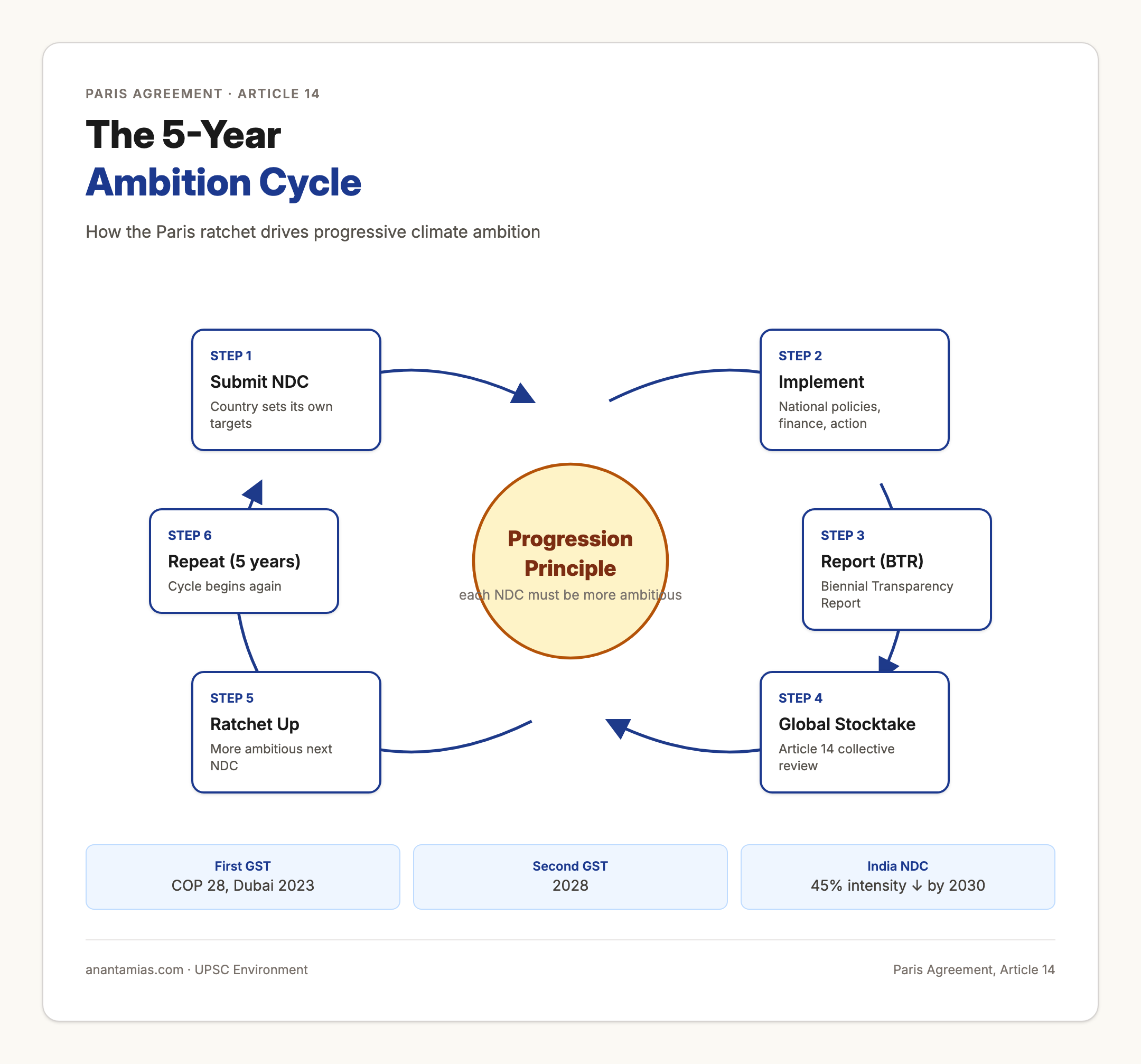
The agreement runs on a five-year ambition cycle. Every country submits an NDC every five years. Each new NDC must be more ambitious than the previous one, a discipline known as the progression principle or the ratchet mechanism. NDCs are voluntary, and there is no penalty for missing a target, but the political pressure created by transparent reporting and review acts as a soft enforcement mechanism. Article 14 mandates a Global Stocktake every five years, a collective report card that assesses whether the world is on track. The first Global Stocktake concluded at COP 28 in Dubai in 2023.
Article 6 of the Paris Agreement creates a framework for voluntary international cooperation through carbon markets and non-market approaches. It has three pillars. Article 6.2 enables bilateral cooperation through Internationally Transferred Mitigation Outcomes, or ITMOs, where one country transfers emission reductions to another. Article 6.4 creates a centralised, UN-supervised carbon market that succeeds the Clean Development Mechanism and allows public and private participation. Article 6.8 covers non-market approaches, including capacity building and technology transfer. The detailed rules for Article 6 took years to negotiate and were finalised only at COP 29 in Baku in 2024.
Climate Finance Architecture
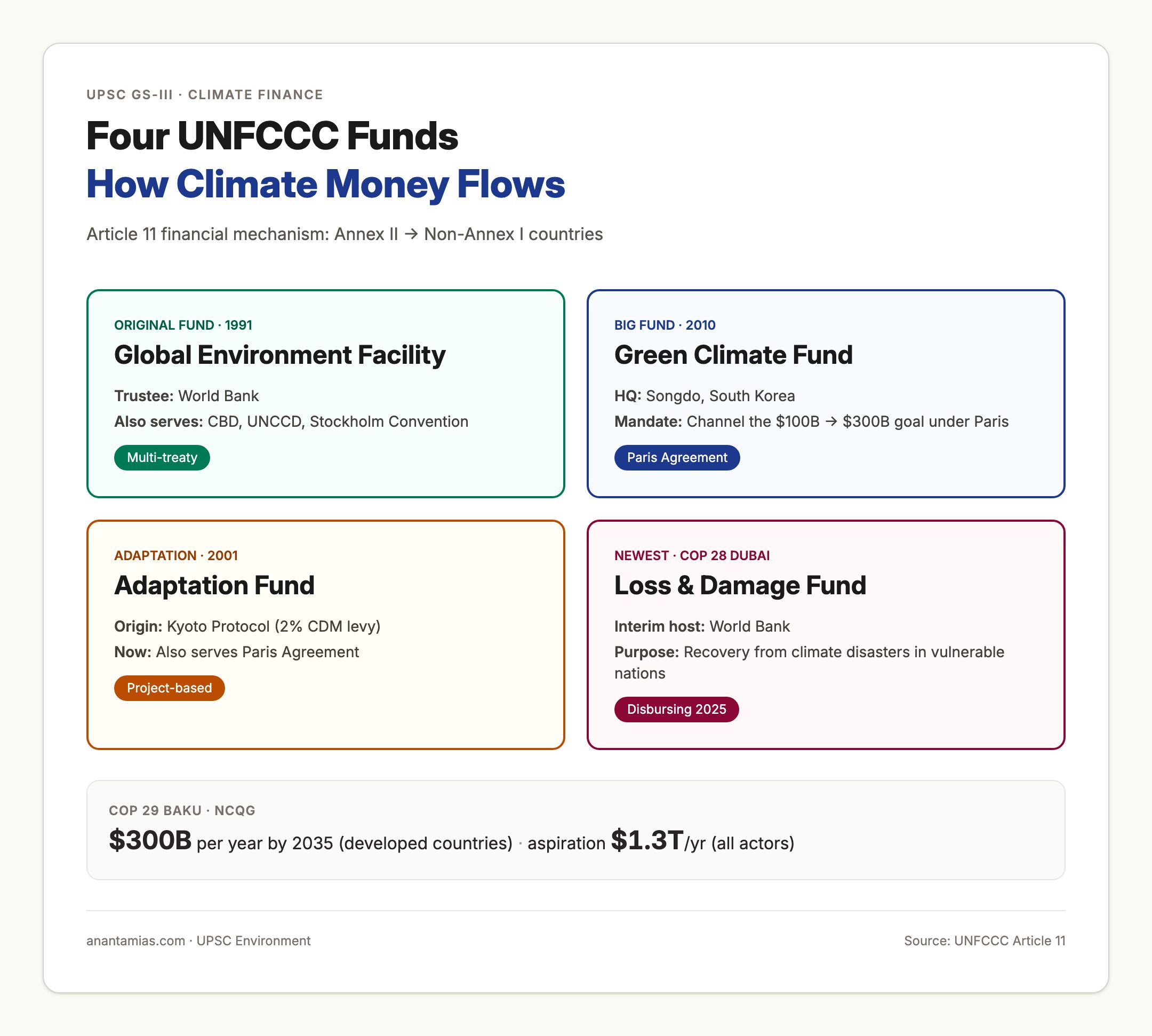
The financial mechanism of the UNFCCC, set up under Article 11, channels funds from Annex II to Non-Annex I countries. Four major funds operate within this architecture, each with a distinct mandate.
The Global Environment Facility, established in 1991 and trusteed by the World Bank, is the original fund and also serves the Convention on Biological Diversity, the UN Convention to Combat Desertification, and the Stockholm Convention on Persistent Organic Pollutants. The Green Climate Fund, headquartered in Songdo, South Korea, was created in 2010 to channel the 100 billion dollar finance goal and is now the primary fund serving the Paris Agreement. The Adaptation Fund was originally established under the Kyoto Protocol and funded by a 2 percent levy on Clean Development Mechanism projects; it now also serves the Paris Agreement and focuses on concrete adaptation projects in vulnerable countries. The Loss and Damage Fund, the newest entrant, was operationalised at COP 28 in Dubai in 2023 and is interim-hosted by the World Bank to help vulnerable nations recover from climate-induced disasters.
For more on India’s adaptation work that interfaces with these funds, see our analysis of India’s efforts for combating climate change and the Lifestyle for Environment movement.
Why It Matters for India and the World
The UNFCCC matters to India for three intertwined reasons. First, India’s climate vulnerability is enormous: extreme heat, glacial retreat, monsoon variability, and coastal flooding all threaten livelihoods and food security. Second, India is the world’s third largest emitter in absolute terms but a low per capita emitter, which makes the equity debate central to its diplomatic strategy. Third, India needs vast climate finance to transition its energy system, and the UNFCCC is the principal forum where that finance is negotiated.
India’s diplomatic posture has been consistent across decades. It anchors its position in CBDR-RC, insists on equitable access to the remaining global carbon budget, demands public grants rather than loans, and resists any dilution of the firewall between developed and developing country obligations. India’s Updated NDC, submitted in 2022, commits to reducing emissions intensity of GDP by 45 percent by 2030 from 2005 levels and achieving 50 percent cumulative non-fossil installed power capacity by 2030. India has also announced a net zero target for 2070.
COP 30 Belem: From Promises to Implementation
COP 30, held in Belem, Brazil in November 2025, was framed as the implementation COP, intended to translate Paris Agreement promises into concrete action. The Belem Package contains four headline outcomes.
The Tropical Forest Forever Facility is a payment-for-performance fund that pays tropical countries 4 dollars per hectare annually for preserved forests, with 20 percent of disbursements ring-fenced for Indigenous Peoples and Local Communities. The Belem Mission to 1.5 Celsius is a watchdog platform launched to monitor whether the Round 3 NDCs submitted in 2025 align with the 1.5 degree limit. The Belem Action Mechanism, also called the BAM, is a new just transition body that supports countries shifting away from fossil fuels. The Global Goal on Adaptation indicators were finally agreed after years of debate, providing a measurable framework for adaptation progress.
India argued at Belem that the 1.3 trillion dollar finance goal must be met primarily through public grants from developed nations rather than loans or private investments. India welcomed the Tropical Forest Forever Facility but warned that it must not become a tool to infringe on national sovereignty over natural resources. India also highlighted the Adaptation Gap Report 2025, which estimates that developing countries need at least 300 billion dollars annually for adaptation alone.
For deeper context, see our coverage of India’s NDC 3 for 2031-2035 and Assessing global and Indian climate action ahead of COP 30.
COP 29 Baku and COP 28 Dubai: The Finance and Energy Transition COPs
COP 29 in Baku, Azerbaijan, in November 2024, was dominated by the New Collective Quantified Goal on climate finance, abbreviated NCQG. The old target of 100 billion dollars annually was replaced by a commitment from developed countries to mobilise at least 300 billion dollars per year by 2035 for developing nations, with a call to all actors, public and private, to scale up financing to reach 1.3 trillion dollars per year by 2035. Developing countries from the G77 plus China bloc, including India, demanded at least 1.3 trillion in public grants and termed the 300 billion figure inadequate. COP 29 also finalised the rules for Article 6: the global market under Article 6.4 was fully operationalised, and transparency rules for bilateral ITMO trading under Article 6.2 were finalised to prevent double counting. The Loss and Damage Fund signed final arrangements to begin disbursing money in 2025.
COP 28 in Dubai, UAE, in 2023, delivered the first Global Stocktake and the historic Dubai Consensus, which called for transitioning away from fossil fuels in energy systems in a just, orderly, and equitable manner to achieve net zero by 2050. It was the first time a COP outcome explicitly named all fossil fuels, although no firm timelines were set. The Global Renewables and Energy Efficiency Pledge committed to tripling installed renewable capacity to at least 11,000 GW by 2030 and doubling the global average annual rate of energy efficiency improvements from around 2 percent to over 4 percent until 2030; India did not sign this pledge. The Global Cooling Pledge aims to reduce cooling-related emissions by 68 percent by 2050 from current levels. The Declaration to Triple Nuclear Energy commits signatories to triple nuclear capacity from 2020 levels by 2050. The Loss and Damage Fund was operationalised at this COP, marking a long-fought victory for vulnerable nations. See our detailed analysis of COP 28 outcomes.
Comparing Kyoto and Paris
Kyoto was top-down. It set a single overall target and divided the burden between developed and developing countries with a sharp legal firewall. Compliance was binding for Annex I countries, and the protocol included punitive consequences for missing targets, although enforcement was weak in practice. Paris is bottom-up. It invites all countries to set their own targets, applies a single legal architecture to all parties, and relies on transparency, peer pressure, and the ratchet mechanism rather than legal compulsion. Kyoto covered six gases; Paris covers a broader basket. Kyoto had a fixed commitment period; Paris has rolling five-year cycles. Kyoto’s CDM was a project-based mechanism; Paris’s Article 6.4 is a credit market with broader scope and stricter integrity rules.
Challenges and Critiques
The UNFCCC system faces serious structural problems. Voluntary NDCs have produced ambition gaps: current NDCs put the world on a trajectory of roughly 2.7 to 2.9 degrees Celsius warming by 2100, well above the Paris goals. Climate finance has consistently fallen short of pledges, and the share of grants versus loans remains contested. The principle of CBDR-RC is under pressure from developed countries who argue that emerging economies must take on more responsibility, while developing countries insist that historical emissions cannot be wished away. The COP process itself is slow, consensus-driven, and vulnerable to fossil fuel interests, with COP 28 famously held in a major oil-producing economy. Loss and damage capitalisation remains tiny relative to estimated needs, and the question of whether climate-vulnerable nations can access funds quickly enough to recover from disasters is unresolved.
UPSC Prelims Pointers
- UNFCCC was adopted at the Rio Earth Summit, 1992, and entered into force in 1994.
- Secretariat is in Bonn, Germany. India ratified in 1993.
- Annex I: industrialised countries plus economies in transition. Annex II: rich OECD only. Non-Annex I: developing countries.
- Kyoto Protocol, 1997, entered into force 2005, covered six gases including CO2, CH4, N2O, HFCs, PFCs, SF6.
- Three Kyoto flexibility mechanisms: CDM, Joint Implementation, International Emissions Trading.
- Paris Agreement adopted at COP 21, 2015. Temperature goal: well below 2 Celsius, pursuing 1.5 Celsius.
- NDCs are voluntary; ratchet up every 5 years; Global Stocktake every 5 years under Article 14.
- Article 6.2 covers ITMOs (bilateral); Article 6.4 is the UN-supervised global carbon market.
- GCF is in Songdo, South Korea. GEF is trusteed by the World Bank.
- Loss and Damage Fund operationalised at COP 28, Dubai, 2023.
- COP 29 NCQG: 300 billion dollars per year by 2035 from developed countries.
- COP 30 Belem Package: TFFF, Belem Mission to 1.5 Celsius, BAM, GGA indicators.
Mains Practice Questions
- The Paris Agreement marks a paradigm shift from the top-down architecture of the Kyoto Protocol. Critically examine the implications of this shift for global climate ambition and equity. (GS-III, 250 words)
- The principle of Common But Differentiated Responsibilities is increasingly contested in climate negotiations. In light of India’s stance at recent COPs, evaluate the continued relevance of CBDR-RC. (GS-III, 250 words)
- Climate finance has emerged as the central battleground of UNFCCC negotiations. Discuss the architecture of climate finance funds and assess whether the New Collective Quantified Goal agreed at COP 29 is adequate. (GS-III, 250 words)
- Operationalisation of the Loss and Damage Fund at COP 28 was hailed as historic. Examine its significance and the challenges in making it deliver for climate-vulnerable nations. (GS-III, 250 words)
Way Forward
The UNFCCC must evolve from a forum of pledges to a regime of delivery. Three priorities stand out. First, climate finance must be scaled rapidly, with a clear ratio of grants to loans and predictable disbursement timelines, so that developing countries can invest in adaptation and just transition. Second, the integrity of carbon markets under Article 6 must be safeguarded through robust accounting and avoidance of double counting; otherwise, market mechanisms risk becoming a fig leaf. Third, the COP process needs reforms to make decision-making faster, less vulnerable to capture by fossil fuel interests, and more responsive to the science of the IPCC. For India, the strategic task is to anchor equity in negotiations while accelerating its own renewable energy and resilience build-out, so that its diplomatic credibility flows from domestic action.
Frequently Asked Questions
What is the UNFCCC and when was it adopted?
The UNFCCC is the United Nations Framework Convention on Climate Change, adopted at the Rio Earth Summit in 1992 and entered into force in 1994. It is the parent treaty for global climate cooperation, with 198 parties. It sets broad goals to prevent dangerous human interference with the climate system but does not specify numerical emission targets, which are filled in by subsequent protocols.
How is the Paris Agreement different from the Kyoto Protocol?
The Kyoto Protocol used a top-down approach, with legally binding emission targets only for developed countries. The Paris Agreement uses a bottom-up approach, inviting every country to set its own Nationally Determined Contributions, with progress tracked through a five-year ratchet cycle and Global Stocktakes. Paris applies one legal architecture to all parties, while Kyoto maintained a sharp legal firewall between developed and developing nations.
What are NDCs and how often must they be updated?
Nationally Determined Contributions are climate action plans submitted by each country under the Paris Agreement, outlining mitigation targets and adaptation measures. Countries must submit a new NDC every five years, and each successive NDC must be more ambitious than the previous one under the progression principle. NDCs are voluntary; there is no penalty for missing a target.
What was the New Collective Quantified Goal agreed at COP 29?
The NCQG, agreed at COP 29 in Baku in 2024, replaces the earlier 100 billion dollar climate finance target. Developed countries committed to mobilise at least 300 billion dollars per year by 2035 for developing nations, with a call to all actors to scale up financing to reach 1.3 trillion dollars per year by 2035. Developing countries criticised the 300 billion figure as inadequate.
What is the Loss and Damage Fund and where is it hosted?
The Loss and Damage Fund was operationalised at COP 28 in Dubai in 2023 to help vulnerable nations recover from climate-induced disasters. The World Bank is the interim host. Disbursements began in 2025 after final arrangements were signed at COP 29.
What did COP 30 in Belem deliver?
COP 30 in Belem, Brazil, delivered the Belem Package: the Tropical Forest Forever Facility for paying tropical countries to preserve forests, the Belem Mission to 1.5 Celsius as a watchdog on NDC ambition, the Belem Action Mechanism for just transition, and the agreed indicators for the Global Goal on Adaptation.
What is Article 6 of the Paris Agreement?
Article 6 enables voluntary international cooperation on climate action through carbon markets and non-market approaches. Article 6.2 covers bilateral cooperation through ITMOs. Article 6.4 establishes a centralised, UN-supervised global carbon market that succeeds the Kyoto-era Clean Development Mechanism. Article 6.8 covers non-market approaches, including capacity building and technology transfer.
What is India’s stance on UNFCCC negotiations?
India anchors its position in the principle of Common But Differentiated Responsibilities and Respective Capabilities. It demands public grants rather than loans, equitable access to the remaining global carbon budget, and resists any dilution of the firewall between developed and developing country obligations. India has committed to reducing emissions intensity of GDP by 45 percent by 2030 and achieving net zero by 2070.
What is CBDR-RC?
Common But Differentiated Responsibilities and Respective Capabilities is the foundational equity principle of the UNFCCC. It recognises that all countries share a common responsibility to protect the climate, but their obligations differ according to their historical contributions to the problem and their capacity to act. Developed countries bear greater responsibility because of cumulative emissions since the Industrial Revolution.
What is the Global Stocktake?
The Global Stocktake is a five-yearly review under Article 14 of the Paris Agreement that assesses collective progress towards the long-term goals. The first Global Stocktake concluded at COP 28 in Dubai in 2023 and confirmed that the world is far off track for the 1.5 degree goal, prompting calls for accelerated NDC ambition in the next round.
Tell Google you want more of this.
Add Anantam IAS as a preferred sourceOne tap, and this site shows up more often in your own Top Stories, AI Overviews and AI Mode. Remove it any time.