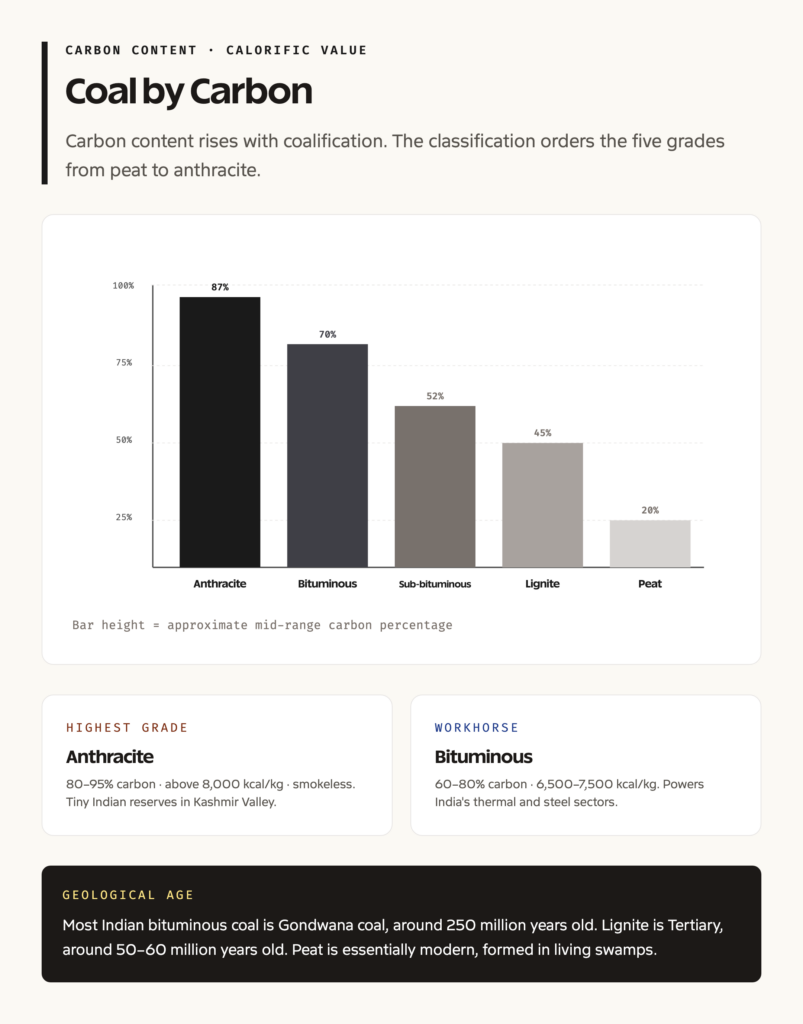
Coal is not a single substance but a continuum. At one end of the continuum sits a soft, brown, water-rich material that looks more like compressed forest litter than a rock. At the other end sits a hard, almost glassy black solid that rings when struck and burns with little flame. Between these end points lie several distinct grades, each with its own carbon content, calorific value, moisture, and industrial use. The classification by carbon content is the simplest and most widely used framework for understanding coal, and it is the framework UPSC repeatedly tests in prelims and uses as the backbone of mains questions on India’s energy mix.
India has a coal economy on a massive scale. The country holds the fifth-largest proven coal reserves in the world, runs about 70 per cent of its electricity generation on coal, and supports a domestic industrial base in steel, cement, and chemicals that is fundamentally tied to coal supply. The internal geography of these reserves is uneven: the bulk of bituminous coal sits in the Damodar, Mahanadi, Son, and Wardha valley basins, while lignite sits separately in Tamil Nadu, Rajasthan, and Gujarat, and the small anthracite occurrence is essentially a Kashmir Valley deposit. Understanding the carbon content classification is therefore not just a textbook exercise. It is the foundation for understanding why a thermal power plant in Talcher draws coal from a different basin than a sponge iron plant in Korba, and why Neyveli Lignite Corporation has a different operational logic from Coal India Limited.
This guide walks through the five main coal types by carbon content, the distinctive characteristics of each, the major Indian deposits, the end-use breakdown, and the prelims and mains framings most likely to appear in UPSC exams.
Quick Facts
- Coal classification basis: Carbon percentage, calorific value, moisture, volatile matter
- Five main grades: Anthracite, bituminous, sub-bituminous, lignite, peat
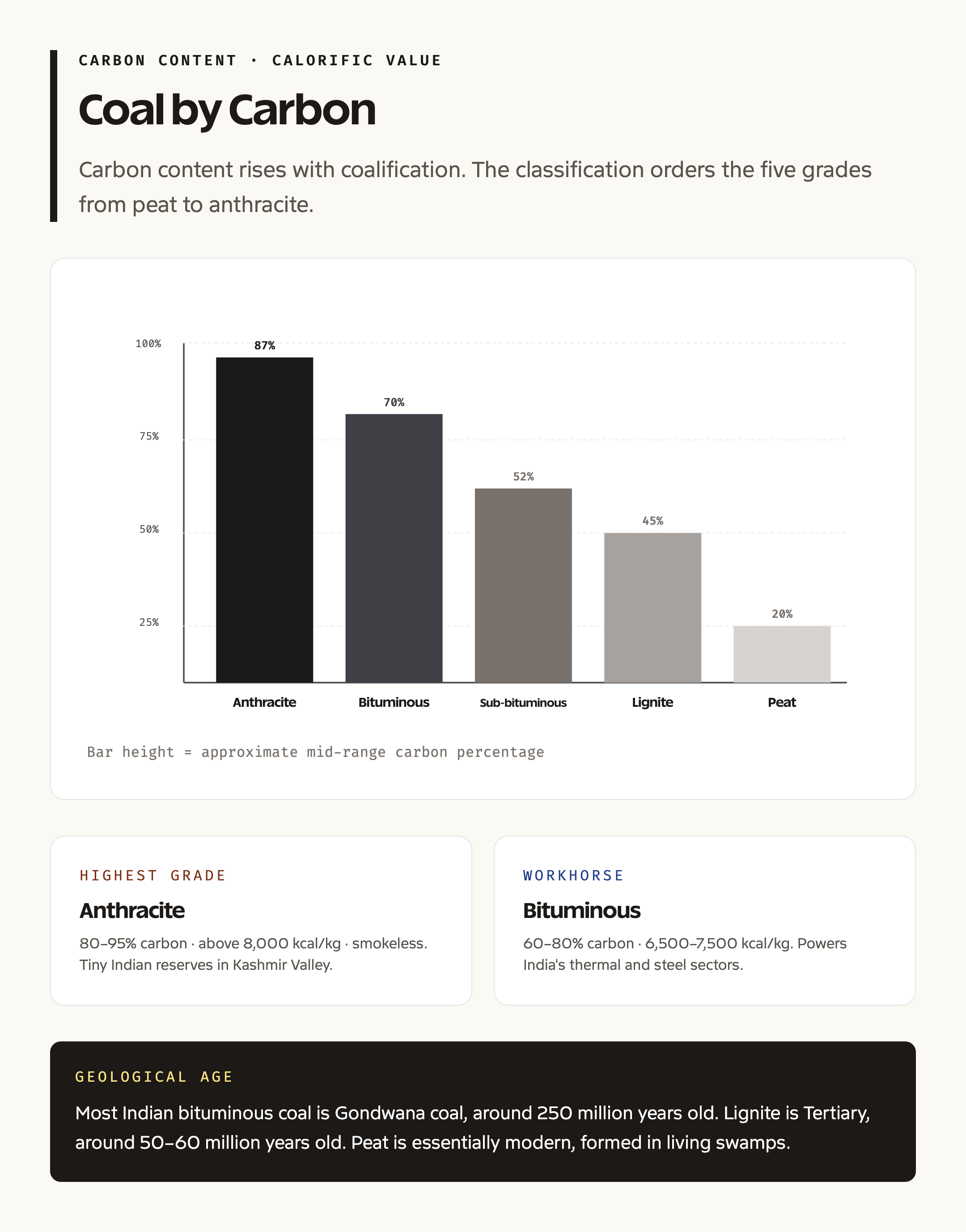
- Highest carbon: Anthracite, 80 to 95 per cent carbon
- Lowest carbon: Peat, less than 25 per cent carbon
- India’s dominant grade: Bituminous coal, used in power and steel
- Largest lignite producer: Neyveli Lignite Corporation, Tamil Nadu
- Anthracite occurrence in India: Kashmir Valley (Jammu and Kashmir), small reserves
- Geological era: Most Indian coal is Gondwana coal, deposited 250 million years ago, with smaller Tertiary coal deposits
- Largest coalfield in India: Jharia (Jharkhand), known for coking coal
- Lignite belt: Tamil Nadu (Neyveli), Rajasthan (Barmer, Bikaner), Gujarat (Kutch), Assam (Makum)
- Major regulator: Ministry of Coal, Coal India Limited, Singareni Collieries
- Use in steel: Coking bituminous coal, mostly imported because Indian deposits have high ash
What Is Coal Classification by Carbon Content
Coal is formed when plant matter accumulates in swampy, oxygen-poor conditions, gets buried under sediment, and undergoes pressure and temperature transformation over millions of years. The transformation, called coalification, drives off water and volatile compounds and progressively concentrates carbon. The longer and more intense the coalification, the higher the final carbon percentage and the lower the moisture and volatile content. The result is a series of grades that capture different points along the transformation pathway.
The carbon percentage is the simplest summary number. It tells you how much of the coal mass is fixed carbon, which is what burns to produce heat. A higher carbon percentage usually means a higher gross calorific value (the heat released per unit mass) and a cleaner burn. But carbon percentage alone is not enough. Two coals with similar carbon content can have very different ash, sulphur, or coking properties depending on the original plant material and the geological history. For most policy and exam purposes, the carbon-content classification is sufficient to set the stage.
Background and Historical Context
Coal in India was first mined commercially in the late 18th century, with the East India Company exploiting the Raniganj field in West Bengal from 1774. The expansion of the railways in the second half of the 19th century created the first sustained domestic coal demand, and Jharia and the Damodar Valley fields developed rapidly to feed the locomotives. After independence, coal was nationalised in stages: coking coal in 1971 to 1972, non-coking coal in 1973, and the entire industry consolidated under Coal India Limited from 1975. Lignite was developed as a separate stream through Neyveli Lignite Corporation, established in 1956 specifically for the Tamil Nadu deposits.
The Five Coal Types in Detail
Anthracite is the highest grade of coal. It contains 80 to 95 per cent carbon and very low moisture, typically under 5 per cent. The structure is hard, dense, lustrous, and almost glassy. Calorific value is highest among coals, often above 8,000 kilocalories per kilogram. Anthracite burns with very little smoke, making it a clean fuel for residential heating in regions where it is available. India’s anthracite reserves are tiny by global standards, confined to a small deposit in the Kashmir Valley region of Jammu and Kashmir. Globally, the major anthracite producers are China, Russia, and the United States. The high cost and low domestic availability mean anthracite is a niche fuel in India and is not used for power generation.
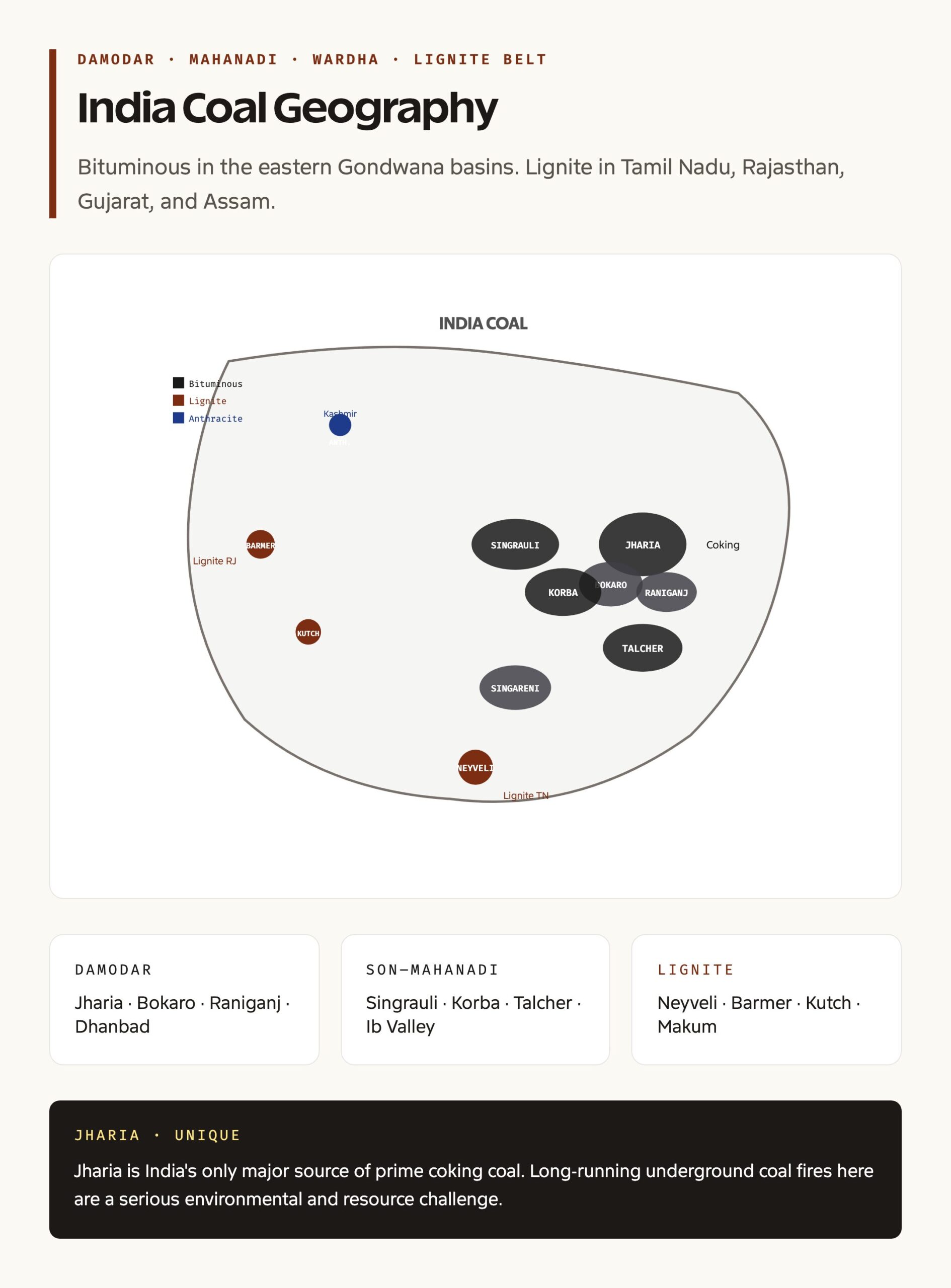
Bituminous coal is the workhorse of the Indian energy economy. Carbon content is 60 to 80 per cent. The coal is dense, black, and breaks into blocky pieces. Calorific value ranges from 6,500 to 7,500 kilocalories per kilogram. Bituminous coal is itself divided into three subgrades. Coking bituminous, also called metallurgical coal, has the property that when heated in the absence of air it forms a strong, porous coke suitable for blast furnace iron-making. Steam coal is used in thermal power plants to raise steam for electricity generation. Industrial bituminous is used in cement, sponge iron, and chemical industries. India’s main bituminous deposits are in the Damodar Valley (Jharia, Bokaro, Raniganj, Dhanbad), Mahanadi Valley (Talcher, Ib Valley), Son and Mahanadi flank (Singrauli, Korba, Sohagpur), and the Godavari and Wardha basins (Singareni). Most Indian bituminous coal has high ash content, around 35 to 45 per cent, and is therefore typically used near the pithead at large thermal plants designed for high-ash feed.
Sub-bituminous coal is a transitional grade between bituminous and lignite. Carbon content is around 45 to 60 per cent, calorific value is 5,500 to 6,500 kilocalories per kilogram, and moisture is moderate. Sub-bituminous coal is sometimes counted within the bituminous category in Indian classification. It is used primarily in thermal power generation and is found in the same Gondwana basins as bituminous coal, often as the weathered upper portion of a seam.
Lignite, often called brown coal, sits below bituminous in the rank order. Carbon content is 35 to 55 per cent, with high moisture (typically 30 to 50 per cent) and a low calorific value of 3,000 to 4,500 kilocalories per kilogram. Lignite is geologically younger than the Gondwana bituminous deposits and was formed in the Tertiary period, around 50 to 60 million years ago. India’s lignite belt runs through Tamil Nadu (Neyveli, the largest), Rajasthan (Barmer, Bikaner), Gujarat (Kutch, Bhavnagar), and small deposits in Assam. Lignite is used almost entirely for electricity generation in pit-head plants, since transporting wet, low-calorific coal long distances is uneconomic.
Peat is the lowest grade and is, properly speaking, a precursor of coal rather than a true coal. Carbon content is below 25 per cent, moisture is very high, and the material is partially decomposed plant matter. It is found in waterlogged swamps and bogs. In India, peat occurs in Kerala backwaters, the Sundarbans of West Bengal, and parts of the Northeast. It is not commercially mined for energy in India, though peat is used for horticulture and as a soil amendment.
Comparison Table
| Type | Carbon % | Calorific Value (kcal/kg) | Moisture | Major Indian Locations | Primary Use |
|---|---|---|---|---|---|
| Anthracite | 80 to 95 | Above 8,000 | Below 5% | Kashmir Valley | Residential heating, niche industrial |
| Bituminous | 60 to 80 | 6,500 to 7,500 | 5 to 15% | Jharia, Bokaro, Raniganj, Korba, Singrauli, Talcher | Power, steel coke, industry |
| Sub-bituminous | 45 to 60 | 5,500 to 6,500 | 15 to 30% | Same Gondwana basins as bituminous | Thermal power |
| Lignite | 35 to 55 | 3,000 to 4,500 | 30 to 50% | Neyveli (TN), Barmer (RJ), Kutch (GJ), Assam | Pithead thermal power |
| Peat | Below 25 | Below 3,000 | Above 50% | Kerala backwaters, Sundarbans, Northeast | Horticulture, not energy |
Why the Classification Matters
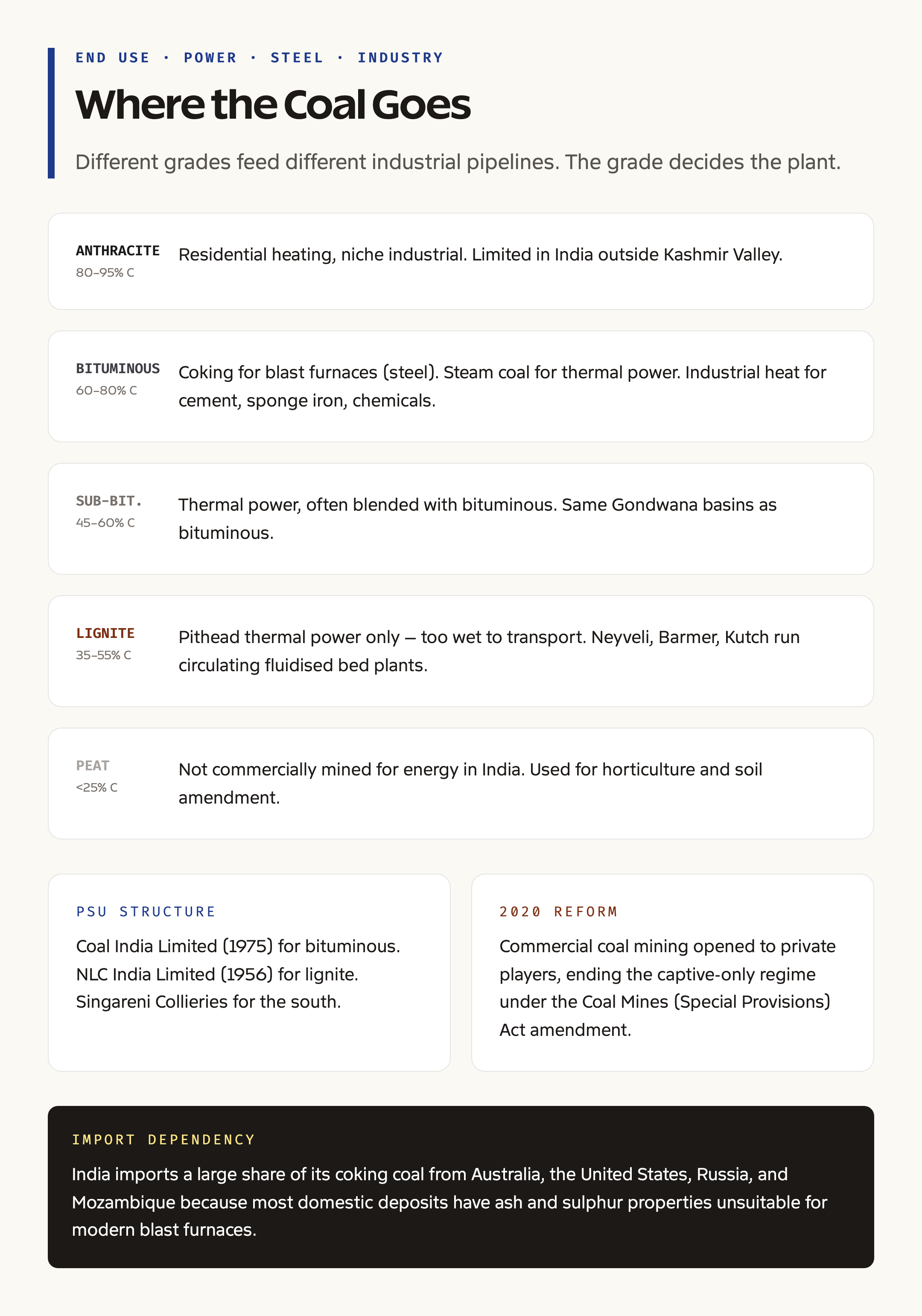
The carbon content classification matters in three practical ways. First, it shapes power station design. A boiler designed for high-ash bituminous coal cannot run efficiently on lignite, and vice versa. The Neyveli lignite plants, the Barmer lignite plant, and the Kutch lignite plants use different boiler technologies (often circulating fluidised bed) from the bituminous-fired plants of the Damodar and Mahanadi basins. Second, it shapes the import dependency picture. India has plenty of high-ash thermal bituminous but relatively little low-ash coking bituminous, so the steel sector imports a large share of its coking coal from Australia, the United States, and Mozambique. Third, it shapes the climate and air-pollution policy debate. Lignite, with its high moisture and low calorific value, has the highest carbon dioxide emissions per unit of electricity generated. Anthracite is cleanest per unit of heat. The shift toward higher-grade coal, blending, and beneficiation can therefore lower emissions intensity even before any renewable substitution.
Detailed Analysis of India’s Coal Geography
The Damodar Valley, running across Jharkhand, West Bengal, and the eastern fringe of Madhya Pradesh, is the historical heart of Indian coal mining. Jharia is the only major Indian source of prime coking coal. Raniganj is the oldest active coalfield. Bokaro and Dhanbad are secondary coking and steam coal districts. The Son-Mahanadi axis, with Singrauli, Korba, Talcher, and Ib Valley, holds the largest steam coal reserves and supplies the bulk of central and eastern India’s thermal power. The Wardha and Godavari basins host Singareni Collieries (Telangana), which serves the southern grid.
The lignite belt is structurally distinct. Neyveli, in Tamil Nadu’s Cuddalore district, has been mined since 1962 and supports a chain of pithead lignite-fired thermal plants run by NLC India Limited. Barmer in Rajasthan hosts the integrated Barmer lignite-fired plant operated by Raj West Power. Kutch lignite supplies plants in Gujarat. Assam’s Tertiary coal deposits, especially in the Makum field, are mineable but small.
Anthracite in India is essentially the Kashmir Valley occurrence and does not feature in the energy balance.
Comparative International Frame
Globally, China holds the largest coal reserves and is the largest producer and consumer. The United States, India, Russia, and Australia round out the top five reserves. Anthracite is concentrated in northern China, Russia, and the Appalachian belt of the United States. Coking bituminous coal of high quality is concentrated in Australia (Queensland), Canada (British Columbia), Russia (Kuzbass), and the eastern United States. Lignite is concentrated in Germany (Lusatia, Rhineland), the United States (North Dakota), Australia (Victoria), and India.
India’s coal mix is unusual in two respects. First, the share of high-ash bituminous coal is unusually high, which limits exports and forces design choices in boilers and pollution control. Second, the lignite share, while small as a percentage of total reserves, is large enough to support a separate corporate structure (NLC India) and a distinct industrial cluster.
Challenges in the Indian Coal Sector
The first challenge is the high ash content of domestic bituminous coal, which raises particulate emissions, ash disposal, and water consumption at thermal plants. The second is the geological concentration of coking coal in Jharia, which is also the site of long-running underground coal fires that are difficult to extinguish. The third is the mismatch between coal location and power demand: most coal sits in central and eastern India, but a large share of demand sits in the west and south, requiring long-haul rail and slurry pipelines. The fourth is the climate and air-quality pressure on coal more broadly, intersecting with India’s net-zero by 2070 commitment, the National Clean Air Programme, and emissions standards for thermal plants. The fifth is the social cost: coal mining districts often have poor human development indicators and contested land rights under the Forest Rights Act.
Prelims Pointers
- Anthracite has the highest carbon (80 to 95 per cent) and highest calorific value
- Peat has the lowest carbon (under 25 per cent) and is a coal precursor, not commercially mined for energy in India
- India’s bituminous coal is mostly Gondwana coal, around 250 million years old
- Lignite is Tertiary coal, around 50 to 60 million years old
- Jharia is the only major source of prime coking coal in India
- Neyveli is India’s largest lignite mining centre
- India’s anthracite occurs in Kashmir Valley
- Coal India Limited (1975) and NLC India Limited (1956) are the two main public sector coal companies
- The 2020 amendment to the Coal Mines (Special Provisions) Act ended captive-only mining and opened commercial coal mining to private players
- India is the second-largest coal consumer globally after China
Mains Practice Questions
- India’s coal endowment is large but unevenly distributed. Discuss the geographical distribution of coal types in India and the implications for the energy and steel sectors.
- The energy transition will not be a clean substitution of renewables for coal. Examine the place of high-ash bituminous coal and lignite in India’s medium-term electricity mix and the policy levers available to lower the emissions intensity of coal use.
- Coal mining has structural human and ecological costs. Evaluate the steps India has taken to address the social and environmental impact of coal mining, with particular reference to the Jharia coalfield fires and the Forest Rights Act, 2006.
Way Forward
The medium-term path for India’s coal sector has several threads. Beneficiation of high-ash bituminous coal at the pithead can reduce ash content and therefore particulate emissions, water consumption, and rail loadings. Commercial coal mining, opened up by the 2020 reforms, can bring in efficiency, capital, and technology, provided the auction architecture and the environmental clearance regime hold. Underground gasification of unmineable lignite seams is a long-running research strand worth scaling. The phase-down of unabated coal, recognised in India’s COP26 statement, can be sequenced through retirement of older sub-critical units, expansion of supercritical and ultra-supercritical units in the near term, and a parallel ramp of renewables and storage. The Just Transition agenda, which has begun to receive attention through the Ministry of Coal and the Ministry of Environment, will need to address employment, revenue, and land restoration in the coal districts.
Frequently Asked Questions
What are the main types of coal based on carbon content?
The main types are anthracite (80 to 95 per cent carbon), bituminous (60 to 80 per cent), sub-bituminous (45 to 60 per cent), lignite (35 to 55 per cent), and peat (under 25 per cent), in descending order of rank.
Which is the highest grade of coal in India?
Anthracite is the highest grade by carbon content and calorific value. India has only small anthracite reserves in the Kashmir Valley, so the highest-grade coal in commercial use is prime coking bituminous coal from Jharia.
Where is lignite mined in India?
The main lignite mines are at Neyveli (Tamil Nadu), Barmer and Bikaner (Rajasthan), Kutch and Bhavnagar (Gujarat), and the Makum field (Assam). Neyveli, run by NLC India Limited, is the largest.
Why is most of India’s coal high in ash?
The Gondwana coal of India was deposited in fluvial and lacustrine settings with significant clastic input, which gives the resulting coal high mineral matter. Tertiary lignite is younger but has high moisture for similar geological reasons.
What is the difference between coking coal and steam coal?
Coking coal, when heated in the absence of air, forms a porous coke used in blast furnaces for iron-making. Steam coal is burned in boilers to raise steam for electricity generation. Both can be bituminous, but coking coal needs specific volatile and ash properties.
Why does India import coking coal?
India’s coking coal reserves are largely concentrated in Jharia, and a substantial share has high ash, sulphur, or moisture that makes it less suitable for modern blast furnaces. The steel sector therefore imports a large share of its coking coal from Australia, the United States, Russia, and Mozambique.
Is peat used as a fuel in India?
Peat is not commercially mined for energy in India. It occurs in Kerala backwaters, the Sundarbans, and parts of the Northeast, and is used in horticulture and as a soil amendment rather than as a heating fuel.
What is the calorific value of Indian bituminous coal?
Indian bituminous coal typically has a gross calorific value in the range of 3,500 to 5,500 kilocalories per kilogram on an as-received basis, due to the high ash content. The intrinsic calorific value of the carbon-rich fraction is comparable to global bituminous coal.
Which Indian state has the largest coal reserves?
Jharkhand has the largest proven coal reserves, followed by Odisha and Chhattisgarh. The Damodar Valley in Jharkhand and the Mahanadi Valley in Odisha together account for the bulk of India’s bituminous reserves.
How is coal classification linked to climate policy?
Coal grades differ in carbon dioxide emissions per unit of electricity. Lignite has the highest emissions intensity, anthracite the lowest. Beneficiation, blending, and replacement of older sub-critical units with supercritical and ultra-supercritical units can lower the emissions intensity of coal use within India’s net-zero pathway.
Tell Google you want more of this.
Add Anantam IAS as a preferred sourceOne tap, and this site shows up more often in your own Top Stories, AI Overviews and AI Mode. Remove it any time.