Introduction
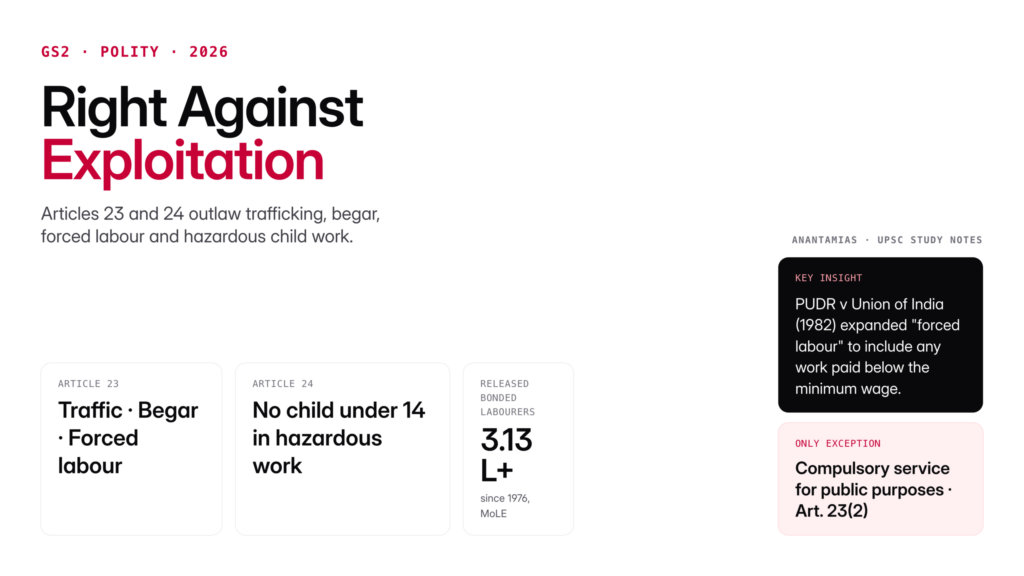
The Right Against Exploitation, enshrined in Articles 23 and 24 of the Indian Constitution, is a promise that no human being in the Republic can be treated as merchandise or machinery. It prohibits trafficking, forced labour and the employment of children in hazardous occupations. The right reaches beyond citizens: it binds the state, private actors, contractors and even foreign employers operating on Indian soil. For a country where bonded labour persisted as a feudal inheritance and where children still work on brick kilns and firecracker factories, this right is not rhetorical. It is load-bearing.
For a UPSC aspirant, Articles 23 and 24 are among the most litigated provisions of Part III. They have generated landmark judgments, statutory architecture, and a living body of jurisprudence on dignity, minimum wages and child rights. This article maps the provisions, their exceptions, the supporting legislation, the major cases, and the persistent implementation challenges that make this right a recurring theme in Prelims, Mains GS2 and Essay papers.
Quick Facts at a Glance
| Item | Detail |
|---|---|
| Constitutional articles | Articles 23 and 24 |
| Part of Constitution | Part III, Fundamental Rights |
| Article 23 | Prohibits traffic in human beings, begar and forced labour |
| Article 24 | Prohibits employment of children below 14 in hazardous work |
| Only explicit exception | Compulsory service for public purposes (Art. 23(2)) |
| Key legislation | Bonded Labour System (Abolition) Act, 1976 |
| Trafficking law | Immoral Traffic (Prevention) Act, 1956 |
| Child labour law | Child and Adolescent Labour (Prohibition and Regulation) Act, 1986 (amended 2016) |
| Landmark case on forced labour | PUDR v Union of India (1982) |
| Landmark case on bonded labour | Bandhua Mukti Morcha v Union of India (1984) |
| Landmark case on child labour | M.C. Mehta v State of Tamil Nadu (1996) |
| Released bonded labourers (since 1976) | Over 3.13 lakh, per MoLE data |
Background and Historical Context
Forced labour and bondage were stitched into India’s colonial and pre-colonial economy. The begar system required peasants to provide unpaid labour to zamindars and local officials. Indentured workers were shipped from India to plantations in Mauritius, Fiji, Trinidad and Guyana under the Kangani and Maistry systems. The Devadasi tradition trapped women in hereditary sexual servitude under the cover of religion. Child labour in match factories, carpet looms and domestic service was widespread and visible.
The nationalist movement took an early stand. The Karachi Resolution of 1931, drafted by Jawaharlal Nehru and moved by Gandhi at the Congress session, promised freedom from exploitation as a fundamental right in an independent India. The Constituent Assembly Debates of November 1948 saw Dr B.R. Ambedkar defend Articles 17 and 23 (then numbered differently) as essential to dismantling social hierarchy. K.T. Shah proposed stronger wording that explicitly banned sweated labour; the final text settled on a flexible formulation that courts could expand.
Post-independence enforcement was slow. The Bonded Labour System (Abolition) Act came only in 1976, during the Emergency, after the Swami Agnivesh-led Bandhua Mukti Morcha movement publicised stone quarry bondage in Faridabad. The Child Labour (Prohibition and Regulation) Act of 1986 was itself a response to the Asiad construction scandals and PUDR litigation. The 2016 amendment tightened the ban to all employment below 14 and restricted adolescent (14 to 18) work to non-hazardous sectors, aligning Indian law with ILO Conventions 138 and 182, which India ratified in 2017.
International commitments further shape the content of Articles 23 and 24. The Universal Declaration of Human Rights (Article 4 on slavery, Article 23 on just conditions of work), the UN Convention on the Rights of the Child and the SAARC Convention on Trafficking of Women and Children all feed Indian jurisprudence.
Key Provisions
Article 23: Prohibition of Traffic in Human Beings and Forced Labour
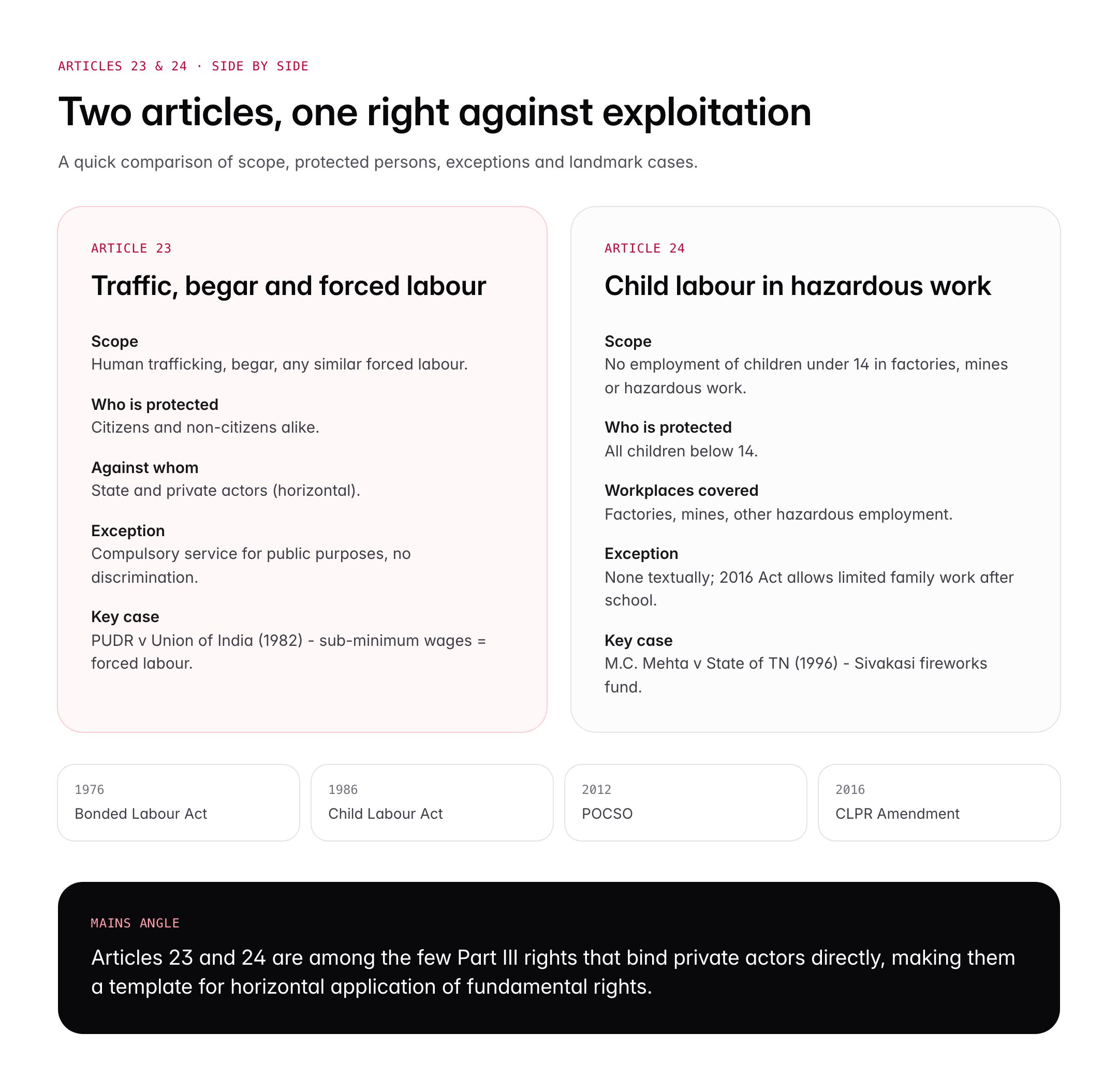
Article 23(1) prohibits three distinct evils: traffic in human beings, begar and other similar forms of forced labour. Any contravention is an offence punishable by law. The right is enforceable against both the state and private individuals, a rare horizontal application within Part III.
Article 23(2) carves a single exception. The state may impose compulsory service for public purposes, such as conscription, jury duty or disaster response. The proviso bars discrimination solely on grounds of religion, race, caste or class while drafting such service.
The Supreme Court has read each limb expansively. In People’s Union for Democratic Rights v Union of India (1982), Justice P.N. Bhagwati held that paying less than the statutory minimum wage amounts to forced labour, because economic compulsion vitiates consent. The ruling transformed Article 23 from an anti-slavery clause into a minimum-wage guarantee.
Article 24: Prohibition of Employment of Children in Factories, etc.
Article 24 bars the employment of children below the age of 14 in any factory, mine or other hazardous employment. Unlike Article 23, it is narrower in scope: it targets specific workplaces. Domestic service, small shops and family enterprises fell outside its strict text for decades, a gap that the 2016 amendment to the 1986 Act partly addressed.
The landmark case is M.C. Mehta v State of Tamil Nadu (1996), popularly known as the Sivakasi fireworks judgment. The Court ordered employers of child labour in hazardous sectors to deposit Rs 20,000 per child into a welfare fund, directed the state to provide alternative employment to an adult family member, and mandated compulsory schooling and medical care for the rescued child. The decision linked Article 24 with the Directive Principles under Articles 39(e), 39(f) and 45.
Supporting Legislation
- Bonded Labour System (Abolition) Act, 1976 abolished the bonded labour system and extinguished existing bonded debts.
- Immoral Traffic (Prevention) Act, 1956 (ITPA) criminalises commercial sexual exploitation.
- Child and Adolescent Labour (Prohibition and Regulation) Act, 1986 (amended 2016) bans child labour below 14 and adolescent work in hazardous industries.
- Juvenile Justice (Care and Protection of Children) Act, 2015 sets up Child Welfare Committees and rehabilitation procedures.
- Protection of Children from Sexual Offences Act, 2012 (POCSO) criminalises sexual abuse of minors.
- Transplantation of Human Organs Act, 1994 addresses trafficking for organ trade.
- Factories Act, 1948 and Mines Act, 1952 complement Article 24 in regulated workplaces.
Enforcement Machinery
The National Human Rights Commission monitors bonded and child labour. District Magistrates chair Vigilance Committees under the 1976 Act. The Pencil Portal (MoLE) receives online complaints on child labour. Anti-Human Trafficking Units operate under state police. The Central Sector Scheme for Rehabilitation of Bonded Labourers provides Rs 1 lakh to 3 lakh per released bonded worker, with higher amounts for women and children.
Significance for UPSC and General Knowledge
- GS2 Polity: Articles 23 and 24 are core Part III material; Prelims questions often test exceptions and scope.
- GS2 Social Justice: Directly relevant to trafficking, child rights, women’s rights and vulnerable group protection.
- GS1 Society: Bonded labour and child labour intersect with caste, poverty and migration themes.
- Essay: Provides strong case law references for topics on dignity, rights and state responsibility.
- Current affairs: Recurring NCRB reports on trafficking, Pencil Portal data, ILO India reports.
- Ethics GS4: PUDR and Bandhua Mukti Morcha cases illustrate judicial activism and public interest litigation.
Detailed Analysis: Landmark Jurisprudence
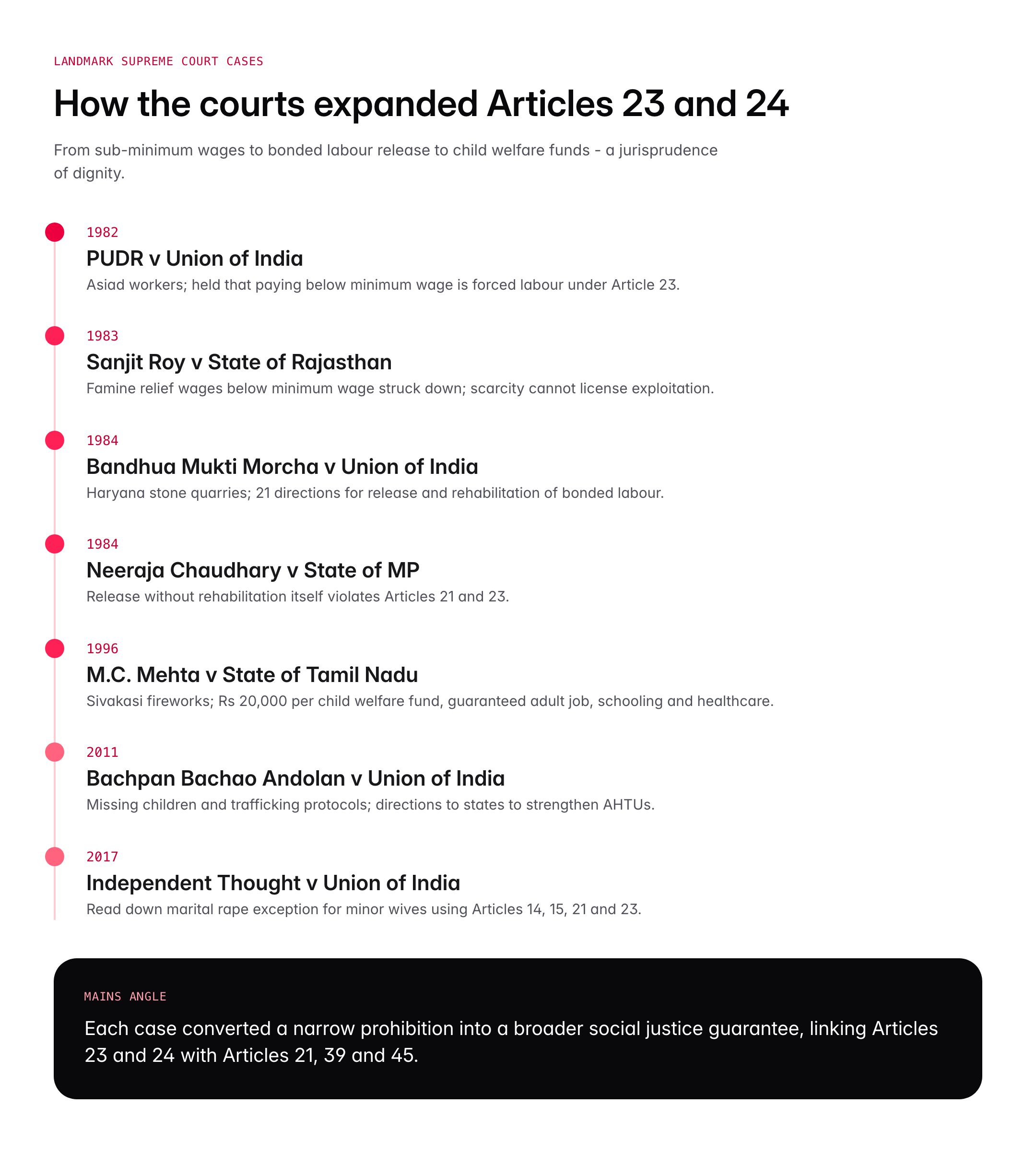
The Supreme Court has used Articles 23 and 24 to build one of the most creative chapters of Indian constitutionalism. In PUDR v Union of India (1982), involving Asiad Games construction workers, the Court held that any worker paid below the statutory minimum was being forced to labour and was therefore entitled to protection under Article 23. The ruling opened the door to Public Interest Litigation in labour matters and demonstrated the horizontal reach of fundamental rights.
Bandhua Mukti Morcha v Union of India (1984) treated a postcard from a social worker as a writ petition. The Court identified systemic bondage in Haryana stone quarries, appointed commissioners, and laid down 21 directions for the release, rehabilitation and economic reintegration of bonded workers. It also ruled that the right to live with dignity under Article 21 was inseparable from freedom from bondage under Article 23.
Neeraja Chaudhary v State of Madhya Pradesh (1984) held that mere release was not enough: the state was obliged to rehabilitate every identified bonded labourer. Failure to rehabilitate was itself a violation of Articles 21 and 23. Sanjit Roy v State of Rajasthan (1983) struck down the payment of less than minimum wage to famine-relief workers, reinforcing that poverty cannot license the state to extract cheap labour.
In child labour, the M.C. Mehta (1996) judgment built a template of deterrence and rehabilitation. Bachpan Bachao Andolan v Union of India (2011) directed the Union and states to implement missing-children protocols and trafficking investigations. In the 2017 case Independent Thought v Union of India, the Court read down the statutory exception to marital rape involving minor wives, drawing on Articles 14, 15, 21 and 23.
Recent cases continue the tradition. In Deepika Singh v Central Administrative Tribunal (2022) and the ongoing judicial monitoring of PLFS and NCRB trafficking data, courts have revisited both the scope of forced labour and the state’s implementation duties. The Anti-Trafficking Bill, which has been under parliamentary consideration in various forms since 2018, reflects legislative efforts to complete the Article 23 project.
Comparative Perspective
| Jurisdiction | Core Provision | Scope | Child Labour Age |
|---|---|---|---|
| India | Articles 23, 24 | Traffic, begar, forced labour, hazardous child work | 14 (total ban in employment below) |
| United States | 13th Amendment (1865) | Slavery and involuntary servitude | 14 for most sectors, 16 for hazardous |
| South Africa | Section 13, Constitution | Slavery, servitude and forced labour | 15 (aligned with ILO 138) |
| United Kingdom | Modern Slavery Act, 2015 | Slavery, servitude, forced labour and trafficking | 16 compulsory education age |
| European Convention | Article 4, ECHR | Slavery, servitude and forced labour | Varies by member state |
| Nepal | Article 29, Constitution 2015 | Trafficking, slavery, bonded labour | 14 |
India’s framework is constitutionally richer than most peers because Article 23 applies horizontally against private actors, not just the state. Few constitutions match the Indian Court’s expansion of forced labour to include sub-minimum wages. On child labour, however, the Indian age threshold of 14 is lower than the ILO’s general standard of 15, and the 2016 family-enterprise exemption has been criticised by ILO for creating a loophole.
Challenges and Criticisms
Despite robust constitutional and statutory scaffolding, enforcement remains the weak link. Government data indicate more than 3.13 lakh bonded labourers released since 1976, but the 2016 National Sample Survey on Bonded Labour (commissioned by MoLE) estimated the true figure at over 18 million, suggesting a vast dark zone. Release without rehabilitation often pushes freed workers back into debt cycles within a year.
Trafficking data from NCRB’s Crime in India reports shows persistent case volumes, with conviction rates below 30 percent. Inter-state coordination between Anti-Human Trafficking Units, shelter home audits after the Muzaffarpur exposures, and rehabilitation gaps for rescued minors remain problem areas. The repeated delays in passing a comprehensive Trafficking of Persons (Prevention, Care and Rehabilitation) Bill have left India without a unified trafficking law.
On child labour, the 2016 amendment to the 1986 Act has been criticised by child rights advocates. By permitting children to work in “family enterprises” after school hours, it arguably reintroduces a back door for the carpet, bangle and agarbatti industries which rely heavily on home-based child labour. Educational enforcement under the Right to Education Act remains patchy, especially for migrant children whose schooling is disrupted seasonally.
Finally, new forms of exploitation, such as online trafficking through dark web platforms, digital bonded labour in micro-task platforms, and debt bondage of migrant workers in Gulf countries, stretch the limits of a 1950 text. Courts and Parliament will need to keep reinterpreting Articles 23 and 24 for these emerging contexts.
Prelims Pointers
- Article 23 prohibits traffic in human beings, begar, and other forms of forced labour.
- Article 23(2) permits compulsory service for public purposes as the only exception.
- Article 24 bars employment of children below 14 in factories, mines or hazardous work.
- The Bonded Labour System (Abolition) Act was passed in 1976.
- The Child and Adolescent Labour (Prohibition and Regulation) Act was amended in 2016.
- PUDR v Union of India (1982) held that less-than-minimum wages amount to forced labour.
- Bandhua Mukti Morcha (1984) laid down detailed directions on bonded labour release.
- M.C. Mehta v State of Tamil Nadu (1996) concerned Sivakasi fireworks child labour.
- India ratified ILO Conventions 138 and 182 on child labour in 2017.
- The Pencil Portal is maintained by the Ministry of Labour and Employment.
- NHRC and District Magistrates are lead enforcement nodes under the 1976 Act.
- Central rehabilitation assistance ranges from Rs 1 lakh (male adult) to Rs 3 lakh (child and disabled).
Mains Practice Questions
Q1. Examine how judicial interpretation has expanded the scope of the Right Against Exploitation beyond its textual boundaries. (15 marks, 250 words)
- Start with the narrow text of Articles 23 and 24; identify the three limbs of Article 23 and the hazardous-work focus of Article 24.
- Trace expansion through PUDR (minimum wage), Bandhua Mukti Morcha (rehabilitation duty), Sanjit Roy (famine relief), M.C. Mehta (child rehabilitation fund).
- Evaluate the link with Article 21 dignity jurisprudence; note limits where implementation has lagged behind doctrine.
Q2. “The Right Against Exploitation is constitutionally ambitious but administratively anaemic.” Discuss with examples from bonded labour, trafficking and child labour. (15 marks, 250 words)
- Establish ambition: horizontal application, broad judicial reading, supporting legislation.
- Bring evidence of gaps: NCRB trafficking data, unverified rehabilitation, 2016 family-enterprise exemption, absent comprehensive trafficking law.
- Suggest reforms: trafficking law, strengthened Anti-Human Trafficking Units, linkage with MGNREGA and RTE, migrant labour database.
Conclusion
Articles 23 and 24 capture a simple moral insight: no person, adult or child, should be reduced to labour without dignity or consent. The Constitution writes this insight into enforceable law, the courts extend it to cover wages, rehabilitation and education, and Parliament backs it with a stack of statutes. Yet the gap between doctrine and delivery remains uncomfortably wide, especially for migrant workers, trafficked women and children caught in informal supply chains.
For aspirants, the Right Against Exploitation offers a rare opportunity to link three Mains registers: constitutional text, judicial creativity and administrative reality. Master the articles, the landmark cases and the statutory scaffolding, and you will be able to answer not just polity questions but also social justice, ethics and essay prompts with the texture that examiners reward.
Frequently Asked Questions
What is the Right Against Exploitation?
The Right Against Exploitation is a Fundamental Right under Articles 23 and 24 of the Indian Constitution. Article 23 prohibits traffic in human beings, begar and other forms of forced labour. Article 24 bars the employment of children below 14 years in factories, mines and other hazardous work, with only a narrow exception for compulsory public service.
What do Articles 23 and 24 of the Indian Constitution prohibit?
Article 23 prohibits human trafficking, begar and any similar form of forced labour, making violations a punishable offence. Article 23(2) carves out compulsory public service as the sole exception, barring discrimination on grounds of religion, race, caste or class. Article 24 bans employment of children under 14 in factories, mines and hazardous occupations.
Why is the Right Against Exploitation important for UPSC?
It is central to GS2 Polity and Social Justice, recurring in Prelims MCQs and Mains answers on fundamental rights, trafficking, bonded labour and child protection. Landmark judgments like PUDR, Bandhua Mukti Morcha and M.C. Mehta are staple references for essay and ethics answers on dignity, judicial activism and public interest litigation.
How is the Right Against Exploitation related to the Right to Life under Article 21?
The Supreme Court in Bandhua Mukti Morcha (1984) held that the right to live with dignity under Article 21 is inseparable from freedom from bondage under Article 23. Forced labour and child exploitation are therefore not just economic wrongs but violations of personal liberty and dignity, enforceable against both state and private actors.
What is considered forced labour under Article 23?
Forced labour includes begar (unpaid work extracted under coercion), bonded labour tied to debt, human trafficking for labour or sexual exploitation, and, per PUDR v Union of India (1982), any work paid below the statutory minimum wage. The Court reasoned that economic compulsion vitiates consent, bringing sub-minimum wage work within the ambit of Article 23.
What is the minimum age for employment in India?
Article 24 prohibits employment of children below 14 in factories, mines or hazardous work. The 2016 amendment to the Child and Adolescent Labour Act extended this into a total ban on employing anyone below 14, and restricted adolescents aged 14 to 18 from hazardous occupations. Family enterprises outside school hours remain a controversial exception.
Which are the key laws enforcing the Right Against Exploitation?
Core statutes include the Bonded Labour System (Abolition) Act, 1976; the Immoral Traffic (Prevention) Act, 1956; the Child and Adolescent Labour (Prohibition and Regulation) Act, 1986 as amended in 2016; POCSO 2012; and the Juvenile Justice Act, 2015. Enforcement rests with NHRC, District Magistrates, Anti-Human Trafficking Units and the Pencil Portal.
What are the landmark cases on Right Against Exploitation?
PUDR v Union of India (1982) equated sub-minimum wages with forced labour. Bandhua Mukti Morcha v Union of India (1984) established bonded labour rehabilitation duties. Sanjit Roy (1983) barred below-minimum famine relief wages. M.C. Mehta v State of Tamil Nadu (1996) created the child labour welfare fund. Bachpan Bachao Andolan (2011) advanced trafficking and missing children protocols.
Tell Google you want more of this.
Add Anantam IAS as a preferred sourceOne tap, and this site shows up more often in your own Top Stories, AI Overviews and AI Mode. Remove it any time.