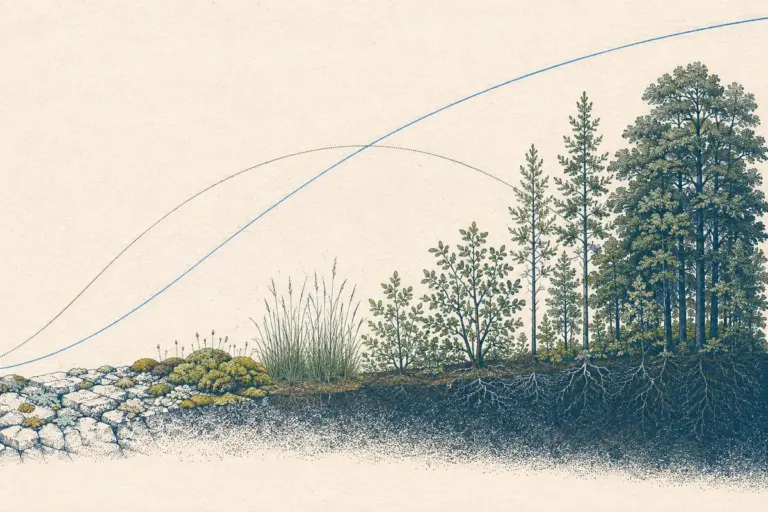
India's natural vegetation is a direct function of rainfall, temperature, altitude, and soil type. H.G. Champion originally classified Indian forests in 1936. Champion and S.K. Seth revised the classification in 1968, producing the standard framework that UPSC still uses: 16 major forest types grouped into 5 broad categories. This classification remains the official reference for the Forest Survey of India and appears regularly in both Prelims and Mains.
India's forest cover, per ISFR 2023 (India State of Forest Report), stands at 8,09,537 sq km — 21.76% of the geographical area. The target under the National Forest Policy 1988 is 33% of geographical area. We are nowhere close, and that gap is itself a UPSC topic.
Champion & Seth Classification: The 5 Groups
1. Tropical Wet Evergreen Forests
Found where annual rainfall exceeds 200 cm with no distinct dry season or a very short one (under 2 months). Temperature stays above 22°C year-round. These are India's densest forests with a multi-layered canopy reaching 45-60 m.
Regions: Western Ghats (below 1,500 m on the windward side), Andaman & Nicobar Islands, upper Assam, Meghalaya, Nagaland, Mizoram, Arunachal Pradesh lowlands.
Key species: Rosewood (Dalbergia latifolia), mahogany, ebony, ironwood, rubber, cinchona. Epiphytes, orchids, and ferns are abundant. The Silent Valley National Park in Kerala preserves one of the last undisturbed tracts of tropical evergreen forest in India.
Commercially, these forests are difficult to exploit because species occur in mixed stands — you cannot find pure stands of a single species. This biodiversity is an asset ecologically but a challenge economically.
2. Tropical Deciduous Forests (Monsoon Forests)
The most extensive forest type in India, covering the largest area. Rainfall: 100-200 cm. Trees shed leaves for 6-8 weeks during the dry season to conserve moisture. Champion & Seth divided these into two sub-types:
Moist Deciduous (100-200 cm rainfall): Found in the eastern slopes of Western Ghats, Chota Nagpur Plateau, Jharkhand, eastern Madhya Pradesh, southern slopes of Himalayas (below 1,000 m), Odisha, and Chhattisgarh. Key species: Teak (Tectona grandis), sal (Shorea robusta), bamboo, sandalwood, mulberry.
Teak dominates in the western and central parts. Sal dominates in the eastern parts. This east-west sal-teak divide is a classic UPSC question.
Dry Deciduous (75-100 cm rainfall): Found in central India, eastern Rajasthan, western Madhya Pradesh, rain shadow areas of the Deccan. Key species: Teak (stunted), tendu (Diospyros melanoxylon), palas (Butea monosperma), mahua, neem. The forest canopy is more open, and undergrowth is dominated by grasses.
Common student mistake: Confusing moist and dry deciduous regions. The simplest mnemonic — moist deciduous forests have bamboo as a prominent undergrowth species. If a question mentions bamboo alongside teak or sal, it is moist deciduous, not dry.
3. Tropical Thorn Forests
Where rainfall drops below 75 cm, forests give way to thorny scrubland. These are found in Rajasthan, Gujarat (Kachchh), southwestern Punjab, and the rain shadow belt of the Western and Eastern Ghats.
Key species: Babool (Acacia nilotica), khair (Acacia catechu), wild date palm, khejri (Prosopis cineraria — Rajasthan's state tree), cacti, euphorbias. Trees are short (typically under 6-8 m), widely spaced, and have thick bark, small leaves, and deep root systems to survive aridity.
Khejri is the classic example of a keystone species in India's arid ecosystem. During the Chipko-like Bishnoi movement in 1730, 363 Bishnois led by Amrita Devi sacrificed their lives protecting khejri trees in Jodhpur.
4. Montane Forests (Temperate & Alpine)
Altitude replaces latitude as the primary climate control. The Himalayas display a compressed vegetation zonation:
Sub-Tropical (1,000-2,000 m): Chir pine (Pinus roxburghii) dominates, especially on southern slopes. Evergreen broad-leaved species on wetter eastern Himalayas.
Temperate (2,000-3,000 m): Oak (Quercus), deodar (Cedrus deodara), walnut, horse chestnut, rhododendron. In the eastern Himalayas, the wetter conditions support laurel, maple, and magnolia.
Alpine (3,000-3,500 m): Silver fir (Abies), birch (Betula), juniper. Stunted trees give way to shrubs. Rhododendron forms dense thickets — Sikkim alone has 36 species of rhododendron.
Alpine Meadows (3,500-4,500 m): Known as bugyals in Uttarakhand and margs in Kashmir. Rich grasslands used as summer pastures by nomadic communities. Dayara Bugyal, Bedni Bugyal, and Roopkund trail meadows are well-known examples.
Above 4,500 m: Mosses, lichens, and bare rock. Permanent snowline varies from 4,500 m in the eastern Himalayas to 5,500 m in the drier western Himalayas.
Western Ghats montane forests (Nilgiris, Anaimalai, Palani Hills) host shola-grassland ecosystems above 1,500 m. Shola forests grow in sheltered valleys; grasslands cover exposed slopes. This is a biodiversity hotspot and a frequent UPSC question topic.
5. Littoral & Mangrove Forests
Found in tidal zones along sheltered coastlines, river deltas, and estuaries. India has 4,992 sq km of mangrove cover (ISFR 2023).
Sundarbans (West Bengal): World's largest mangrove forest at ~4,200 sq km (India's share). Dominated by sundari (Heritiera fomes) — the tree that gives Sundarbans its name. Home to the Royal Bengal Tiger.
Bhitarkanika (Odisha): Second-largest mangrove in India, with 62 mangrove species — the highest species diversity.
Gulf of Kutch (Gujarat): Westernmost mangrove in India, adapted to high salinity and extreme aridity.
Other significant mangroves: Pichavaram (Tamil Nadu), Coringa (Andhra Pradesh), Andaman & Nicobar islands.
Mangroves provide coastal protection against cyclones and tsunamis (Bhitarkanika absorbed the 1999 super cyclone's fury, protecting hinterland villages), serve as fish nurseries, and sequester carbon at rates 3-5 times higher than terrestrial forests.
Forest Cover: ISFR 2023 Numbers
The Forest Survey of India (FSI) publishes the biennial India State of Forest Report. Key figures from ISFR 2023:
| Category | Area (sq km) | % of India's Area |
|---|---|---|
| Very Dense Forest (canopy >70%) | 99,779 | 3.02% |
| Moderately Dense Forest (canopy 40-70%) | 3,06,890 | 9.33% |
| Open Forest (canopy 10-40%) | 3,10,472 | 9.41% |
| Scrub (<10% canopy) | 46,539 | 1.41% |
| Total Forest Cover | 8,09,537 | 21.76% |
| Total Tree Cover (outside recorded forest areas) | 95,748 | 2.91% |
State-wise leaders:
- Largest forest area: Madhya Pradesh (77,414 sq km), followed by Arunachal Pradesh (66,164 sq km) and Chhattisgarh (55,547 sq km)
- Highest percentage forest cover: Mizoram (84.53%), Arunachal Pradesh (79.33%), Meghalaya (76.00%)
- Lowest percentage: Haryana, Punjab, and Rajasthan (all below 10%)
- Largest mangrove cover: West Bengal (2,114 sq km), followed by Gujarat (1,175 sq km)
Common student mistake: Confusing "largest forest area" with "highest forest cover percentage." Madhya Pradesh has the most forest in absolute area, but Mizoram leads in percentage terms. UPSC has tested this distinction directly.
Forest Types: Comprehensive Comparison Table
| Forest Type | Rainfall (cm) | Region | Key Species | Canopy | Area Rank |
|---|---|---|---|---|---|
| Tropical Wet Evergreen | >200 | Western Ghats, NE India, Andamans | Rosewood, Mahogany, Ebony | Dense, multi-layered (45-60 m) | 4th |
| Moist Deciduous | 100-200 | Eastern Ghats, Chota Nagpur, NE foothills | Teak, Sal, Bamboo, Sandalwood | Moderate (25-35 m) | 1st (largest) |
| Dry Deciduous | 75-100 | Central India, eastern Rajasthan | Teak (stunted), Tendu, Palas | Open (15-25 m) | 2nd |
| Tropical Thorn | <75 | Rajasthan, Gujarat, SW Punjab | Babool, Khejri, Cacti | Sparse (<10 m) | 5th |
| Montane Subtropical | 100-200 | Himalayas 1,000-2,000 m | Chir Pine, Broad-leaved evergreen | Moderate | — |
| Montane Temperate | 100-250 | Himalayas 2,000-3,000 m | Oak, Deodar, Rhododendron | Dense coniferous | — |
| Alpine | Variable | Above 3,000 m | Silver Fir, Birch, Juniper | Stunted to absent | — |
| Mangrove/Littoral | Variable | Coastal deltas, estuaries | Sundari, Rhizophora, Avicennia | Dense tidal | 6th |
Threats to India's Natural Vegetation
Five major threats degrade India's forests:
- Agricultural expansion — Shifting cultivation (jhum) in NE India affects 8,000+ sq km; encroachment for farming in Central India
- Mining — Coal mining in Jharkhand-Chhattisgarh destroys sal forests; iron ore mining degrades Western Ghats
- Urbanization and infrastructure — Linear projects (highways, railways) fragment habitats
- Forest fires — Uttarakhand's pine forests are highly fire-prone; 2024 saw over 1,200 fire incidents in Uttarakhand alone
- Overgrazing — Estimated 120 million cattle graze in forest areas, preventing natural regeneration
National Forest Policy and Conservation
The National Forest Policy 1988 set the target of 33% forest cover for the country and 67% for hill and mountain regions. India currently stands at 21.76%. At the current rate of change (+/- 0.1% per year), reaching 33% within this century is unrealistic without transformative intervention.
Key conservation frameworks:
- Wildlife Protection Act, 1972 — Created the legal basis for national parks and sanctuaries
- Forest Conservation Act, 1980 — Regulates diversion of forest land for non-forest purposes (every forest diversion needs central approval)
- Compensatory Afforestation Fund (CAMPA) — Funds collected from projects diverting forest land, used for afforestation
- Green India Mission — Under NAPCC, targets 5 million hectares of afforestation and restoration
UPSC Relevance
UPSC Prelims 2019 tested the difference between tropical evergreen and tropical deciduous forests. Mains GS-I regularly asks about "distribution of natural vegetation and its determining factors." Geography Optional Paper-I covers biogeography in depth, including the Champion & Seth framework.
Key connections to build: climate determines vegetation type (link to Koppen classification), vegetation supports specific fauna (link to Tiger Reserves in India), and legal protection frameworks govern conservation (link to Environmental Laws in India).
Tell Google you want more of this.
Add Anantam IAS as a preferred sourceOne tap, and this site shows up more often in your own Top Stories, AI Overviews and AI Mode. Remove it any time.