Coal still powers most of India. About 70 percent of the country’s electricity generation runs on coal, and despite a decade of ambitious renewable energy targets the absolute volume of coal consumed has continued to climb because demand has outpaced everything that solar and wind have added. The geography of coal in India is concentrated, geologically layered, and politically charged. A handful of coalfields in the Damodar valley, the Mahanadi basin, the Godavari valley, and a small lignite belt in Tamil Nadu produce nearly all of the country’s annual output, while a separate northeastern belt in Meghalaya raises distinct legal and humanitarian issues through its infamous rat-hole mines.
For UPSC the topic feeds prelims through dense factual questions about coalfields, producers, types of coal, and pollutants, and feeds mains through environmental and federal questions about Just Transition, mine safety, and the post-2020 commercial coal mining auctions. The chapter sits at the intersection of GS-I geography, GS-III environment, and the energy security debate that runs through every economic survey.
This guide takes you through the geology of Indian coal, the major coalfields and producing states, the structure of the coal industry under Coal India Limited and Singareni Collieries, the unique cases of Neyveli lignite and Meghalaya rat-hole mines, the chemistry of coal combustion, and the environmental and policy questions that follow.
Quick Facts at a Glance
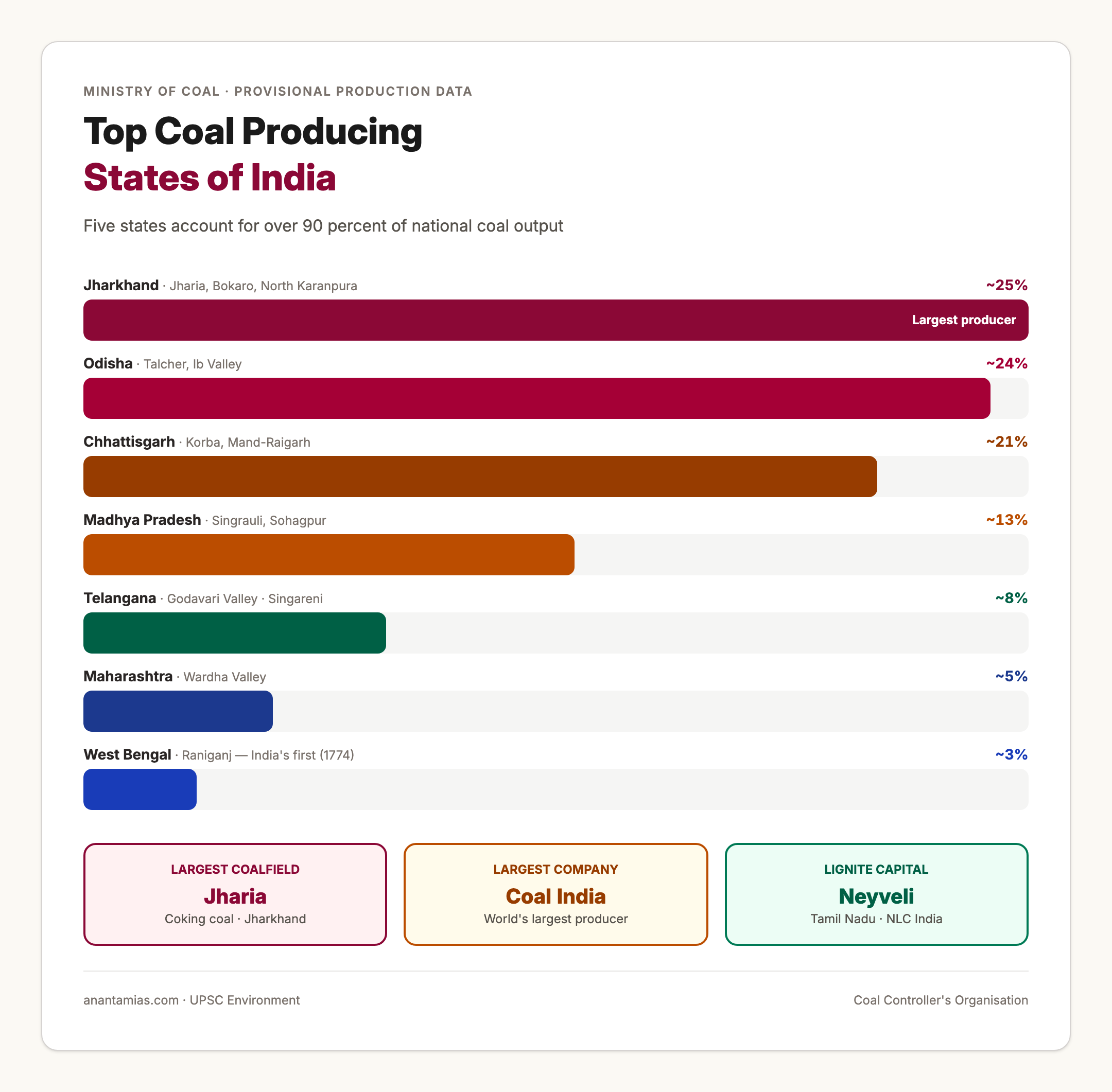
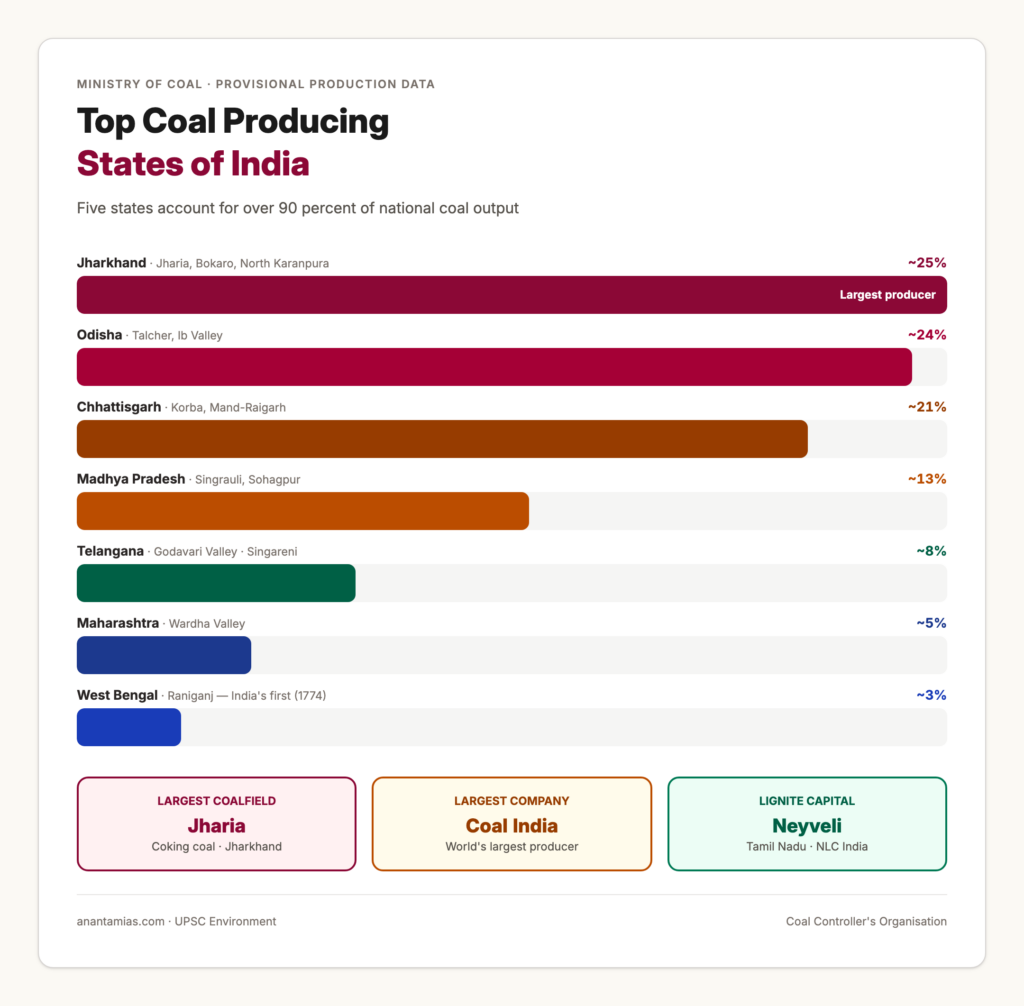
The largest coalfield in India is Jharia in Jharkhand, richest in coking coal used by the steel industry. The second largest is Raniganj in West Bengal, which was also India’s first coalfield, opened in 1774. The largest coal-producing state is Jharkhand, followed by Odisha, with major fields at Talcher and Ib Valley. Coal India Limited is the world’s largest coal producer by output. The largest Gondwana coalfield by reserve is the Godavari Valley Coalfield in Telangana, mined by Singareni Collieries Company Limited. The largest lignite reserve in India is at Neyveli in Tamil Nadu, operated by NLC India. Meghalaya is India’s only major Tertiary coal-bearing state, infamous for unregulated rat-hole mining. The deepest underground coal mine historically is Sudamdih in Jharkhand. Globally, China is the largest coal producer, generating more than 50 percent of world coal output. India is the second largest producer and the largest producer of brown coal and lignite combined after China. Coal combustion at thermal power plants releases carbon dioxide, oxides of nitrogen, and oxides of sulphur, and the resulting fly ash carries arsenic, lead, and mercury.
What Coal Is and How It Forms
Coal is a sedimentary rock formed from accumulated plant material that has been compressed, heated, and chemically transformed over geological time spans. The progression from peat to lignite to sub-bituminous coal to bituminous coal to anthracite reflects increasing rank, where rank is a function of carbon content, calorific value, and degree of metamorphism. Indian coal sits at the lower-rank end of the spectrum compared with American or Australian coals, and it has high ash content, which has implications for boiler design, particulate emissions, and thermal efficiency. The static treatment of coal types is covered in the article on types of coals based on carbon content.
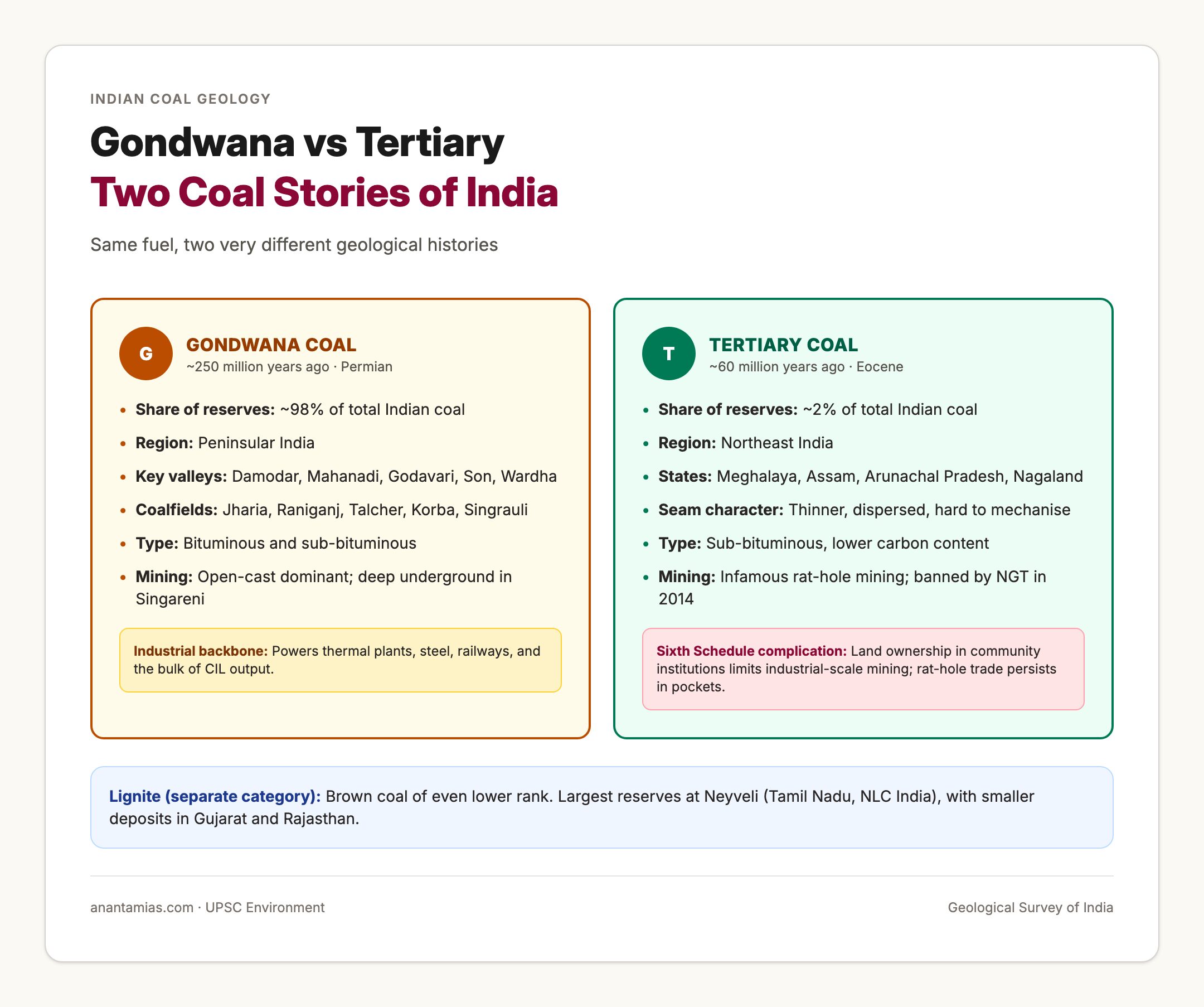
Indian coal is divided into two great geological groups. Gondwana coal, formed about 250 million years ago in Permian-aged swamp ecosystems, accounts for about 98 percent of India’s reserves and underpins the major coalfields of the Damodar, Mahanadi, Godavari, and Son valleys. Tertiary coal, formed about 60 million years ago, is found mainly in the northeastern states of Meghalaya, Assam, Arunachal Pradesh, and Nagaland. Tertiary coal seams in the northeast tend to be thinner, more dispersed, and harder to mine on industrial scale, which is one reason why rat-hole mining persists.
Background and Historical Context
Commercial coal mining in India began in 1774 at Raniganj, then in the Bengal Presidency, when the East India Company opened a colliery to fuel the early steamship trade on the Hooghly. The industry expanded slowly through the nineteenth century to feed the railways and the British wartime economy. After Independence the Indian government progressively asserted greater control through the Coal Mines (Nationalisation) Act 1973. Coking coal mines were nationalised first in 1971 to 1972, followed by non-coking mines in 1973, with the result that almost all coal mining in India was brought under state ownership through Coal India Limited and its subsidiaries. The Coal Mines (Special Provisions) Act 2015 reopened the door to private participation by allowing auction of cancelled coal blocks, and the Mineral Laws (Amendment) Act 2020 went further by permitting commercial coal mining by private companies for sale in the open market.
Major historical milestones include the formation of Coal India Limited in 1975 as the holding company; the long Jharia coalfield underground fires that have burned for over a century; the periodic Mining Plan revisions; the Eastern Coalfields, Bharat Coking Coal, Central Coalfields, Western Coalfields, South Eastern Coalfields, and Northern Coalfields subsidiaries; and the Singareni Collieries Company Limited as a public sector undertaking jointly owned by the Government of Telangana and the Government of India.
Largest Coalfields and Producing States
| Category | Name | Location | Key Facts |
|---|---|---|---|
| Largest Coalfield | Jharia Coalfield | Jharkhand | Richest in coking coal; underground fires for over a century |
| Second Largest Coalfield | Raniganj Coalfield | West Bengal | India’s first coalfield, opened in 1774 |
| Largest Coal Producing State | Jharkhand | – | Jharia, Bokaro, North Karanpura |
| Second Largest Producing State | Odisha | – | Talcher and Ib Valley coalfields |
| Largest Coal Mining Company | Coal India Limited | Pan-India | World’s largest coal producer |
| Largest Gondwana Coalfield by Reserve | Godavari Valley Coalfield | Telangana | Major Singareni Collieries area |
| Largest Lignite Reserve | Neyveli (NLC India) | Tamil Nadu | Power plus mining complex; major lignite deposits |
| Major Tertiary Coal State | Meghalaya | NE India | Tertiary younger coal; infamous for rat-hole mining |
| Deepest Underground Coal Mine (historic) | Sudamdih Mine | Jharkhand | Part of Jharia division; very deep levels |
| Largest Global Producer | China | – | Produces more than 50 percent of world coal annually |
| Second Largest Global Producer | India | – | Largest producer of brown coal plus lignite after China |
For a sectoral context that connects mining to electricity generation, the article on coal power in India provides the demand-side picture.
Why It Matters
Coal matters because it is still the spine of India’s electricity system and a large share of its industrial fuel mix. Even with renewable additions accelerating, coal-fired thermal capacity remains the swing producer that meets evening peaks and winter demand. The geography of coal therefore drives the geography of electricity, the railways, the steel industry, and the mining workforce. Jharkhand, Odisha, Chhattisgarh, Madhya Pradesh, and Telangana receive significant district-level mineral royalties and District Mineral Foundation funds because of coal, and these revenues are used to finance development in the same regions where mining causes displacement.
The political economy is dense. Mining draws labour from across the country into a few districts, the rail freight equation depends on coal as anchor cargo for cross-subsidising passenger trains, and the just transition debate around how to reskill coal-dependent communities is now central to India’s climate policy. The India coal sector reforms article discusses post-2020 changes in detail.
Detailed Analysis
Coal Mining Methods
Two broad methods dominate the industry. Open-cast mining accounts for the bulk of Indian production because most coal seams are shallow and broad, especially in the Mahanadi, Ib Valley, and South Eastern Coalfields. It is cheaper, safer, and more productive per worker but causes greater land disturbance and dust generation. Underground mining is older and necessary for deeper or steeper seams; it has higher cost, lower productivity, and greater fatality risk. Mechanised longwall mining has been deployed in select Singareni mines but the share of underground production keeps falling.
Rat-Hole Mining in Meghalaya
Rat-hole mining describes the practice of digging narrow horizontal tunnels into hillsides where workers, often children, crawl in to mine thin Tertiary coal seams. The National Green Tribunal banned the practice in 2014, but enforcement has been patchy and the trade continues in pockets, often into West Bengal and Bangladesh. Multiple rescue operations after pit collapses, most recently in East Jaintia Hills, have drawn national attention. The structural problem is that Meghalaya’s Sixth Schedule status places land ownership in the hands of community institutions, and large industrial mining is therefore not feasible, leaving the rat-hole trade as the default.
Singareni and Neyveli
Singareni Collieries Company Limited is a joint venture between the Government of Telangana, with majority share, and the Government of India. It is the largest underground coal mining company in India and operates almost entirely within the Godavari Valley Coalfield. NLC India, formerly Neyveli Lignite Corporation, runs the largest open-cast lignite mining and power generation complex in India at Neyveli in Tamil Nadu, and is also expanding into solar power.
Comparative Note
Globally, China produces more than 50 percent of the world’s coal and remains the largest consumer. India is the second largest producer and consumer. The United States and Australia are also major producers but their domestic consumption has declined as gas and renewables displace coal. India’s coal is, on average, of lower quality than Australian or American coal, with higher ash content and lower calorific value. This is why Indian power plants typically import some coking and high-calorific thermal coal even while exporting little.
Pollution and Environmental Costs
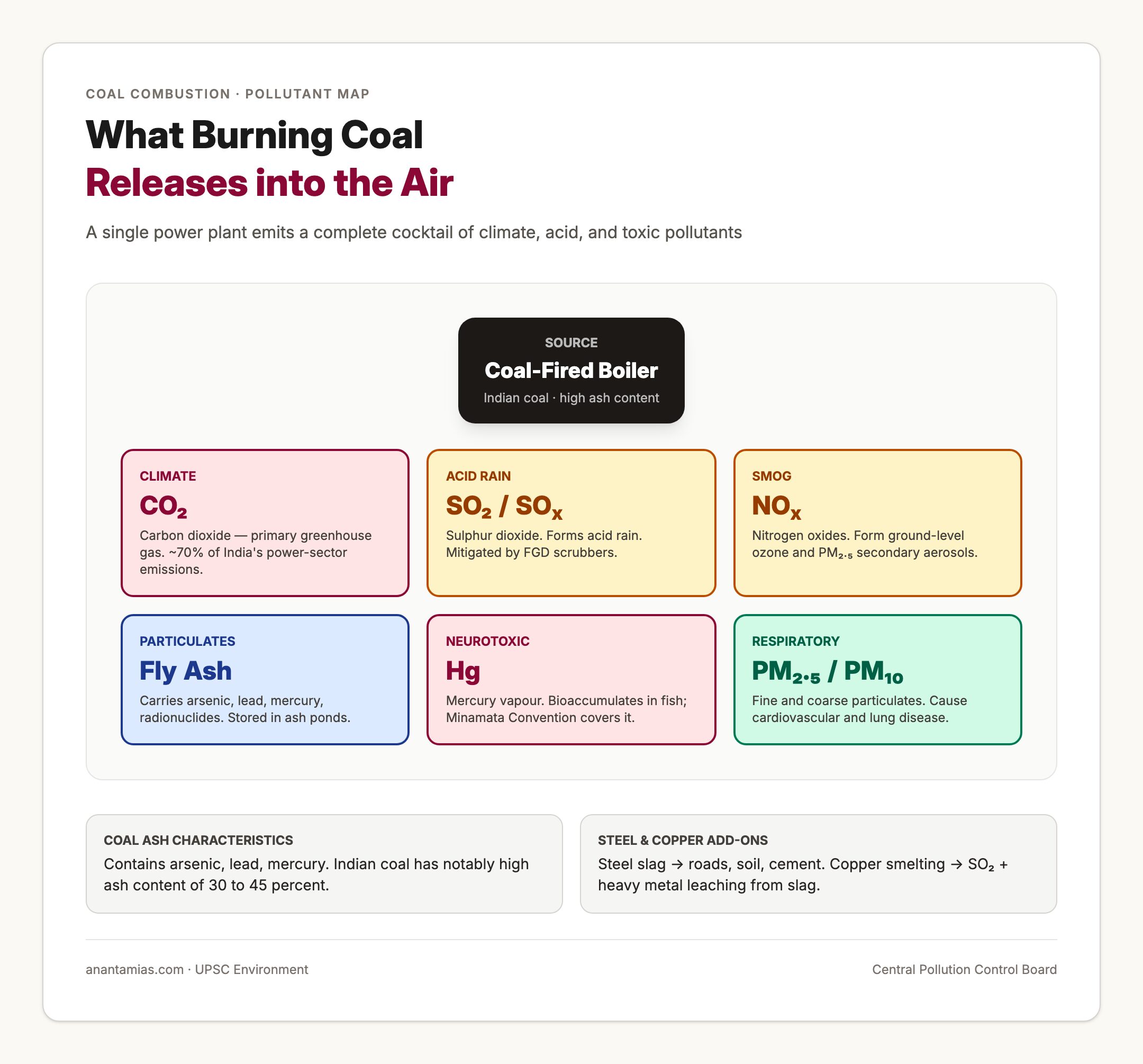
Coal combustion at thermal power plants releases carbon dioxide as the primary climate pollutant, oxides of sulphur, oxides of nitrogen, and large volumes of particulate matter that include fly ash. Coal ash is laced with arsenic, lead, mercury, and trace radionuclides, all of which can leach into groundwater from poorly engineered ash ponds. Indian coal has notably high ash content, which intensifies these problems. Mercury emissions from coal combustion accumulate downstream in fish and human tissue. The article on pollution: smog, microplastics, thermal covers the wider pollution context. Steel industry coal use adds carbon monoxide and additional particulate burdens, and copper smelting can release sulphur dioxide and leach heavy metals from copper slag.
Challenges and Implementation Gaps
Land acquisition remains the toughest constraint on new mining capacity. Even where blocks have been auctioned, public hearings, forest clearance under the Forest Conservation Act, and tribal consent under the forest rights act 2006 often delay projects by years. Rehabilitation and resettlement of displaced communities is patchy. Mine fires in Jharia continue to release carbon and threaten houses built on subsidence-prone land. Mine safety, especially in underground operations, lags global standards on fatalities per million tonne. Just Transition planning for coal districts that will face declining demand after 2040 is still nascent, with limited skilling or alternative livelihood programmes in place.
Prelims Pointers
Jharia is the largest coalfield in India and is richest in coking coal. Raniganj is the second largest and the oldest, opened in 1774. Jharkhand is the largest coal producing state, followed by Odisha. Coal India Limited is the world’s largest coal producer. Singareni Collieries is a joint Telangana-Government of India undertaking. The Godavari Valley Coalfield is the largest Gondwana coalfield by reserve. NLC India operates the Neyveli lignite complex in Tamil Nadu. Meghalaya is the only major Tertiary coal state; rat-hole mining was banned by the National Green Tribunal in 2014. Sudamdih in Jharkhand is historically the deepest underground coal mine. China is the world’s largest coal producer; India is second. Coal combustion releases carbon dioxide, oxides of sulphur, oxides of nitrogen, and particulate matter. Coal ash contains arsenic, lead, and mercury. Indian coal has high ash content. Steel industry pollutants include sulphur dioxide, oxides of nitrogen, carbon monoxide, and carbon dioxide; steel slag is used in road construction, agricultural soil improvement, and cement production. Copper smelting can release sulphur dioxide and leach heavy metals from copper slag.
Mains Practice Questions
GS-III: Discuss the role of coal in India’s energy security and the challenges of just transition for coal-dependent districts. (250 words)
GS-III: Critically examine the environmental and health impacts of coal mining and combustion in India, and outline the regulatory architecture that addresses them. (250 words)
GS-I: Describe the geology of Gondwana and Tertiary coal in India and explain why most commercial coal mining is concentrated in peninsular India rather than the northeast. (250 words)
GS-II: Evaluate the legal and constitutional dimensions of rat-hole mining in Meghalaya with reference to the Sixth Schedule and the National Green Tribunal’s 2014 order. (250 words)
Way Forward
Indian coal policy needs to balance four objectives at once: energy security, climate commitments, livelihoods in coal districts, and environmental protection. The path forward includes accelerating retrofits of older thermal plants with flue gas desulphurisation, raising boiler efficiency, capping fly ash and mercury emissions, deploying mine fire control technology in Jharia, formalising worker safety and welfare in private commercial mines, building Just Transition plans backed by skilling and alternative employment for coal districts, and supporting Meghalaya in moving from rat-hole to safer, regulated, smaller-scale mechanised operations consistent with Sixth Schedule autonomy. Coal will not vanish from India’s energy mix in the next two decades, but the manner in which it is mined, burned, and finally retired will determine how much of the climate and health cost the country eventually pays.
Frequently Asked Questions
Which is the largest coalfield in India?
Jharia in Jharkhand is the largest coalfield in India and is also the richest source of coking coal used in the steel industry. Underground fires in parts of the field have burned for over a century.
Which is India’s first coalfield?
Raniganj in West Bengal is India’s first coalfield. Commercial mining began there in 1774 under the East India Company, making it the oldest coal mining region in the country.
Which state produces the most coal in India?
Jharkhand is the largest coal producing state in India, with major fields at Jharia, Bokaro, and North Karanpura. Odisha follows as the second largest with the Talcher and Ib Valley coalfields.
What is rat-hole mining and why is it controversial?
Rat-hole mining is the practice of digging narrow horizontal tunnels into hillsides where workers, often children, crawl in to extract thin coal seams. It is unsafe, unregulated, and causes frequent fatalities. The National Green Tribunal banned it in 2014, but enforcement has been weak in Meghalaya.
Where are India’s largest lignite reserves?
The largest lignite reserves in India are at Neyveli in Tamil Nadu, operated by NLC India. Lignite is a low-rank brown coal used mainly for power generation.
What is the difference between Gondwana and Tertiary coal?
Gondwana coal formed about 250 million years ago and accounts for about 98 percent of India’s reserves; it is found in peninsular India in the Damodar, Mahanadi, Godavari, and Son valleys. Tertiary coal formed about 60 million years ago and is found in the northeastern states; it is thinner and harder to mine on an industrial scale.
Who is Coal India Limited?
Coal India Limited is the state-owned holding company that controls most coal production in India through subsidiaries such as Eastern Coalfields, Bharat Coking Coal, Central Coalfields, Mahanadi Coalfields, Western Coalfields, South Eastern Coalfields, and Northern Coalfields. By output it is the world’s largest coal producer.
What pollutants does coal combustion release?
Coal combustion at thermal power plants releases carbon dioxide, oxides of sulphur, oxides of nitrogen, and particulate matter including fly ash. Fly ash contains arsenic, lead, and mercury, and Indian coal has high ash content.
How does India’s coal output compare globally?
China is the world’s largest coal producer, producing more than 50 percent of global output. India is the second largest producer. India is also the largest producer of brown coal and lignite combined after China.
What is the role of Singareni Collieries?
Singareni Collieries Company Limited is a public sector undertaking jointly owned by the Government of Telangana, with majority share, and the Government of India. It is the largest underground coal mining company in India and operates almost entirely within the Godavari Valley Coalfield.
Tell Google you want more of this.
Add Anantam IAS as a preferred sourceOne tap, and this site shows up more often in your own Top Stories, AI Overviews and AI Mode. Remove it any time.