Amendments to Indian Constitution: Important List
India’s Constitution has been amended 106 times since it came into force on 26 January 1950. That’s a significant number — the US Constitution has been amended only 27 times in over 230 years. This reflects the framers’ deliberate choice to make the Constitution a living document, adaptable to changing social, economic, and political realities. But the amendment power is not unlimited. The basic structure doctrine — evolved by the Supreme Court — sets the outer boundary of what Parliament can change. Understanding the amendment process, the key amendments, and this boundary is essential for UPSC.
The Amendment Process: Article 368
Article 368 in Part XX of the Constitution governs how it can be amended. The procedure depends on the type of provision being amended.
Three Methods of Amendment
Method 1: Simple Majority (Not Article 368)
Some provisions can be amended by a simple majority of Parliament — meaning the same majority needed to pass an ordinary law. These are not considered constitutional amendments under Article 368. Examples:
- Admission of new states (Article 2)
- Formation of new states (Article 3)
- Creation or abolition of Legislative Councils (Article 169)
- Citizenship provisions (Article 11)
- Salaries of Supreme Court judges
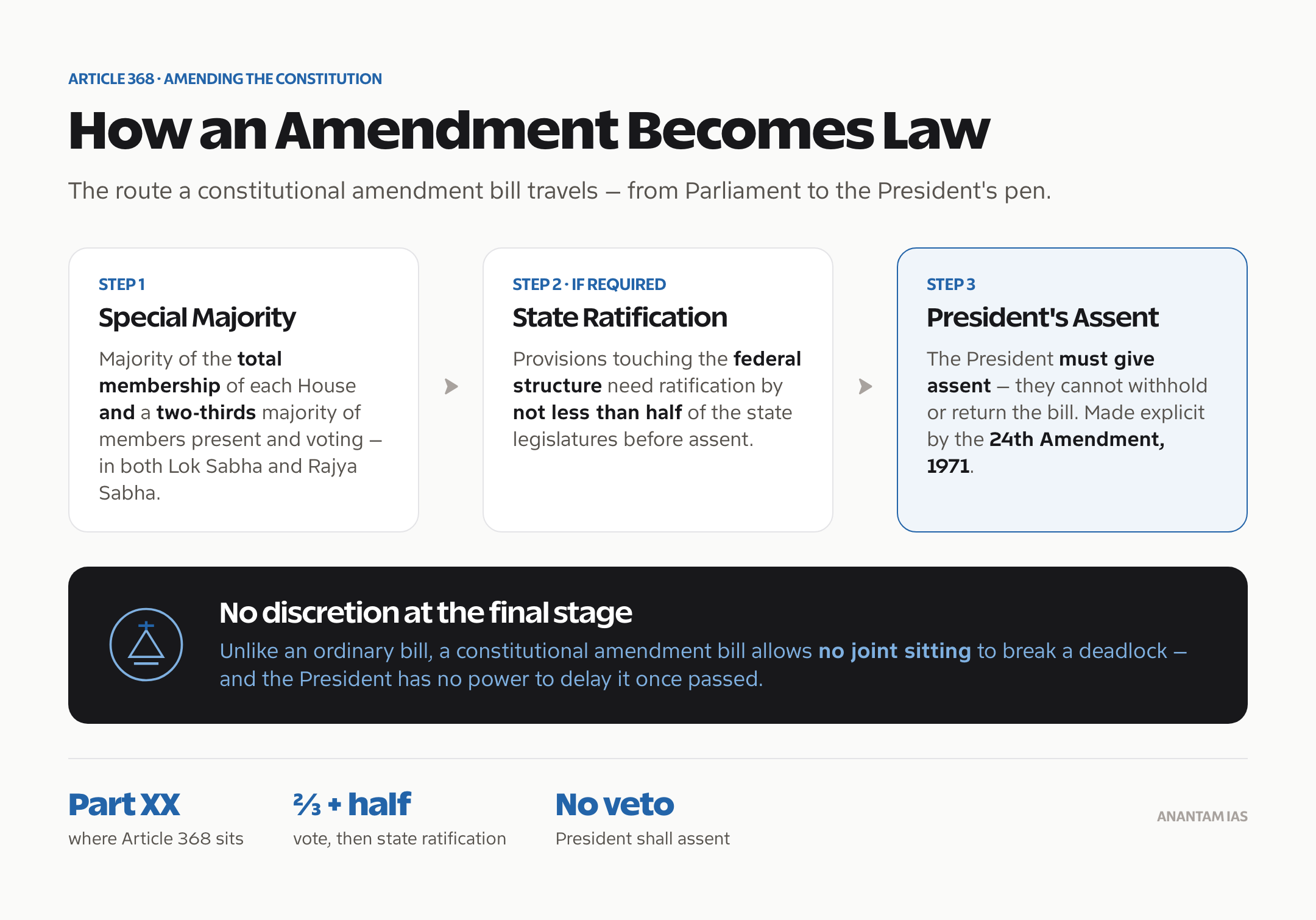
Method 2: Special Majority (Article 368)
Most constitutional provisions require a special majority:
- Majority of total membership of each House (not just those present and voting)
- Two-thirds majority of members present and voting
- Both conditions must be satisfied simultaneously
- Required in both Lok Sabha and Rajya Sabha
Method 3: Special Majority + Ratification by States
Certain provisions additionally require ratification by not less than half of the state legislatures before the President can give assent. These include provisions affecting the federal structure:
- Article 54 and 55 (Election of President)
- Article 73 and 162 (Executive power of Union and States)
- Articles 124–147 (Supreme Court)
- Articles 214–231 (High Courts)
- Article 241 (High Courts for Union Territories)
- Seventh Schedule (Union, State, Concurrent Lists)
- Representation of States in Parliament
- Article 368 itself
There is no provision for a joint sitting of Parliament to resolve a deadlock on a constitutional amendment bill (unlike ordinary bills).
Role of the President
Once passed by Parliament (and ratified by states where required), the bill is presented to the President. The President must give assent — they cannot withhold or return a constitutional amendment bill. This was confirmed after the 24th Amendment (1971), which made it explicit that the President shall give assent.
The Basic Structure Doctrine
Before diving into individual amendments, you must understand the basic structure doctrine — because it’s the most important constraint on Parliament’s amendment power.
Kesavananda Bharati v. State of Kerala (1973)
In this landmark 13-judge bench ruling, the Supreme Court held by a 7-6 majority that while Parliament has wide power to amend the Constitution under Article 368, it cannot destroy the basic structure or essential features of the Constitution.
The Court did not define basic structure exhaustively, but elements held to be part of it include:
- Supremacy of the Constitution
- Republican and democratic form of government
- Secular character of the Constitution
- Separation of powers
- Federal character
- Judicial review
- Rule of law
- Free and fair elections
- Independence of the judiciary
- Unity and integrity of India
- Fundamental Rights (at least their core)
- Parliamentary system
Any constitutional amendment that destroys any of these elements can be struck down by the Supreme Court. This is the final limit on Parliament’s amending power.
Major Constitutional Amendments: Comprehensive Table
| Amendment | Year | Key Changes |
|---|---|---|
| 1st | 1951 | Added Ninth Schedule (land reform laws shielded from judicial review); added Article 15(4) for OBC reservations; amended Article 19 on speech restrictions |
| 4th | 1955 | Strengthened state power to acquire property; clarified compensation clause |
| 7th | 1956 | Reorganised states on linguistic basis; abolished Part B states; altered state categories |
| 17th | 1964 | Extended Ninth Schedule protection; clarified definition of “estate” for land reforms |
| 24th | 1971 | Made it explicit that Parliament can amend any part of the Constitution; President must give assent to amendment bills |
| 25th | 1971 | Replaced “compensation” with “amount” for property acquisition; curtailed judicial review of such laws; added Article 31C to protect laws implementing DPSP Articles 39(b) and (c) |
| 26th | 1971 | Abolished privy purses and privileges of former princely rulers |
| 31st | 1974 | Changed delimitation of parliamentary and assembly constituencies |
| 36th | 1975 | Made Sikkim the 22nd state of India |
| 38th | 1975 | Made Presidential proclamation of Emergency non-justiciable (later reversed by 44th) |
| 39th | 1975 | Placed elections of President, VP, Speaker, PM outside judicial review (largely struck down by SC) |
| 42nd | 1976 | “Mini-Constitution” — added “Socialist” and “Secular” to Preamble; Fundamental Duties (Part IVA); extended President’s Rule to 2 years; made constitutional amendments non-justiciable; curtailed judicial review; many provisions later reversed |
| 43rd | 1977 | Restored Supreme Court’s jurisdiction to examine central laws after Emergency |
| 44th | 1978 | Reversed many Emergency-era changes; replaced “Right to Property” (Art. 31) with legal right (Art. 300A); restored pre-Emergency safeguards; strengthened Art. 352 safeguards |
| 52nd | 1985 | Anti-defection law — added Tenth Schedule |
| 58th | 1987 | Authoritative text of Constitution in Hindi |
| 61st | 1989 | Lowered voting age from 21 to 18 years |
| 69th | 1991 | Special status for Delhi as National Capital Territory; Legislative Assembly and Council of Ministers for Delhi |
| 70th | 1992 | Included Delhi and Puducherry elected members in Presidential Electoral College |
| 71st | 1992 | Added Konkani, Manipuri, Nepali to Eighth Schedule |
| 73rd | 1992 | Constitutional status to Panchayati Raj; Part IX; 29 subjects in Eleventh Schedule; reservations for women/SC/ST |
| 74th | 1992 | Constitutional status to Urban Local Bodies; Part IX-A; 18 subjects in Twelfth Schedule |
| 76th | 1994 | Tamil Nadu 69% reservation upheld; added to Ninth Schedule |
| 84th | 2002 | Extended delimitation freeze on assembly seats till 2026 |
| 86th | 2002 | Article 21A — Right to Education (6–14 years); Article 45 amended; Fundamental Duty added for parents |
| 89th | 2003 | Created National Commission for Scheduled Tribes as separate body from NCSC |
| 91st | 2003 | Cabinet size capped at 15% of House strength; strengthened anti-defection law |
| 92nd | 2004 | Added Bodo, Dogri, Maithili, Santhali to Eighth Schedule (22 languages total) |
| 93rd | 2006 | OBC reservations in private unaided institutions (Article 15(5)) |
| 97th | 2011 | Right to form co-operative societies (Art. 19(1)(c)); Part IXB for cooperative societies |
| 99th | 2014 | National Judicial Appointments Commission — struck down by SC in 2015 |
| 100th | 2015 | Land boundary agreement with Bangladesh |
| 101st | 2016 | Goods and Services Tax — GST Council; new Articles 246A, 269A, 279A |
| 102nd | 2018 | Constitutional status to National Commission for Backward Classes; Article 338B |
| 103rd | 2019 | 10% reservation for Economically Weaker Sections (EWS) — Article 15(6) and 16(6) |
| 104th | 2020 | Extended reservation for SC/ST in Lok Sabha and state assemblies till 2030; ended Anglo-Indian nominated seats |
| 105th | 2021 | Restored states’ power to identify OBCs (post-Maratha reservation judgment) |
| 106th | 2023 | Women’s Reservation Act — 33% seats in Lok Sabha and state assemblies for women (effective after delimitation post-2026 Census) |
The 42nd Amendment: The “Mini-Constitution”
The 42nd Constitutional Amendment Act, 1976 — passed during the Emergency by the Indira Gandhi government — was the most sweeping constitutional change in Indian history. It:
- Added “Socialist” and “Secular” to the Preamble
- Added “Integrity” alongside “Unity” in the Preamble
- Added Fundamental Duties (Part IVA, Article 51A) — 10 duties for citizens
- Gave primacy to Directive Principles over Fundamental Rights (Article 31C expanded)
- Made constitutional amendments non-justiciable (Parliament’s amending power made absolute)
- Extended the life of Lok Sabha and state assemblies from 5 to 6 years
- Extended President’s Rule from 1 year to 2 years in a state
- Curtailed judicial review of central and state laws
- Inserted a chapter on Fundamental Duties
- Established the Administrative Tribunals (Article 323A-B)
Many of these changes were reversed by the 44th Amendment (1978) after the Janata government came to power:
- Lok Sabha term restored to 5 years
- President’s Rule maximum period reduced back to 1 year (with extension to 3 years in exceptional circumstances)
- Judicial review restored
- Article 368 amendments making Parliament’s power absolute struck down by courts based on basic structure
The 44th Amendment: Restoring Constitutional Balance
The 44th Constitutional Amendment Act, 1978 was the democratic correction to Emergency-era excesses:
- Right to Property removed from Fundamental Rights — made only a legal right under Article 300A (cannot be taken away without authority of law)
- Restored pre-Emergency protection against arbitrary detention (Articles 20, 21 cannot be suspended even during Emergency)
- Strengthened safeguards before President can proclaim Emergency under Article 352:
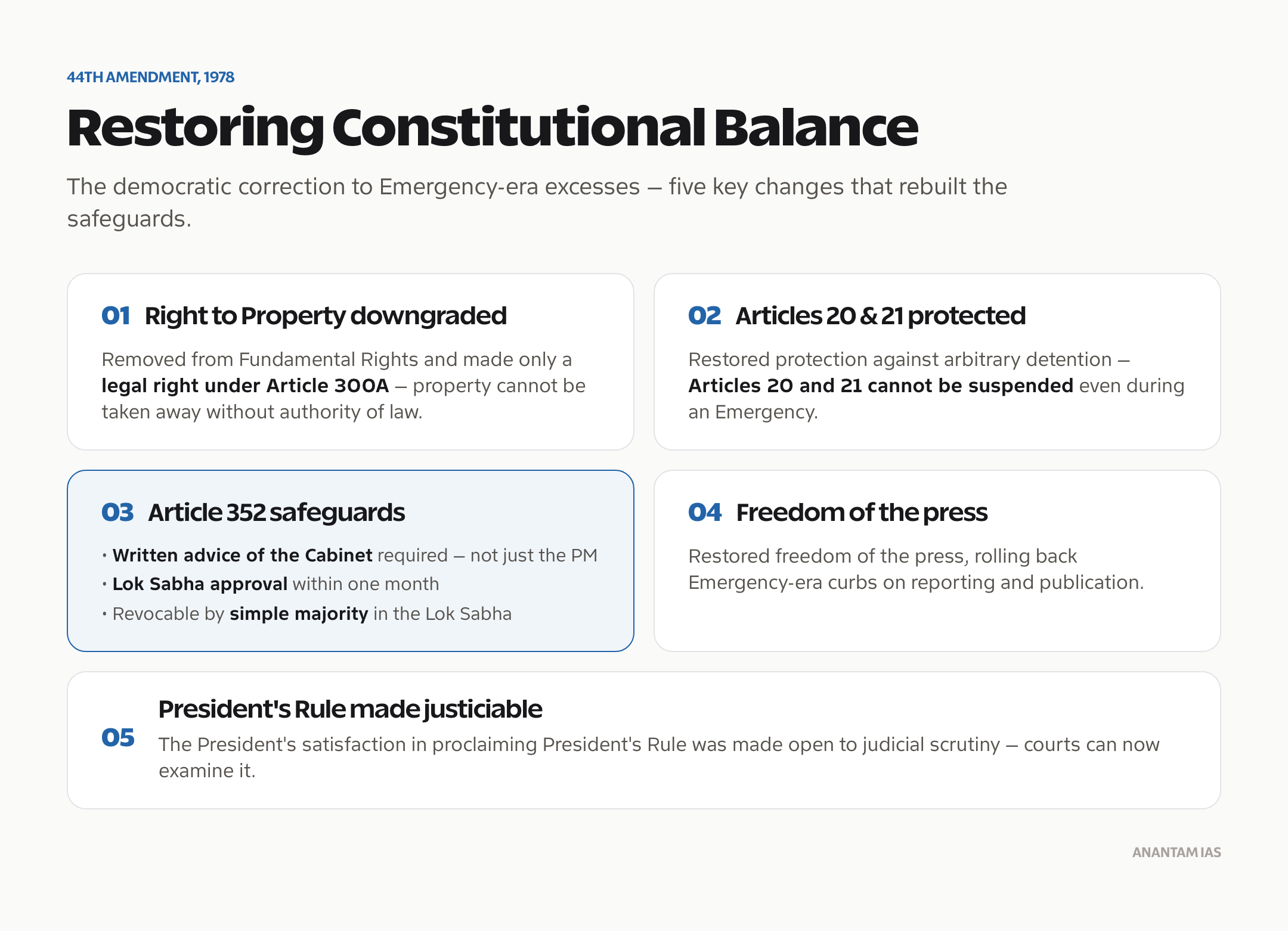
– Written advice of Cabinet (not just PM) required – Lok Sabha approval within one month – Emergency can be revoked by simple majority in Lok Sabha
- Restored freedom of the press
- Made Presidential satisfaction regarding President’s Rule justiciable
The 73rd and 74th Amendments: Decentralisation
The 73rd Amendment (1992) gave constitutional recognition to Panchayati Raj:
- Added Part IX to the Constitution (Articles 243 to 243O)
- Added Eleventh Schedule with 29 subjects to be transferred to Panchayats
- Mandatory elections every 5 years for all three tiers (village, intermediate, district)
- Reservations for SC, ST, and women (not less than 1/3rd of total seats)
- State Finance Commission and State Election Commission made mandatory
The 74th Amendment (1992) did the same for urban local bodies:
- Added Part IX-A (Articles 243P to 243ZG)
- Added Twelfth Schedule with 18 subjects for municipalities
- Three types of municipalities: Nagar Panchayat, Municipal Council, Municipal Corporation
- Mandatory reservations for women, SC/ST
These amendments are among the most significant for local self-governance in India’s post-independence history.
The 101st Amendment: GST
The 101st Constitutional Amendment Act, 2016 transformed India’s indirect tax system:
- Added Article 246A: Both Parliament and state legislatures can make laws on GST (concurrent power)
- Added Article 269A: Integrated GST (IGST) on inter-state supplies to be collected by Centre and shared with states
- Added Article 279A: Created the GST Council — a constitutional federal body comprising the Union Finance Minister, Union Minister of State for Finance, and State Finance Ministers
- Amended the Seventh Schedule — removed most goods and services from separate Union and State Lists, brought under the GST regime
- Alcohol for human consumption, petroleum (except natural gas), and tobacco (centre only) were kept outside GST initially
The GST Council must make decisions with a 3/4th majority — Centre has 1/3rd of voting power; all states together have 2/3rd.
The 103rd Amendment: EWS Reservation
The 103rd Constitutional Amendment Act, 2019 provided for 10% reservation for Economically Weaker Sections (EWS) in educational institutions and public employment:
- Added Articles 15(6) and 16(6)
- EWS defined as those with annual family income below Rs 8 lakh and not already covered by existing reservations
- Upheld by the Supreme Court in Janhit Abhiyan v. Union of India (2022) — 3-2 majority
- Dissenting judges (Ravindra Bhat J and S. Ravindra Bhat J) argued it violated the basic structure by breaching the 50% ceiling
The 106th Amendment: Women’s Reservation
The 106th Constitutional Amendment Act, 2023 — known as the Nari Shakti Vandan Adhiniyam — reserved one-third of seats in the Lok Sabha and state legislative assemblies for women.
- Added Article 330A for Lok Sabha and Article 332A for state assemblies
- Within the reserved seats, sub-reservation for SC and ST women
- But: the reservation will take effect only after the next delimitation exercise following the next Census
- Since the Census has been delayed, the actual implementation is expected no earlier than 2029 elections
Frequently Asked Questions
Q1. What is the basic structure doctrine and how did it emerge?
The basic structure doctrine holds that Parliament cannot amend the Constitution to destroy its essential features. It emerged from the Supreme Court’s 13-judge bench ruling in
Kesavananda Bharati v. State of Kerala (1973), where the Court held that while Parliament’s amending power is wide, certain features are indestructible. The Court built on an earlier hint in Golak Nath v. State of Punjab (1967), which the 24th Amendment tried to overrule, prompting the definitive Kesavananda ruling.nnQ2. Can Fundamental Rights be amended?
Yes, with a special majority under Article 368. But the core of Fundamental Rights is part of the basic structure and cannot be destroyed — even by amendment. The Court will invalidate amendments that abridge Fundamental Rights to the point of making them meaningless.
Q3. Why is the Ninth Schedule significant?
The Ninth Schedule contains laws that are protected from judicial review on grounds of violation of Fundamental Rights. It was created by the 1st Amendment to protect land reform laws. But the Supreme Court in
I.R. Coelho v. State of Tamil Nadu (2007) held that laws placed in the Ninth Schedule after 24 April 1973 (Kesavananda date) can still be challenged if they violate the basic structure.nnQ4. What does u0022ratification by statesu0022 mean in the amendment process?
For amendments affecting federal provisions, the amendment bill must be ratified by the legislatures of not less than half the states before it is presented to the President. The ratification must happen before Presidential assent. If a state revokes its ratification before the Presidential assent, it’s unclear constitutionally whether that withdrawal is valid — a grey area in practice.
Q5. Is the Preamble part of the Constitution and can it be amended?
Yes to both. The Supreme Court in
Tell Google you want more of this.
Add Anantam IAS as a preferred sourceOne tap, and this site shows up more often in your own Top Stories, AI Overviews and AI Mode. Remove it any time.