The Coal Controller’s Organisation, usually abbreviated as CCO, is one of those bureaucratic bodies that almost no one outside the coal sector has heard of, but which nonetheless touches every tonne of coal that moves through Indian markets. Every coal grade declaration, every monthly production statistic, every appellate decision in a coal grade dispute, and every mine that opens, closes, or restarts in India runs through the CCO at some point. The organisation has been doing this work in roughly its current form since 1916, which makes it older than the Reserve Bank of India, older than the Indian Forest Act, and older than most of the coal companies it regulates.
For UPSC GS-III, the CCO is a useful body to know for three reasons. It sits at the regulatory layer of India’s coal economy alongside the Ministry of Coal, Coal India Limited, and the Coal India Singareni Collieries, and the question of who does what at this layer is a recurring prelims framing. Its mandate flows from a stack of three statutes that together define the regulatory perimeter of coal in India, which makes it a useful test of whether students understand how subordinate offices operate under composite statutory authority. And it has come into renewed policy focus over 2023-25 with the Coal Board of India proposal, which would either restructure or absorb the CCO depending on the final design.
This guide walks through the CCO’s history, its current mandate under the Ministry of Coal, the statutory backbone that authorises its functions, the operational workstreams it runs, the recent reform debate, and the policy hooks for mains answers.
Quick Facts
- Full name: Coal Controller’s Organisation
- Abbreviation: CCO
- Established: 1916
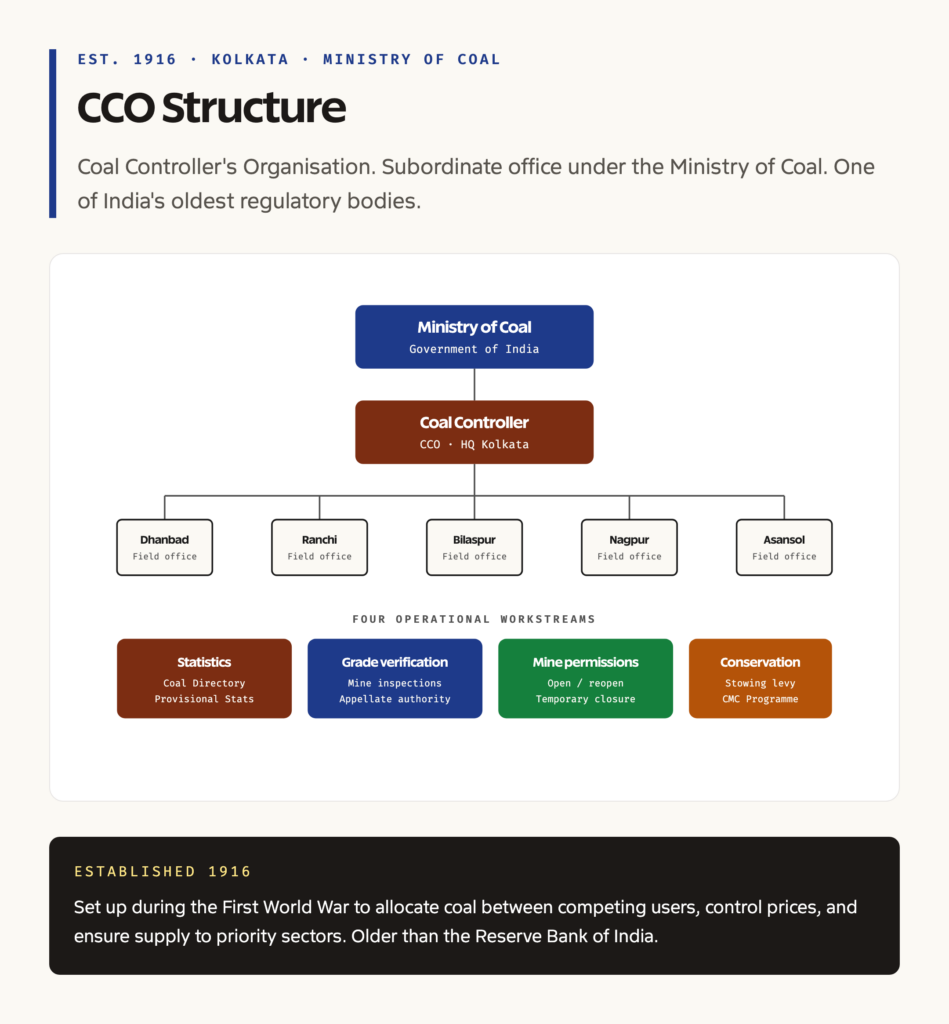
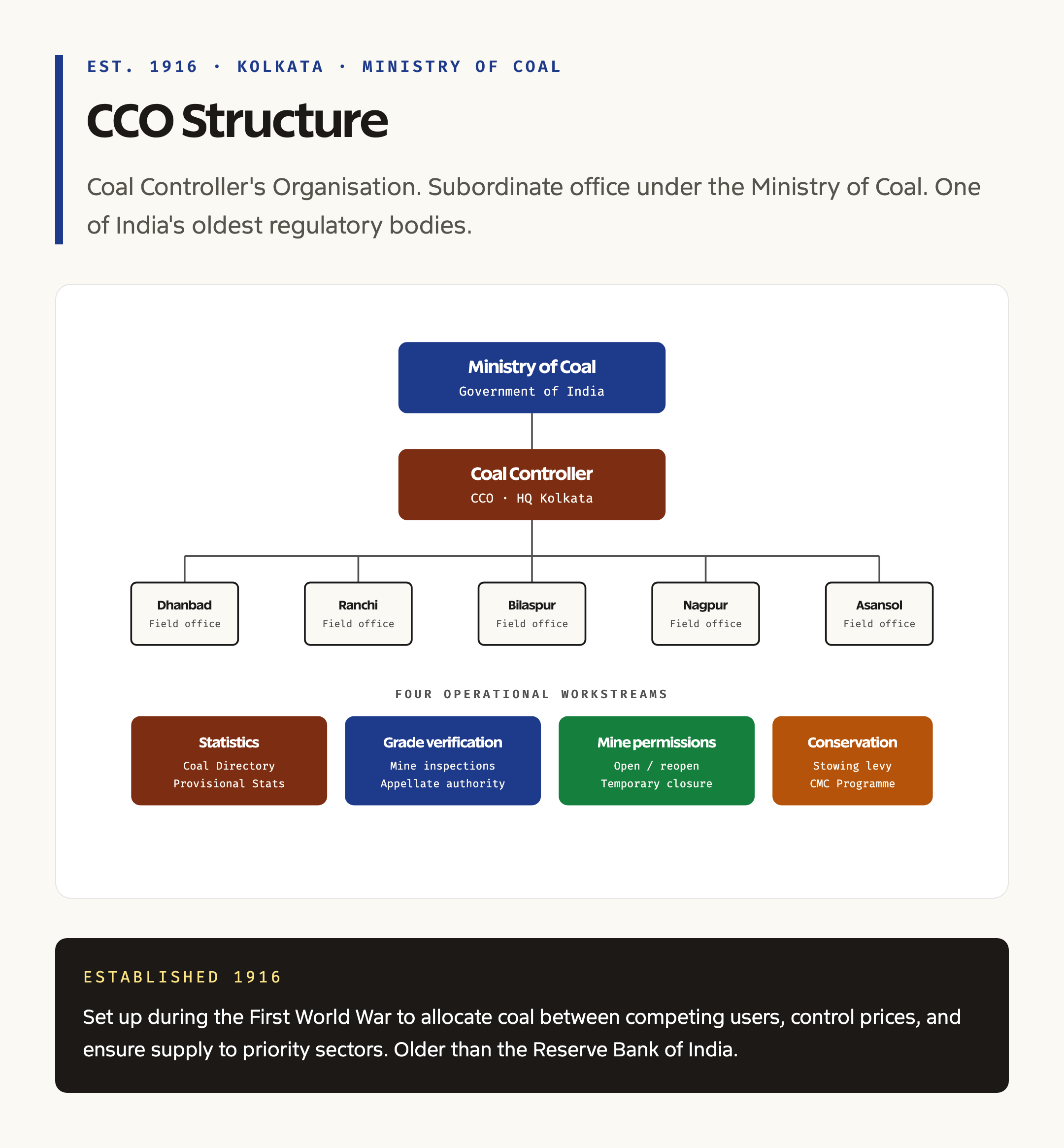
- Headquarters: Kolkata (with field offices at Dhanbad, Ranchi, Bilaspur, Nagpur, and Asansol)
- Parent ministry: Ministry of Coal
- Type: Subordinate office (not a statutory body, not a corporation, not an attached office)
- Head: Coal Controller (with Additional Coal Controllers and Deputy Coal Controllers)
- Statutory backbone: Colliery Control Rules 2004, Coal Mines (Conservation and Development) Act 1974, Collection of Statistics Act 2008
- Successor of: Office of the Coal Commissioner (1916), reorganised after independence
- Coal grading: CCO is the appellate authority for coal grade and size disputes between consumers and coal companies
- Mine permissions: CCO grants permission for opening, reopening, and temporary closure of coal mines
- Statistics: CCO publishes the Provisional Coal Statistics, the monthly Coal Directory of India, and the annual Coal Statistics
- Coal types covered: Coking coal, non-coking coal, lignite, peat (limited), captive and commercial mining
- Recent development: Coal Board of India proposal under discussion 2023-25 may restructure or absorb CCO
What the Coal Controller’s Organisation Does
The CCO is best understood as a four-function organisation, each function flowing from a different part of its statutory mandate.
The first function is statistical. The CCO collects, compiles, and publishes coal and lignite production, dispatch, stock, consumption, and grade data on a monthly and annual basis. The Provisional Coal Statistics that comes out a few weeks after the close of each month is the headline number that the Ministry of Coal, the Reserve Bank of India, the Central Electricity Authority, and analysts use to track the coal economy in real time. The annual Coal Directory of India is the comprehensive reference document.
The second function is grade and quality verification. CCO inspectors visit coal mines to verify the declared grade and size of the coal being dispatched. The grade verification is consequential because coal price under both the Fuel Supply Agreements and the e-auction route is tied to grade, and a misdeclared grade can mean millions of rupees in disputed payments per dispatch. The CCO acts as the appellate authority when a consumer (typically a power plant) disputes the grade declared by a coal company.
The third function is mine permissions. Under the Colliery Control Rules 2004, no coal mine can be opened, reopened, or temporarily closed without permission from the CCO. The permission process verifies the technical adequacy of the mine plan, the safety provisions, and the conservation measures, drawing on the parallel jurisdictions of the Directorate General of Mines Safety and the Coal Mines Conservation framework.
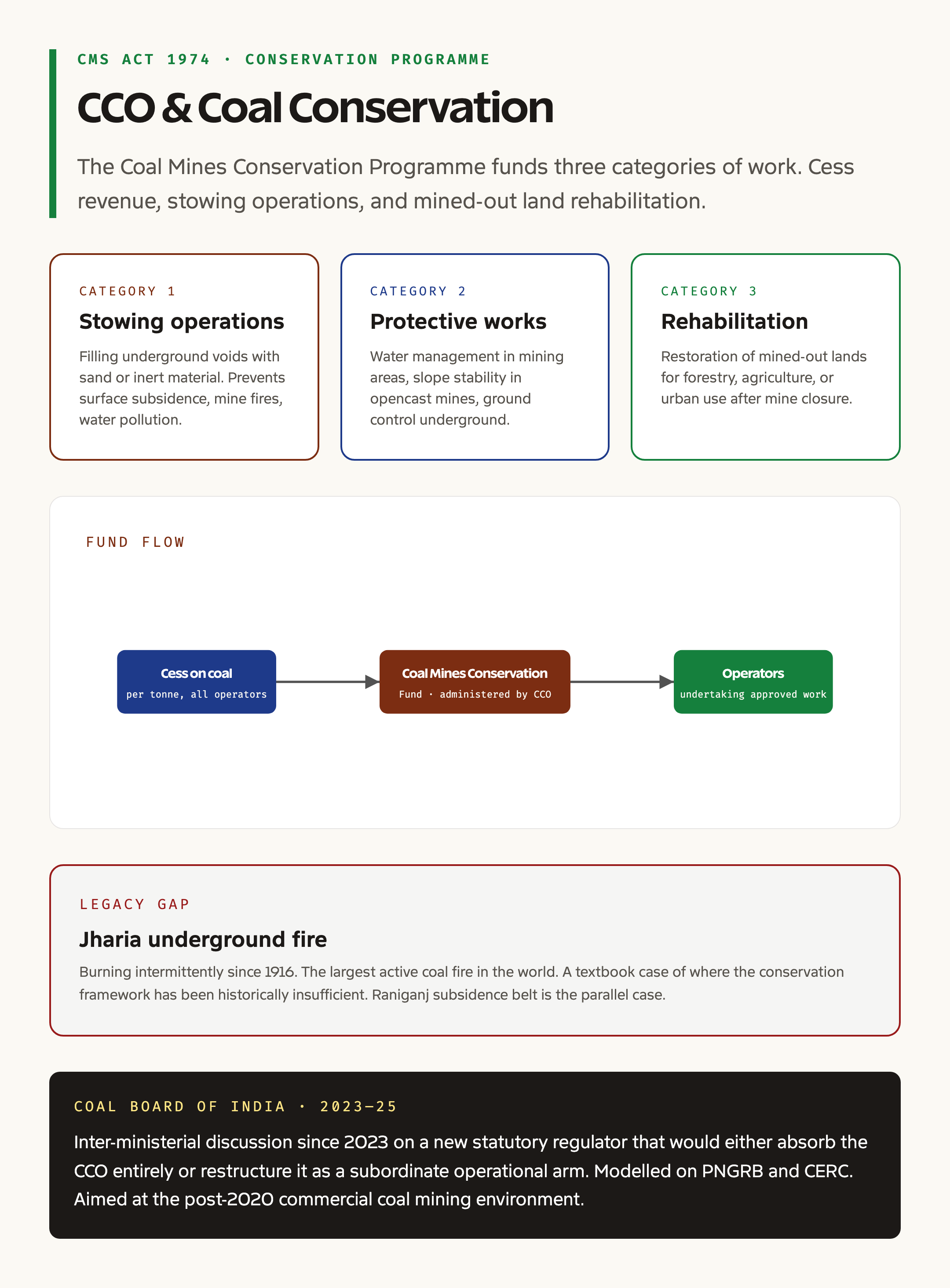
The fourth function is regulatory enforcement under the Coal Mines (Conservation and Development) Act 1974. The CCO levies and collects the Stowing Excise Duty (now subsumed under GST, but historically a central revenue) and the Coal Mines Conservation cess, which fund the Coal Mines Conservation Programme. The Programme supports stowing operations (filling underground voids with sand to prevent surface subsidence and mine fires), protective works in mining areas, and rehabilitation of mined-out lands.
Background and Historical Context
The Office of the Coal Commissioner was established in 1916, during the First World War, when British India faced a coal supply crisis driven by railway demand, military requirements, and the disruption of European coal markets. The Commissioner’s mandate was to allocate coal between competing users, control prices, and ensure supply to priority sectors. The wartime emergency made coal one of the first commodities to come under direct government regulation in colonial India.
After the war, the office continued in a peacetime regulatory form. The Indian Coal Mining Committee of 1920 reviewed the structure and recommended retention of the Coal Commissioner as a permanent regulator. Through the interwar period, the office handled coal grading disputes, monitored production from the Raniganj, Jharia, and Bokaro fields, and maintained the statistical series.
After independence, the office was renamed the Coal Controller’s Organisation and brought under the Ministry of Industry and Supply, then under the Ministry of Energy, and finally under the Ministry of Coal when the latter was created. The nationalisation of coal in 1971-73 changed the operating environment dramatically: with Coal India Limited becoming the dominant producer, the CCO’s role shifted from policing private coal markets to verifying the production and dispatch of the public-sector monopoly. The 2014-15 coal block re-allocation, the 2020 commercial coal mining reforms, and the entry of private commercial miners has reintroduced a degree of market complexity, and the CCO’s regulatory role is again expanding.
Statutory Backbone
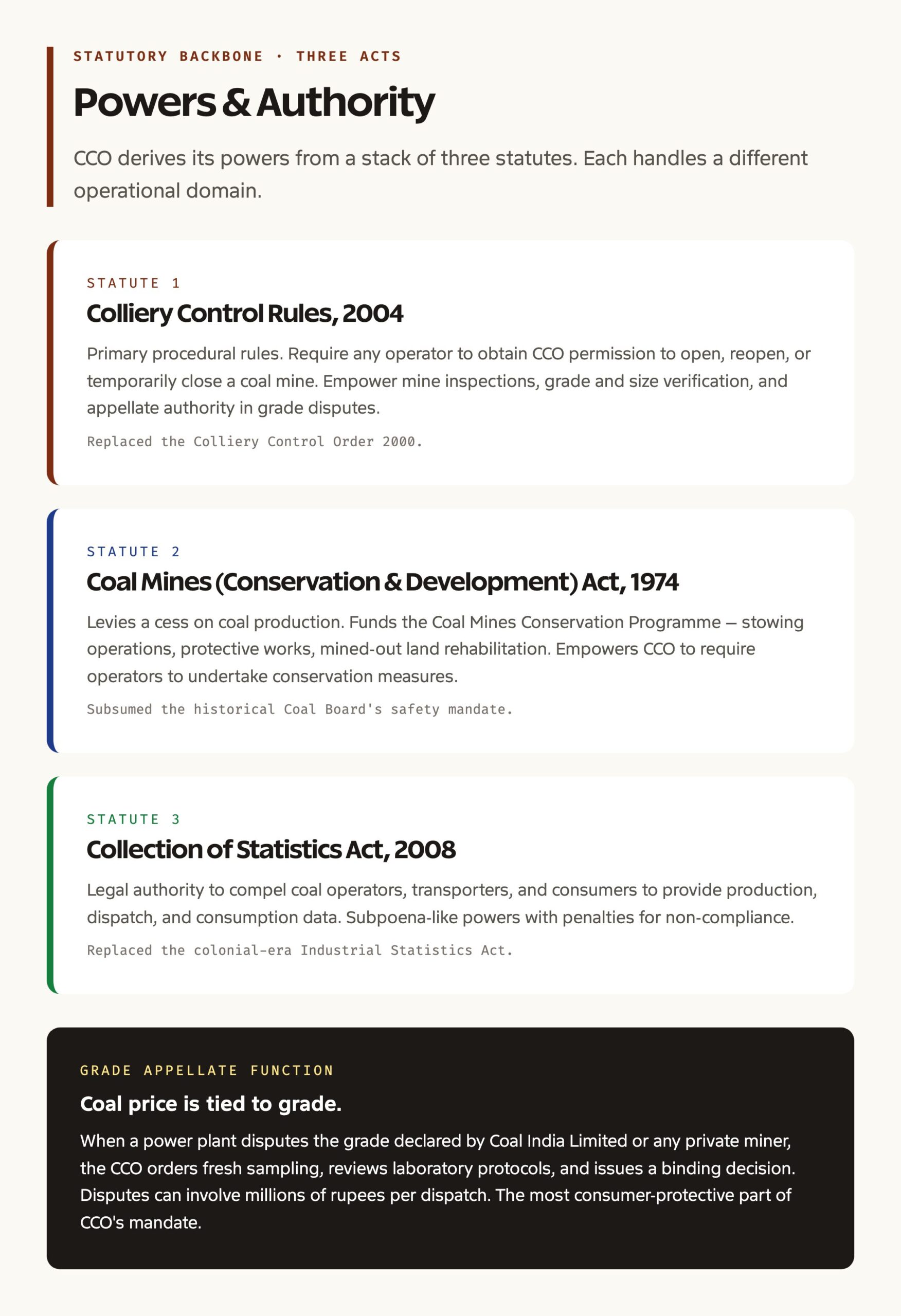
The CCO derives its powers from a stack of three statutes, each handling a different operational domain.
Colliery Control Rules, 2004 are the primary procedural rules under which the CCO operates. The Rules require any operator opening, reopening, or temporarily closing a coal mine to obtain CCO permission. The Rules also empower the CCO to inspect mines, verify coal grade and size, and act as appellate authority in grade disputes. The 2004 Rules replaced the earlier Colliery Control Order 2000, which had in turn replaced colonial-era rules.
Coal Mines (Conservation and Development) Act, 1974 is the statute under which the CCO administers the Coal Mines Conservation Programme. The Act levies a cess on coal production, the proceeds of which fund stowing operations, protective works, and rehabilitation of mined-out lands. The Act gives the CCO the power to require operators to undertake conservation measures, including stowing of underground voids to prevent subsidence and mine fires. The Jharia underground fire, which has been burning intermittently since 1916 and remains the largest active coal fire in the world, is a textbook case of where the conservation framework was insufficient.
Collection of Statistics Act, 2008 provides the legal authority for the CCO to compel coal operators, transporters, and consumers to provide production, dispatch, and consumption data. The Act gives the CCO subpoena-like powers over the data flow, with penalties for non-compliance.
The three statutes together cover the four operational workstreams (statistics, grading, permissions, conservation) and provide the legal teeth that allow the CCO to function as a regulator rather than an advisory body.
Coal Grade and Size Verification
The grade verification function is operationally consequential and worth understanding in detail. Indian coal is graded on the basis of useful heat value (UHV) for non-coking coal and ash content for coking coal. Each grade carries a different price under the Fuel Supply Agreement (FSA) framework, and grade-based pricing applies equally to e-auction sales.
Grade declaration is initially made by the coal company at the dispatch stage, based on its own laboratory analysis of the coal seam being mined. CCO inspectors verify the declaration through independent sampling, which is sent to a CCO-empanelled laboratory. If the verified grade differs from the declared grade, the price is adjusted retroactively, and the difference can run into significant amounts for large dispatches.
When a consumer disputes the declared grade, the matter is referred to the CCO as appellate authority. The CCO orders fresh sampling, reviews the laboratory protocols, and issues a binding decision. The appellate function is the most consumer-protective part of the CCO’s mandate and is routinely invoked by power plants, sponge iron units, and cement plants.
Linkage with Coal Mines Conservation Programme
The Coal Mines Conservation Programme administered by the CCO under the 1974 Act funds three categories of work. Stowing operations involve filling underground voids with sand or other inert material to prevent surface subsidence, mine fires, and water pollution. Protective works include water management in mining areas, slope stability in opencast mines, and ground control in underground mines. Rehabilitation includes restoration of mined-out lands for forestry, agriculture, or urban use after mine closure.
The Programme is funded by a cess on coal production, set at a per-tonne rate. The cess revenue is pooled into the Coal Mines Conservation Fund, from which the CCO disburses grants to operators undertaking approved conservation work. The Programme has been criticised for under-utilisation of the Fund, with significant balances accumulating against limited project disbursement, and for inadequate impact in addressing legacy issues like the Jharia underground fire and the Raniganj subsidence belt.
CCO and the Coal Board of India Proposal
The Coal Board of India is a proposed regulator that has been under inter-ministerial discussion since 2023. The basic idea is to consolidate coal regulation under a single statutory body, similar to how the Petroleum and Natural Gas Regulatory Board governs the gas sector and the Central Electricity Regulatory Commission governs the power sector. The proposed Coal Board would either absorb the CCO entirely or restructure the CCO as a subordinate operational arm under the Board.
The reform debate centres on whether a body established by executive order in 1916 has the regulatory teeth needed for the post-2020 commercial coal mining environment. With private commercial miners entering the market, with coal-fired power plants increasingly procuring through e-auctions, and with import-substitution and energy security objectives driving rapid capacity addition, the regulatory perimeter is more complex than the CCO’s current statutory backbone fully covers. The Coal Board proposal would replace the existing arrangement with a unified statutory regulator with adjudicatory and enforcement powers comparable to other sectoral regulators.
A related comparison that UPSC has tested is between the Coal Controller’s Organisation and the now-defunct Coal Board of India that existed under the Coal Mines (Conservation and Safety) Act 1952 before being subsumed when the Conservation and Development Act 1974 came into force. The historical Coal Board was an advisory body, while the proposed new Coal Board would be a regulatory body, which is an important distinction.
Recent Developments
Through 2023-25, the CCO has been expanding its statistical reporting to cover commercial coal mining, where private players auctioned coal blocks under the 2020 reforms have begun production. The first commercial coal sales by private miners in 2023 required the CCO to extend its grading and dispatch verification to non-Coal-India producers, which has involved building new field-office capacity at the new mine locations.
The CCO has also been integrating its data systems with the National Coal Index (NCI), the Coal Vidyut Abhiyan, and the Single Window Clearance System for mine permissions. Digital integration is intended to reduce the lag between production and reporting, currently around 4 to 6 weeks for the Provisional Coal Statistics, to under 2 weeks.
Mains Hooks and Prelims Pegs
For prelims, the high-frequency facts are CCO’s founding year (1916), parent ministry (Coal), headquarters (Kolkata), the three statutes that authorise it (Colliery Control Rules 2004, Coal Mines Conservation and Development Act 1974, Collection of Statistics Act 2008), and the four functions (statistics, grading, permissions, conservation).
For mains, the CCO fits naturally into questions on energy security and coal-sector reform, on the regulatory architecture for natural-resource industries in India, on the comparative analysis of sectoral regulators (CCO vs CERC vs PNGRB), and on the institutional design for the post-2020 commercial coal mining environment. The Coal Board of India proposal is the live policy hook around which an answer can be built.
Frequently Asked Questions
What is the Coal Controller’s Organisation?
The Coal Controller’s Organisation, or CCO, is a subordinate office under the Ministry of Coal, established in 1916. It collects coal statistics, verifies coal grade and size, grants permission for mine operations, and administers the Coal Mines Conservation Programme. Headquartered in Kolkata, it is one of India’s oldest regulatory bodies in the coal sector.
Under which acts does CCO function?
The CCO derives its powers from three statutes: Colliery Control Rules 2004 (mine permissions, grade verification), Coal Mines (Conservation and Development) Act 1974 (conservation cess, stowing operations), and Collection of Statistics Act 2008 (statistical reporting). Together these define the regulatory perimeter.
What is the CCO’s role in coal grading?
The CCO inspects coal mines to verify the declared grade and size of dispatched coal, and acts as the appellate authority when a consumer disputes the grade declared by a coal company. The function is consequential because coal price under Fuel Supply Agreements and e-auctions is tied to grade, and grade disputes can involve significant financial amounts.
How is the CCO different from Coal India Limited?
CCO is a regulator under the Ministry of Coal. Coal India Limited is a public-sector coal producer. CCO sets and enforces the rules under which CIL operates, verifies CIL’s coal grades, and administers conservation regulation that applies to CIL mines. The two are at different layers of the coal economy.
What is the Coal Board of India proposal?
The Coal Board of India is a proposed statutory regulator under inter-ministerial discussion since 2023. It would either absorb the CCO or restructure it under the Board, providing a unified statutory regulator with adjudicatory and enforcement powers for the post-2020 commercial coal mining environment.
Tell Google you want more of this.
Add Anantam IAS as a preferred sourceOne tap, and this site shows up more often in your own Top Stories, AI Overviews and AI Mode. Remove it any time.