What are Biosphere Reserve?
- Biosphere Reserves (BRs) are large areas of terrestrial and coastal ecosystems promoting the conservation of biodiversity, sustainable development, and scientific research. They are internationally recognized under UNESCO’s Man and the Biosphere (MAB) Programme.
- Biosphere reserves include terrestrial, marine and coastal ecosystems.
- Biosphere Reserves involve local communities and all interested stakeholders in planning and management. They integrate three main “functions”:
- Conservation of biodiversity and cultural diversity
- Economic development that is socio-culturally and environmentally sustainable
- Logistic support, underpinning development through research, monitoring, education and training
What is the structure of Biosphere Reserve?
The Articles 6-20 of CBD call for in-situ and ex-situ conservation, incentives
for conservation and sustainable use, research and training, awareness and education,
impact assessment, regulating access to genetic resources, access and transfer of
technology and provisions of financial resources. While dealing with these issues, CBD
emphasizes on nationally determined priorities, capacity and needs and with full and
effective participation of local communities.
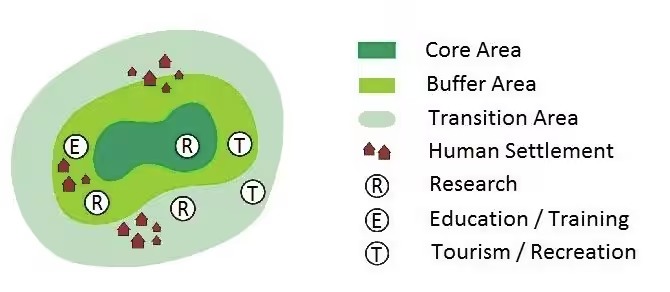
In order to undertake complementary activities of biodiversity conservation and
development of sustainable management aspects, Biosphere Reserves are demarcated into
three inter-related zones. These are (I) natural or core zone (ii) manipulation or buffer zone
and (iii) A transition zone outside the buffer zone.
1. Core Zone:
- The core zone is kept absolutely undisturbed.
- It includes higher order predators and may contain centres of endemism and important genetic reservoirs.
- Research & management is allowed.
- The core zone is to be kept free from all human pressures external to the system.
- Often overlaps with protected areas like National Parks.
2. Buffer Zone
- Activities are managed in ways that protect the core zone.
- Limited recreation, tourism, fishing and grazing, are permitted to reduce its effect on core zone.
- Research and educational activities are encouraged.
- Human activities, if natural within BR, are likely to be permitted to continue if these do not adversely affect the ecological diversity.
3. Transition Zone
- Outermost part of a Biosphere Reserve.
- This is usually not delimited one.
- This includes settlements, crop lands, managed forests and area for intensive recreation, and other economic uses characteristic of the region.
What is MAB Programme?
- The idea of `Biosphere Reserves’ was initiated by UNESCO in 1973-74 under its Man and Biosphere (MAB) Programme.
- The MAB was launched in 1970 by UNESCO.
- MAB is primarily a programme of research and training and seeks scientific information to find solution of concrete practical problems of management and conservation.
- Biosphere reserves are nominated by national governments and remain under the sovereign jurisdiction of the states where they are located.
- Their status is internationally recognized. Their functions are reviewed every 10 years under the periodic review process.
- The Indian National Man and Biosphere (MAB) Committee identifies and recommends potential sites for designation as Biosphere Reserves, following the UNESCO’s guidelines and criteria.
What is the statutory status of B.R in India?
- Biosphere Reserves in India do NOT have statutory backing under wildlife or forest laws.
- At the initiative of the central/state governments, detailed study is carried out and a project report is prepared by the concerned state following the criteria adopted for designation of BRs.
- BR is designated by the centre; MoEFCC.
- The land and forest being the state concerns, the respective state governments have to agree to designate the identified area as Biosphere Reserve.
- The Central Govt. provides financial assistance for management and research activities in these BRs.
- The Management of Biosphere Reserves is the responsibility of the concerned State/UT with necessary technical input and training facilities provided by the Central Government. Management Action Plan for each BR is prepared by the concerned State Government
- Designation of a site as Biosphere Reserve does not affect the legal status of the land, forests and regulations for natural resources and their ownership continue to remain unchanged.
How many BR exist in India and how many of them are the part of MAB programme?
| Total Biosphere Reserves in India | 18 |
| UNESCO WNBR sites | 13 |
| Not in UNESCO | 5 |
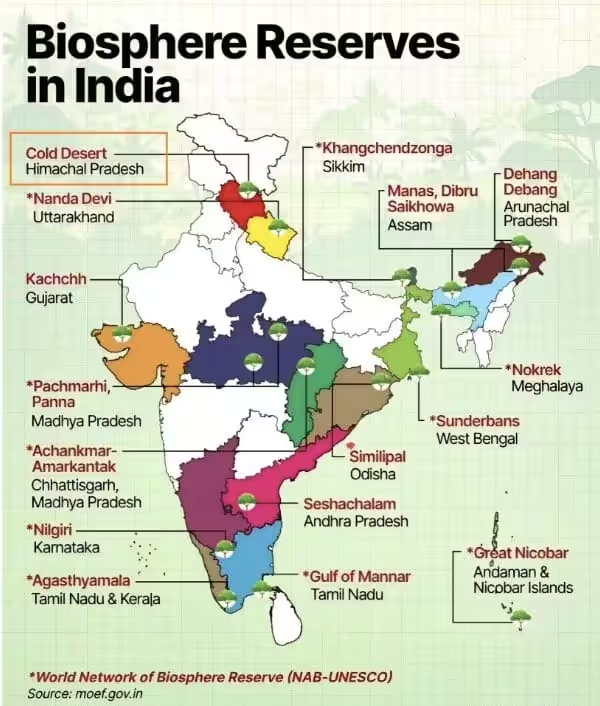
Part of WNBR:
| No. | Biosphere Reserve | State(s) | Key Characteristics | UNESCO Year |
|---|
| 1 | Nilgiri (1986) | TN, Kerala, Karnataka | Western Ghats, shola forests, Nilgiri tahr, lion-tailed macaque | 2000 |
| 2 | Gulf of Mannar (1989) | Tamil Nadu | Coral reefs, seagrass, dugong habitat | 2001 |
| 3 | Sundarbans (1989) | West Bengal | Mangroves, estuarine habitat, Royal Bengal tiger | 2001 |
| 4 | Nanda Devi (1988) | Uttarakhand | Himalayan alpine ecosystem, snow leopard, Valley of Flowers | 2004 |
| 5 | Nokrek (1988) | Meghalaya | Nokrek peak, citrus genetic diversity hotspot | 2009 |
| 6 | Simlipal (1994) | Odisha | Moist deciduous forests, tiger & elephant habitat | 2009 |
| 7 | Pachmarhi (1999) | Madhya Pradesh | Satpura landscape, teak forests, gaur | 2009 |
| 8 | Achanakmar–Amarkantak (2005) | MP & Chhattisgarh | Source of Narmada & Son rivers, mixed forests | 2012 |
| 9 | Great Nicobar (1989) | A&N Islands | Island rainforest, Nicobarese tribes, leatherback turtles | 2013 |
| 10 | Agasthyamalai (2001) | TN & Kerala | Southern Western Ghats, medicinal plant diversity | 2016 |
| 11 | Khangchendzonga (2000) | Sikkim | Eastern Himalayas, glaciers, snow leopard, cultural sacred landscapes | 2018 |
| 12 | Panna (2011) | Madhya Pradesh | Tiger reintroduction success, plateaus & gorges | 2020 |
| 13 | Cold Desert (Spiti / Lahaul-Spiti) (2009/2025) | Himachal Pradesh | High-altitude cold desert, snow leopard, blue sheep | 2025 |
Not part of WNBR:
| 1 | Dibru–Saikhowa (1997) | Assam | Riverine islands, swamp forests, Gangetic dolphin |
| 2 | Dehang–Dibang (Dihang–Dibang) (1998) | Arunachal Pradesh | Eastern Himalayan forests, high endemism |
| 3 | Kachchh (Kutch) (2008) | Gujarat | Arid desert, saline Rann, wild ass habitat |
| 4 | Seshachalam Hills (2010) | Andhra Pradesh | Red sanders endemic zone |
| 5 | Manas (1989) | Assam | Asiatic Elephant, Golden Langur, Pygmy Hog, Assam Roofed Turtle |
| NOTE : | Khangchendzonga Buffer Expansion Zones (portions) | Sikkim | Some notified zones not part of UNESCO nomination |
Tell Google you want more of this.
Add Anantam IAS as a preferred sourceOne tap, and this site shows up more often in your own Top Stories, AI Overviews and AI Mode. Remove it any time.